

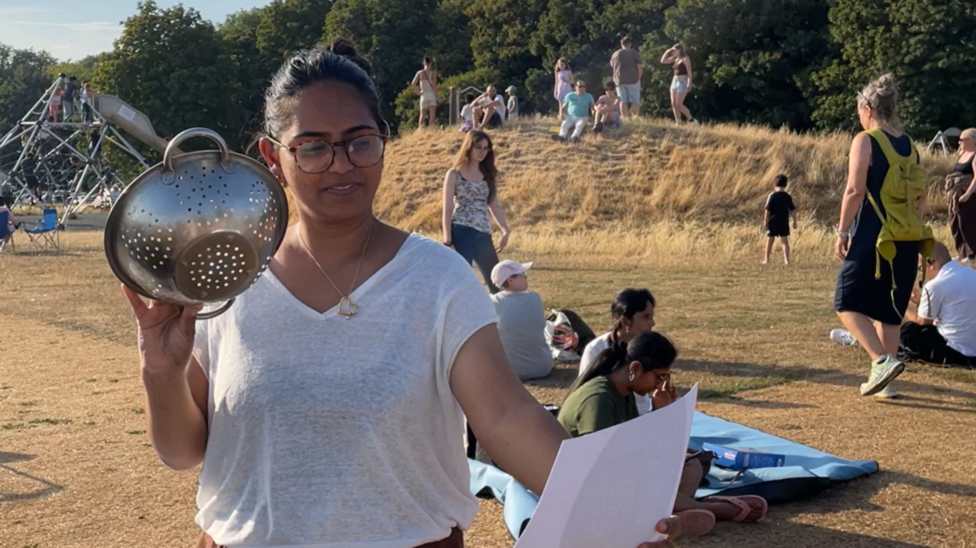
Crowds across Yorkshire gathered on 12 August 2026 to watch a deep partial solar eclipse, widely described as the most striking such event visible from the region since 1999. Families, students and astronomy enthusiasts assembled at sites including Beetle Bank Farm in York, Roundhay Park in Leeds and the University of York, using telescopes, solar glasses, pinhole cameras and even a colander to observe the Moon passing in front of the Sun.
An eclipse occurs when the Sun, Moon and Earth line up so that the Moon casts a shadow on the Earth as it passes between the two bodies, blocking out the Sun either partially or completely. According to independent eclipse tracking data, the eclipse over York began at around 6:12pm, reached its maximum at approximately 7:09pm with roughly 92% of the Sun obscured, and ended by about 8:02pm, according to timeanddate.com. The same tracking service recorded a magnitude of 0.918 for the eclipse as seen from York, with the whole event lasting one hour and fifty minutes.
Thousands of people took part across the county on the Wednesday evening, according to a local newspaper's report, which described the event as Yorkshire's most significant eclipse in nearly three decades and noted that the peak, shortly after 7pm, saw more than 90% of the Sun covered by the Moon for many observers.
Where did people gather to watch?
At Beetle Bank Farm in York, members of the York Astronomical Society set up telescopes while families built pinhole cameras and put on solar glasses to view the event safely. Brian Jones, from the astronomical society, said it was heartening to share the moment with roughly 200 other people.
"The universe is there to be shared. I've been interested since I was about five, and it gets you," he said.
"You're made of star stuff - everything in your body comes from a star, so you're looking back at family history."
At Roundhay Park in Leeds, hundreds of people queued to look through a telescope provided by Leeds Astronomical Society, many bringing homemade viewing devices of their own. Leeds Astronomical Society said the county's viewing window ran slightly later there, from 6:12pm to 8:03pm, according to a separate local report, a minor variation from the 8:02pm end time recorded for York.
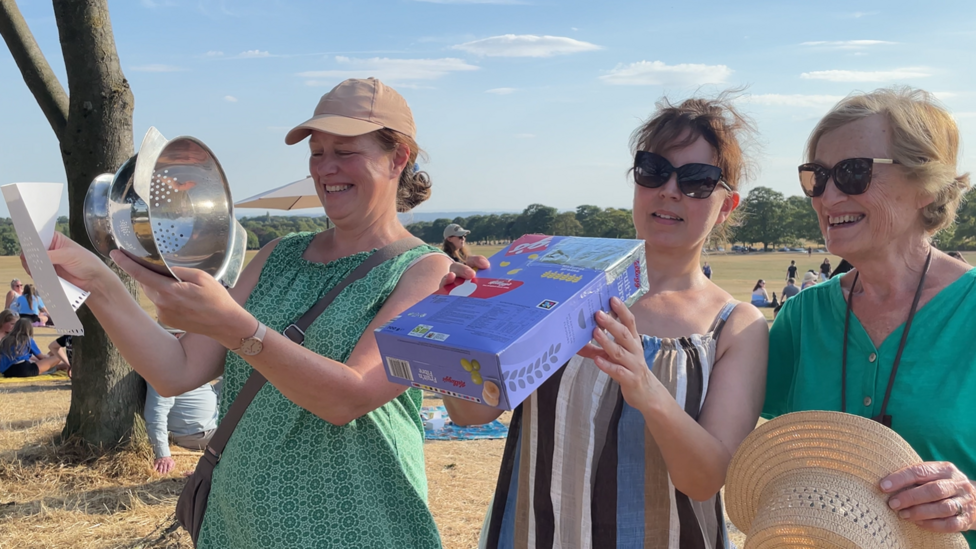
Eleven-year-old Rory called the experience "incredible."
"It's really a once-in-a-generation experience," he said.
His brother Max noticed a distinct drop in temperature as the eclipse progressed.
"The Sun generates all the heat and the Moon is blocking out the Sun," he explained.
Their mother, Tracey, said she felt fortunate to witness the phenomenon for a second time in her life, while 18-year-old Ash, who described herself as fascinated by astronomy, said the mystery of the universe was part of the appeal.
"I like the fact you don't know what's out there. You don't really know how everything works, it's just really fascinating to me."
"I've never seen anything like it before, it's really exciting."
Meera Daby and her family, visiting during the summer holidays with relatives staying over, improvised when solar glasses sold out locally.

"It's the summer holidays. We have a lot of family staying over so we thought it would be a nice experience to come and watch the solar eclipse with our family," she said.
How significant was this eclipse compared with past events?
The 12 August 2026 eclipse is being described by multiple eclipse guides as the most dramatic seen from the UK since the total eclipse of 1999. Yorkshire had earlier been forecast to see up to 92% of the Sun disappear behind the Moon, according to our earlier coverage of preparations for the event.
The Royal Observatory Greenwich has said obscuration levels ranged between roughly 90% and 96% in different parts of the UK, according to the Royal Observatory Greenwich. Figures compiled separately show Leeds reaching 90.8% obscuration at 7:09pm and London reaching 91.4% at 7:13pm, according to Sky at Night Magazine. However, a mapping analysis from another national outlet placed Yorkshire among the eastern parts of the UK expected to see somewhat lower coverage of between 88% and 90% in some locations, according to a national newspaper's eclipse map, illustrating some variation between forecasts depending on exact location and source.
Yorkshire itself lay outside the path of totality, which instead swept over Greenland, Iceland and northern Spain, meaning only a partial eclipse was visible from the region rather than a total one, according to a regional visitor guide. NASA has confirmed the 12 August 2026 event was a total solar eclipse whose path of totality crossed outside the UK entirely, which is why Yorkshire and the rest of the country experienced only a partial eclipse, according to NASA. Some UK-based astronomers travelled abroad to see the total eclipse directly, as detailed in our earlier report on Cambridge astronomers heading to Spain and the Faroe Islands. NASA has said the same event was also visible as a partial eclipse across parts of the northern United States, most of Canada, much of Europe and northwestern Africa, according to NASA.
The eclipse was not confined to Yorkshire. Elsewhere in England, people across the East Midlands watched the same deep partial eclipse, with up to 90% of the Sun covered depending on location, according to our coverage of skywatchers in the East Midlands. In Lincolnshire, up to 96% of the Sun was covered by the Moon, making it the county's deepest eclipse since 1999, according to our report on Lincolnshire's eclipse viewing events. Further south, thousands also gathered across South West England and the Channel Islands to watch the phenomenon, as detailed in our coverage of eclipse viewing in Cornwall and the Channel Islands.
How did people view the eclipse safely?
At the Ron Cooke Hub at the University of York, physicists set up five telescopes fitted with filters allowing safe observation of the Sun. Mark Laughton explained the equipment used to protect viewers' eyes.
"We have five telescopes set up, perfectly safe to look at the Sun, in the particular wavelength that we call H Alpha, so that blocks out a lot of the energy of the Sun so we can view it safely," he said.
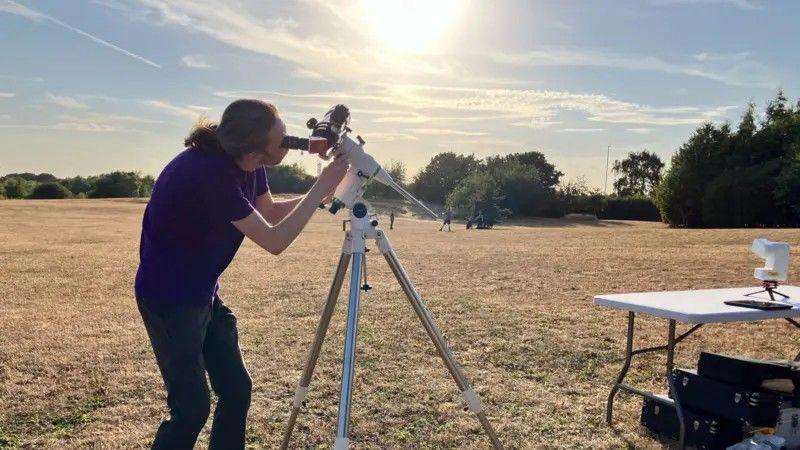
PhD student James Metcalf, 24, said staff continually adjusted the telescopes to track the Sun's position throughout the event.
"It's lovely to get involved with people in the community - it's all about introducing people to physics in a safe-ish environment," he said.
The UK Health Security Agency published safety guidance on 23 July 2026 reminding the public to use proper eye protection rather than looking directly at the Sun, according to UK Health Security Agency guidance. That guidance made clear the eclipse would be visible across the whole of the UK, not solely in Yorkshire, meaning similar safety precautions applied to observers nationwide. The Royal Observatory Greenwich separately advised UK viewers to use eclipse glasses or a solar telescope rather than looking at the Sun unaided, according to the Royal Observatory Greenwich.
What happens next?
The University of York's public "Experience the Eclipse" event ran from 6.15pm to 7.30pm on 12 August 2026 at The Lakehouse, Ron Cooke Hub, Campus East, according to University of York event listings. Eclipse tracking services confirm the eclipse reached its maximum point at approximately 7:09pm local time on the same date, according to timeanddate.com. The Royal Observatory Greenwich also offered a free live stream of the eclipse from London on 12 August 2026 for those unable to view it in person, according to the Royal Observatory Greenwich.
Key Facts
- Up to roughly 92% of the Sun was obscured over Yorkshire at the eclipse's peak on 12 August 2026, though one national newspaper's mapping put parts of eastern England, including Yorkshire, at 88%-90%.
- The eclipse over York ran from about 6:12pm to 8:02pm, peaking near 7:09pm, with a magnitude of 0.918 and a total duration of one hour fifty minutes.
- Leeds recorded 90.8% obscuration at 7:09pm and London 91.4% at 7:13pm; Leeds Astronomical Society put the local viewing window at 6:12pm to 8:03pm.
- Yorkshire experienced a partial eclipse only; totality was visible over Greenland, Iceland and northern Spain, with the event also seen as a partial eclipse across the northern United States, Canada, Europe and northwestern Africa.
- The University of York hosted a public viewing event from 6.15pm to 7.30pm at the Ron Cooke Hub, while the Royal Observatory Greenwich streamed the eclipse live from London.


