On 12 August 2026, skywatchers across Yorkshire and the rest of the UK will have the chance to see the most striking solar eclipse the country has witnessed since the total eclipse of 1999. As much as 95% of the Sun's disc will be obscured as the Moon passes across it between roughly 18:00 and 20:15 BST, with astronomers describing the event as a rare and memorable spectacle, weather allowing.
This event follows other recent celestial highlights, including a report on the Worm Moon and lunar eclipse seen elsewhere in March 2026, and coverage of the Buck Moon rising over the West Country in late July. Similar excitement has already been building further south, where the West Country is preparing for what has been billed as the UK's biggest eclipse since 1999, with Cornwall and the Isles of Scilly expected to offer some of the clearest views. Elsewhere in the British Isles, an astronomer in Guernsey has urged residents to watch safely, noting that the island will not see another total eclipse until 2081.
What will Yorkshire actually see during the eclipse?
Skywatchers in Yorkshire will witness a deep partial eclipse rather than totality, with the Moon covering around 92% of the Sun's surface at the peak moment. Neil Sanders, an astronomer with Go Stargazing and co-founder of UK Eclipse, said the event stands out because of how much of the Sun will be hidden.
"These aren't rare events, but they are uncommon. They happen almost yearly. But what's very, very special about this one is the amount of coverage."
He added that the eclipse offers a rare chance to visibly track the mechanics of the solar system.
"What's really cool about it is that, certainly when you're using eclipse glasses, you can actually see the movement that's happening in our solar system. You are looking at the movement of the moon as it goes around the earth. It's one of these very rare events when you can see the solar system in action."
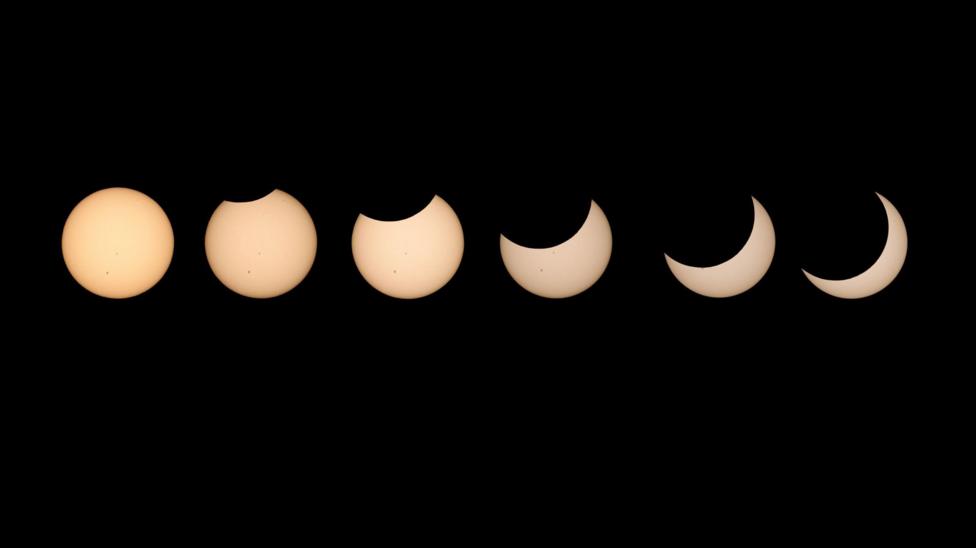
According to astronomy publication Sky at Night Magazine, the eclipse will only reach totality in Iceland and Spain, which is why observers in Yorkshire will need to find a clear western horizon to catch the best view. The same publication reports that the Moon will appear to move from right to left across the Sun, leaving a distinctive frown-shaped crescent visible at the point of maximum eclipse.
Parts of Spain and Portugal will experience a full total eclipse, while the UK will only see a partial version of the event. Chris Higgins, a retired scientist who volunteers at the Lime Tree Observatory and Planetarium in Grewelthorpe, North Yorkshire, said the partial eclipse is still well worth watching.
"It's quite significant. It's not the greatest prize, a total eclipse, but it is a partial eclipse of almost nine-tenths of the sun's disk. It's a natural phenomenon that will have been witnessed by humanity forever, so it's something that will inspire people."
How can people watch the eclipse without damaging their eyes?
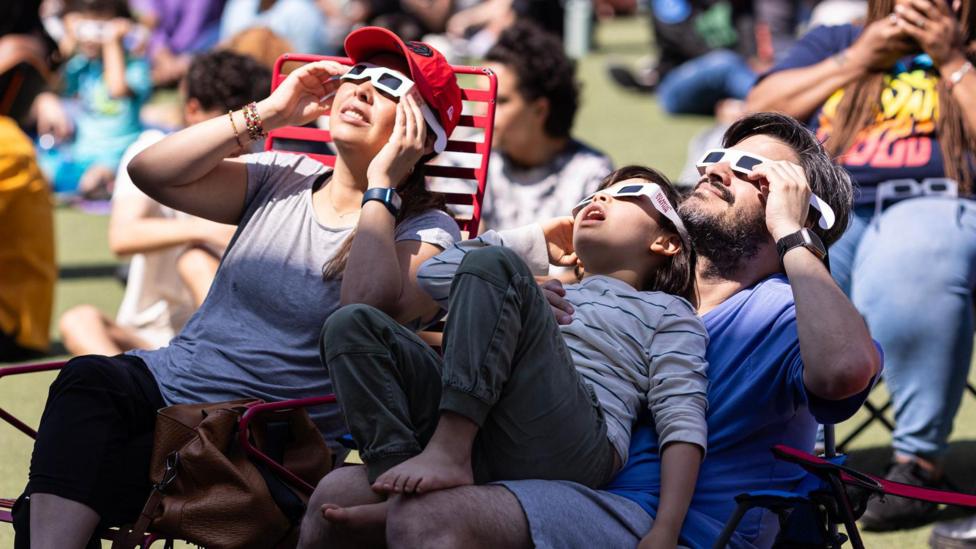
Looking directly at the Sun without proper protection can cause serious eye damage, so experts stress that safety precautions are essential throughout the event. Sanders warned that the naked eye should never be used to view the eclipse directly, and that viewers should follow established safety guidance.
Certified eclipse glasses are considered a reliable option, and The Royal Observatory Greenwich advises checking that any pair carries the safety marking "ISO 12312-2" or "ISO 12312-2:2015" printed on the frame. Ordinary sunglasses are not a substitute, Sanders explained, since they fail to filter out harmful solar radiation — a particular risk here, as roughly 8% of the Sun's surface will remain visible even at the eclipse's peak.
Other safe viewing methods include using a solar telescope, several of which will be available at local astronomy events, or building a simple pinhole projector that casts an indirect image of the Sun onto a surface. Higgins noted that everyday household items with small holes, such as a colander, can be repurposed to create this kind of projector.
For those who would rather stay indoors, the Royal Observatory Greenwich is planning to broadcast a free live stream of the eclipse from London, offering an alternative way to follow the event as it happens.

Where are the best places to watch in Yorkshire?
Because the Sun and Moon will be sinking toward the western horizon as sunset approaches, the ideal viewing spot is somewhere elevated with an unobstructed view to the west. Higgins acknowledged that this poses a particular challenge for Yorkshire's geography.
"If we were a west coast county, we could all go to the beach and then we'd have a nice low horizon and we could watch it. So you need to find a vantage point where your horizon looking west is clear of any obstructions such as trees."
Local guidance reported by the Yorkshire Post has identified specific high-ground locations suited to the event, including Buckden Pike, Otley Chevin and Rosedale Chimney Bank, all of which offer clearer sightlines to the western sky. Meanwhile, the tourism guide Yorkshire.com reports that a river cruise operator in York is running a dedicated eclipse-viewing trip along the River Ouse, timed to coincide with the event's departure and viewing windows.
Independent eclipse trackers cited by timeanddate.com give a slightly more precise timeline for Yorkshire than earlier estimates, putting the start of the eclipse at 6:12pm, maximum coverage at 7:09pm, and the end of the event at 8:02pm local time. The same source states that at its peak, the Moon will cover a magnitude of 0.918 of the Sun, with the full event lasting one hour and 50 minutes. This is broadly consistent with earlier estimates from the corporation's climate correspondent Paul Hudson, who said the Moon should begin crossing the Sun between approximately 18:12 and 18:19 BST, with the peak arriving roughly an hour later and the event concluding just after 20:00, shortly before sunset.
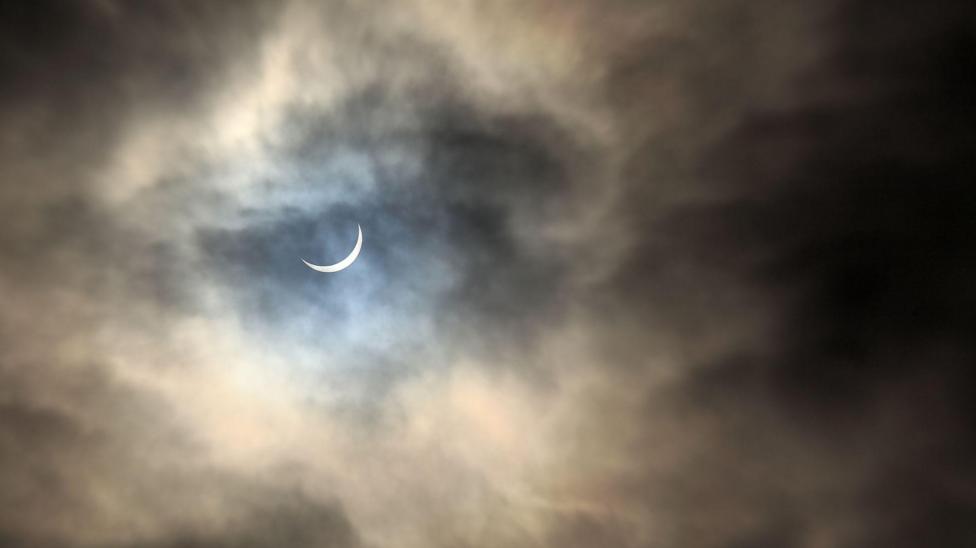
Higgins reassured would-be observers that the eclipse unfolds gradually, so there is no need to worry about missing the moment, and even some cloud cover need not ruin the experience.
"It's not suddenly going to whiz past and you'll miss it. It's worth waiting around just in case the clouds move on."
Several community viewing events are being organised across the region for those who want to watch alongside fellow enthusiasts:
- The University of York, Ron Cooke Hub, York — starting at 18:15 with a talk from astrophysicist Dr Emily Brunsden.
- Olivers' Mount, Scarborough — Scarborough & Ryedale Astronomical Society will set up solar telescopes from 18:00.
- Otley Science Festival, Otley — free eclipse glasses available, with volunteers on hand to explain safe viewing.
- Banstead Park, Harehills, Leeds — visitors are advised to gather at the top end of the park for the clearest sightline.
- Tingley Methodist Church, Wakefield — free eclipse glasses distributed during a relaxed coffee evening.
- Brough Observatory, Brough — solar telescopes and eclipse glasses available from 18:00.
- Rosse Observatory, Pontefract — a live stream will be shown on a large screen in case cloud obscures the view.
- J.A Jones Observatory, Wentworth — a family-friendly event hosted by Mexborough & Swinton Astronomical Society.
- Austerfield Field Study Centre, Doncaster — astronomers from Doncaster Astronomical Society will be present to answer questions.
Will the weather cooperate on the day?
Yorkshire has enjoyed an extended run of warm, clear nights in recent weeks, conditions well suited to both stargazing and eclipse viewing. Paul Hudson said the outlook for 12 August currently looks favourable.
"At the moment, the forecast for Wednesday couldn't be better. It will be a hot day with plenty of sunshine, although as the event begins there may be some high cloud towards the western horizon where the eclipse will take place."
He added that any such cloud is unlikely to be dense enough to block the view of the eclipse entirely.
What happens after this eclipse?
Astronomy commentators have placed this event in a wider context, with space news outlet Space.com describing 12 August 2026 as the UK's most spectacular solar eclipse in 11 years. Smaller partial eclipses will follow in subsequent years, including one due in August 2027, but anyone hoping to see a total solar eclipse from the UK will have to wait considerably longer, with the next one not expected until 23 September 2090.
In the meantime, the Royal Observatory Greenwich's live stream and the various community events across Yorkshire offer immediate ways to mark the occasion on the day itself, regardless of local weather conditions.