Astronomers from Cambridge have been leaving the UK in large numbers this summer to witness Wednesday evening's total solar eclipse from countries where the Sun will be completely blocked out. Dr Matt Bothwell of Cambridge University's Institute of Astronomy is travelling to northern Spain for the event, while Jonathan Clough, vice chairman of the Cambridge Astronomical Association, is sailing towards the Faroe Islands hoping to catch the total eclipse, the Northern Lights and the Perseid meteor shower in a single trip.
Their departure has left what one astrophysicist described as an "astronomer exodus" across Cambridge, even as watch parties are organised throughout the East of England for a partial eclipse that will still be the most complete view of a blocked Sun seen in the region since 1999.
According to NASA, the narrow path of totality sweeps across Greenland, Iceland, northern Spain and a small corner of Portugal, with totality lasting as long as two minutes and 18 seconds along the centreline. The space agency also states that totality begins at roughly 4:58pm UTC and ends around 6:34pm UTC, reaching its peak at 5:46pm UTC. Separately, NASA's eclipse data shows that in Reykjavik, Iceland, totality is expected to begin at around 5:48pm local time and last only about a minute before ending near 5:49pm.
Where can people watch the eclipse in the East of England?
Numerous local astronomy groups are hosting free or ticketed viewing events across the region. In Northamptonshire, more than 90% of the Sun is expected to be covered, and 14-year-old Aston, a junior ambassador for the charity UK Astronomy, is hosting a watch party for neighbours in a dark corner of his housing estate in Northampton.
"I'm going to take two telescopes, some equipment and offer experiences for all ages. UK Astronomy has donated loads of solar glasses," he said.
Aston, who donates proceeds from his book All About Space to the charity, has already seen three eclipses but says this one stands apart.
"Every single one is different, especially this one as it is the biggest solar eclipse to hit the UK until 2090," he added.
"And just after the sun sets, the Perseid meteor shower will peak and the sky will be incredibly dark with 50 to 100 meteors every hour."
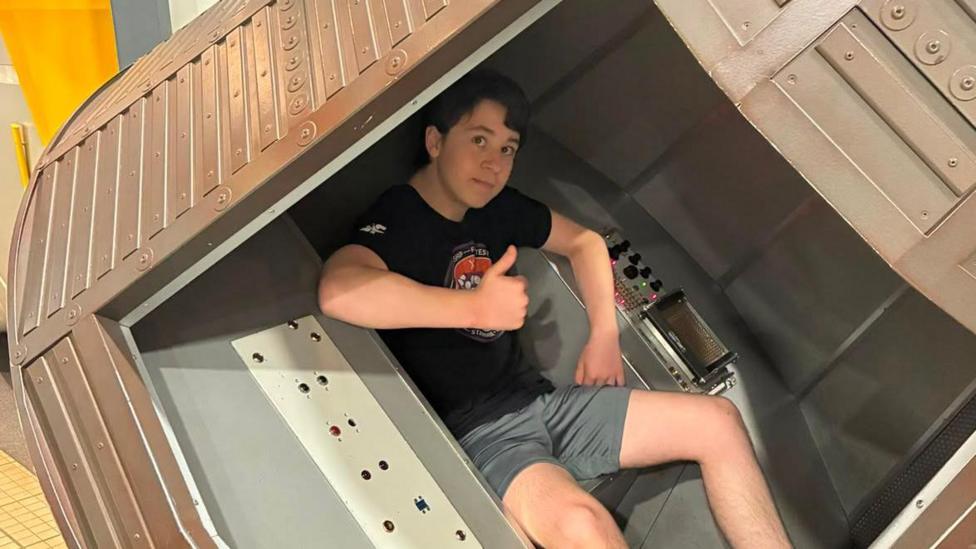
Elsewhere in the region, Peterborough Astronomical Society members will gather at Ferry Meadows country park, while Luton Astronomical Society is holding an event at Stopsley Common in Bedfordshire and Bedford Astronomical Society is hosting a viewing at the Piazzi Smyth Observatory at Bedford School.
In Suffolk, West Stow Country Park is running a pre-booked eclipse event starting at 17:45, and the Dash Astronomical Society has relocated its planned gathering from fire-damaged Dunwich Heath to nearby Darsham Village Hall. Essex residents can watch from Southend-on-Sea pier, at an event hosted by the Munnings Museum in Dedham, or with Loughton Astronomical Society at Theydon Bois village green.
North Norfolk Astronomy Society will bring specialist solar telescopes to its watch party at Binham Village Hall near Fakenham, and Ingham Village Hall has organised its own viewing event. In Cambridge, the Lumo housing development in Eddington is holding a gathering, though Bothwell and Clough note that fewer astronomers than usual will be present locally, since many have travelled to Spain or Iceland to see totality.
Hertford Astronomy Group will set up at Bramfield Village Hall in Hertfordshire, while in Buckinghamshire the public is invited to bring their own eclipse glasses or a homemade pinhole projector to Town Hall Green in Beaconsfield. Those wanting to watch the total eclipse without travelling can follow a livestream of the event on YouTube, hosted by the European Space Agency.
This regional wave of eclipse-watching events mirrors preparations already reported elsewhere in the country. Our earlier coverage detailed viewing spots and safety advice across the UK, including North West England, while other reports focused on events across the South West and Channel Islands and on Yorkshire's preparations for its biggest eclipse in nearly three decades.
What actually causes a solar eclipse?
A solar eclipse occurs when the Moon passes directly between the Earth and the Sun, temporarily blocking sunlight. The Moon is roughly 400 times smaller than the Sun but also about 400 times closer to Earth, meaning the two bodies appear almost identical in size from our planet — something Bothwell calls an "extraordinary cosmic coincidence" that makes total eclipses possible at all.
Within the path of totality, complete darkness can last anywhere from ten seconds to seven and a half minutes, accompanied by a drop in temperature and stronger winds. Stars and planets become visible, and birds have been known to fall silent as if night had fallen. Areas outside the path of totality instead experience a partial eclipse, marked by a dimming of sunlight and a milder temperature drop.
Which regions will see totality, and when will it peak locally?
Parts of Spain, Portugal, Iceland and Greenland will experience full totality on Wednesday, while most of the rest of Europe, including the UK, will see only a partial eclipse. Separate reporting notes that the path of totality travels unusually from east to west across the Arctic region, narrowly bypassing the North Pole, according to background research on the eclipse's path. This is also being described as Europe's first total solar eclipse since 1999, according to ongoing live coverage of the event.
In England, the South West will see the deepest partial eclipse, but the East of England will still experience close to 90% coverage of the Sun. Bothwell said the eclipse is forecast to begin at 18:15 BST in Cambridge, reach its peak at 19:12, and conclude by around 20:00, with the exact peak time elsewhere in the UK falling between 19:02 and 19:16 depending on location.
How can people watch safely without proper glasses?
Bothwell and Clough both stressed that looking directly at the Sun with the naked eye remains dangerous even when most of it is obscured, warning that clouds and ordinary sunglasses offer no protection and that damage to the retina is not always immediately painful or obvious. Direct viewing should only be attempted with eclipse glasses that meet recognised international safety standards, as advised by the UK Health Security Agency.
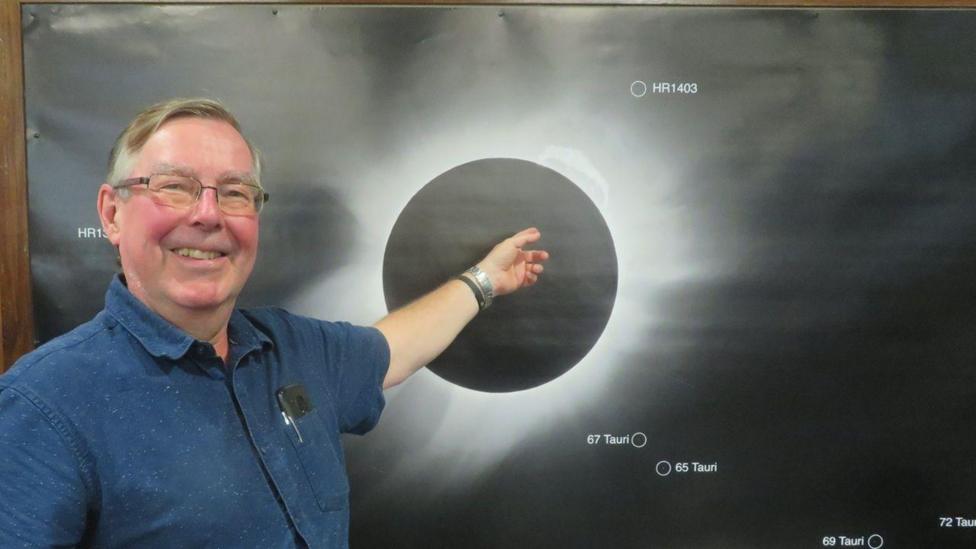
For those without certified glasses, simple household alternatives can safely reveal the eclipse's progress. Bothwell suggests standing beneath a leafy tree, where gaps between leaves can project dozens of crescent-shaped images onto the ground — an effect similar to a homemade pinhole camera, which can be made cheaply using paper or cardboard. Clough recommends an even simpler option: holding a kitchen colander up to project a similar pattern of crescent shapes.
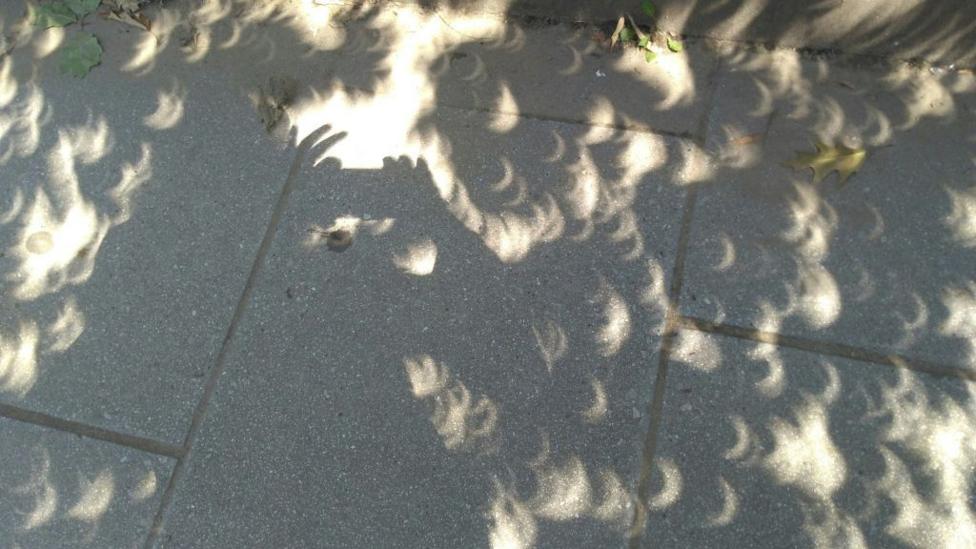
These same low-cost viewing methods were highlighted in earlier reporting after eclipse glasses sold out in much of the country, with guidance on three safe household tricks for watching the eclipse without dedicated glasses.
How rare is an eclipse like this one?
In 1999, most of the UK saw a partial solar eclipse while Cornwall and Devon experienced totality, and a further partial eclipse crossed the UK on 29 March 2025. After Wednesday's event, Britain will not see another total eclipse until 2090. Globally, a total eclipse occurs somewhere on Earth roughly every 18 months, though any single location typically waits around 400 years between total eclipses. Partial eclipses, by contrast, happen about twice a year to varying degrees, but Wednesday's event will offer the deepest coverage of the Sun seen from the UK in 27 years.
Why are experienced astronomers calling this trip 'life-changing'?
Bothwell, who is in his 40s, said he has never witnessed a total eclipse because none has occurred close enough to him during his lifetime.
"It can be once in a lifetime," he said. "People who have seen totality, that experience of the Moon completely covering the Sun, say it is a genuinely life-changingly amazing experience."
"I can't pass up the chance to see something so exciting."
Clough previously travelled to the Faroe Islands in 2015 hoping to witness totality but was thwarted by cloud cover on that occasion, meaning Wednesday's cruise offers him a rare second chance.
What happens after Wednesday's eclipse?
Once totality passes over Greenland, Iceland, northern Spain and Portugal on 12 August 2026, skywatchers in those areas will not get another chance to see a total solar eclipse from the same locations for centuries, based on the roughly 400-year average recurrence pattern for any single site. For the UK specifically, the next total solar eclipse is not expected until 2090, meaning Wednesday's partial view is likely to remain the most significant solar event many current viewers will witness in their lifetime.
Key Facts
- Totality on 12 August 2026 will be visible in parts of Greenland, Iceland, northern Spain and Portugal, lasting up to two minutes and 18 seconds at its longest.
- The East of England will see up to roughly 90% of the Sun covered, the deepest partial eclipse in the UK since 1999.
- In Cambridge, the eclipse begins at 18:15 BST, peaks at 19:12, and ends by about 20:00.
- The next total solar eclipse visible from the UK will not occur until 2090.
- Certified eclipse glasses, pinhole projectors, colanders or tree-leaf shadows are all recommended as safe viewing methods.