A partial solar eclipse will pass over the South West of England, Wales and the Channel Islands on the evening of 12 August 2026, with the Moon covering as much as 95% of the Sun at its peak. The spectacle is expected to run for roughly one hour and 50 minutes, beginning at about 18:20 BST and concluding by around 20:10 BST, though coverage across England and Wales as a whole is expected to range between 90% and 96% depending on location. Broadcasters have separately described the event as the fullest eclipse the UK will see since 1999, and the best the country will witness for the next 50 years.
A solar eclipse happens when the Sun, Moon and Earth line up so precisely that the Moon's shadow falls across part of the Earth's surface. Depending on the alignment, the Moon casts two distinct types of shadow, producing either a total or partial eclipse depending on where an observer is standing.
Where will the eclipse be visible?
The path of totality — the narrow band where the Sun is completely blotted out — will sweep from northern Russia across Greenland, Iceland, Spain and northern Portugal, according to specialists at the National Space Centre, who have dubbed the UK event the "Great British Partial Solar Eclipse 2026," according to the National Space Centre. The UK sits outside that path, but observers here will still witness a significant portion of the Sun disappear behind the Moon. The National Museum Wales similarly confirms that totality will be confined to Greenland, Iceland and Spain, with Wales experiencing only a partial eclipse.
The National Space Centre team said that although the route of totality bypasses Britain, viewers can still expect to see more than 90% of the Sun obscured. That assessment is broadly supported by figures from the Royal Observatory Greenwich, which estimates London will see around 90% coverage, Cornwall about 95%, and Pembrokeshire roughly 94%, while the southwest of Ireland could see nearly 97.5% of the Sun covered. According to NASA, the partial phase will also be visible across mainland Europe and Africa that evening, even though full totality is confined to Greenland, Iceland, northwestern Africa, northern Russia, Spain and a small section of Portugal. NASA's own figures put London's coverage slightly higher, at around 91%, a modest variation from the Royal Observatory Greenwich's estimate of 90%.
Broadcast coverage of the event has offered a further, UK-wide breakdown: Devon, Cornwall and the western parts of Pembrokeshire are expected to see the eclipse at its fullest, with 94% to 96% of the Sun obscured, while the rest of Wales, Northern Ireland, parts of the West Midlands and the South West, and the westernmost parts of Scotland can expect 92% to 94% coverage. Our earlier coverage detailed how Scotland is bracing for its clearest eclipse view in nearly 30 years, with up to 95% of the Sun obscured there.
People across England more broadly have a rare chance to see the eclipse, with dozens of local viewing events planned and regional guidance issued for the South West, the South of England and the North West of England, in addition to London and Yorkshire. People in the South West of England are expected to see the greatest coverage in the country, while those in parts of Greenland, Iceland and northern Spain will experience a full total eclipse.
Estimates for the exact depth of coverage vary between sources. According to Sky at Night Magazine, the highest coverage in the UK is expected at Bishop Rock Lighthouse in the Isles of Scilly, where 96.5% of the Sun's disc will be obscured, ahead of Land's End at 95.8% and Lizard Point at 95.6%. The same guide notes that SaxaVord Spaceport in Shetland will see only 87.9% coverage, illustrating how much the depth of the eclipse varies across the country. Separately, Time puts Cornwall's best coverage at around 95%, with Truro's maximum eclipse falling at 7:16pm local time, and suggests the best way to improve the chances of a clear view is to find a location with an unobstructed western horizon.
Timings also differ slightly depending on the source. Royal Museums Greenwich, cited by the Mirror, gives the eclipse's start in London, Bristol and Cardiff as about 6:17pm, with maximum eclipse at 7:12pm and the event finishing by 8:06pm, a slightly narrower window than the 18:20 to 20:10 BST timeframe given by other timing services. Time gives a similar sequence for Truro, running from 6:18pm to 8:10pm local time, with greatest eclipse at 7:16pm. Broadcast reporting puts the UK-wide peak somewhat later still, between 18:58 and 19:15 BST depending on location, while a national broadcaster's youth-focused coverage gives a peak window of between 19:02 and 19:16, according to a children's news service. Separately, Timeanddate's UK eclipse page gives the nationwide partial eclipse window as 5:59pm to 8:10pm BST, with an England-specific start time of 6:09pm BST, figures that sit close to, but not identical with, the estimates above.
Our earlier coverage detailed how the West Country is set for its biggest eclipse since 1999, with Cornwall and the Isles of Scilly expected to offer some of the best vantage points in the country. A separate report also examined how Yorkshire is bracing for its most striking eclipse in nearly three decades, with up to 92% coverage expected there, while a further report explored how the Isle of Man is set for one of the best views in the British Isles, with around 93% coverage expected at its peak. A broader guide on the best places and times to watch the 2026 eclipse across the UK outlines viewing conditions nationwide, including in the South of England and North West England.
The next total solar eclipse visible from the UK will not occur until 23 September 2090, some 64 years from now.
How will Wales experience the eclipse?
Wales is expected to be among the best places in the UK to view the eclipse, with the event visible there between roughly 18:17 and 20:06 BST. Pembrokeshire is forecast to see between 94% and 96% of the Sun covered, with Strumble Head ranked as the second-best individual viewing location in the UK, while the rest of Wales can expect coverage of between 92% and 94%.
Rhossili Bay on Gower in south Wales has also been named a top spot, alongside Craig Goch Dam in the Elan Valley in mid Wales, which offers wide views of the surrounding landscape and sky, and Rest Bay Beach in Porthcawl. In Cardiff, coverage is estimated at around 93.2%, with slightly different figures given by different sources: one estimate puts the capital's obscuration at 93.24%, with the eclipse peaking there at 7:13pm, while data from Timeanddate gives a slightly lower figure of 93.21%, with first contact at 6:16pm, maximum eclipse at 7:13pm and the event ending at 8:07pm BST.
Timings from Aberystwyth University offer a further point of comparison. According to the university, cited in its own guidance, the eclipse will begin at 18:10, peak at 19:12 and end at approximately 20:00, a slightly earlier finishing time than the 8:07pm given by Timeanddate for Cardiff. The university also describes the 1999 eclipse as the last comparable event witnessed in the UK, characterising 12 August 2026 as a deep partial eclipse visible across the whole country.
The National Museum Wales has cautioned that, despite the high percentage of coverage expected, the sky over Cardiff is not expected to turn genuinely dark even at the moment of maximum eclipse, because a visible sliver of the Sun will remain uncovered throughout.
Why is this eclipse being treated as unusually significant?
Several outlets have described the 12 August event as the deepest partial solar eclipse visible from the UK since 1999, according to the Mirror. Broadcast coverage has gone further, describing it as the best eclipse the UK will see for the next 50 years. That significance is heightened by the fact that Cornwall itself experienced a total eclipse 27 years earlier, in 1999, making this year's event a natural point of comparison for viewers who witnessed the original. For those actually standing within the narrow path of totality elsewhere in the world, the Sun will be hidden for less than two minutes, underlining how brief even a full eclipse experience would be compared with the UK's extended partial viewing window.
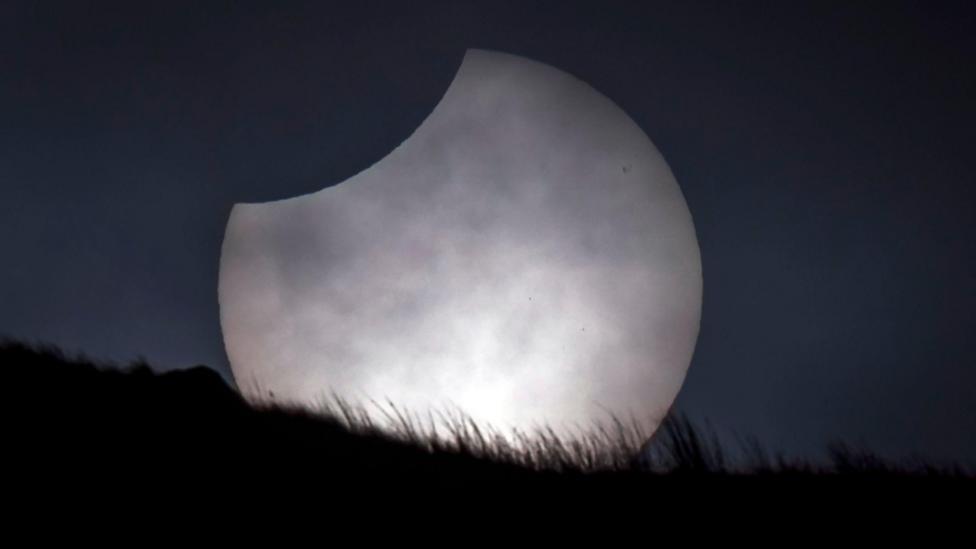
A total solar eclipse occurs somewhere on Earth roughly every 18 months, but only those standing within the narrow path of the Moon's shadow will see it. Those witnessing totality first see the sky darken before a pearly-white ring appears around the blacked-out Sun — the corona, a vast halo of superheated plasma extending millions of miles into space that is normally invisible because it is more than a million times fainter than the Sun's surface. Just above the visible surface sits a thinner, pinkish layer called the chromosphere, visible during the first seconds of totality as a narrow pink-red ring around the Moon's edge.
How is Spain experiencing the total eclipse?
Hundreds of thousands of people have travelled to northern Spain to witness the total eclipse, with half a million visitors expected according to the country's finance ministry. Clear skies are forecast to give good views of totality in Bilbao, Valencia and Palma, Mallorca, while Barcelona and Madrid are expected to see more than 99% coverage without reaching full totality. Depending on location, the total eclipse will peak between 20:26 and 20:33 local time, or 19:26 to 19:33 BST.
Julie, who travelled with her family from Brest in France to the Spanish city of Burgos, said she was "very excited" about the event.
"We came from very far to see it in totality. I have seen [it] once and it was beautiful and amazing - I am so happy to have the chance to see one again."
Leonor Aguilar, from Jaén in Spain, described what she hoped to experience during totality.
"During that minute and a half, what I hope to see is the grandeur of nature and to experience it with my family. We often spend money on trivial things instead of investing in something as beautiful as witnessing such a marvellous sight."
Martin Griffith, director of the Brecon Beacons Observatory in Wales, described the phenomenon in similarly striking terms, noting that observers in Spain will experience true darkness as the Moon completely covers the Sun.
"It is going to be a fantastic eclipse in Spain, we are right on the path of totality. What they will see is about a minute and 40 seconds of totality. It will be dark, the Moon will completely cover the Sun."
"Although we know they happen quite often we're not always in the path of totality - they could be over the Pacific Ocean, but to have it over land is just incredible."
How will nature respond during the eclipse?
Wildlife and plant life are expected to react as daylight fades and temperatures dip slightly during the peak of the eclipse. Dr Jean Dean, a Guernsey-based fellow of the Royal Astronomical Society, explained that the changes unfold gradually from the very first moment the Moon begins crossing the Sun.
"First contact is when the edge of the moon touches the edge of the sun and after first contact, you will very quickly see the moon start to bite the sun."
"A little while after this, you should start to notice a slight change in temperature and the sky starting to darken."
"As the maximum approaches, nature will begin to respond. Birds will fall silent and nyctinastic plants (plants that open their leaves during the day and close them at night) such as clovers, dandelions and daises will close."
"Nature will then return to normal, the sky will lighten and the temperature will rise slightly."
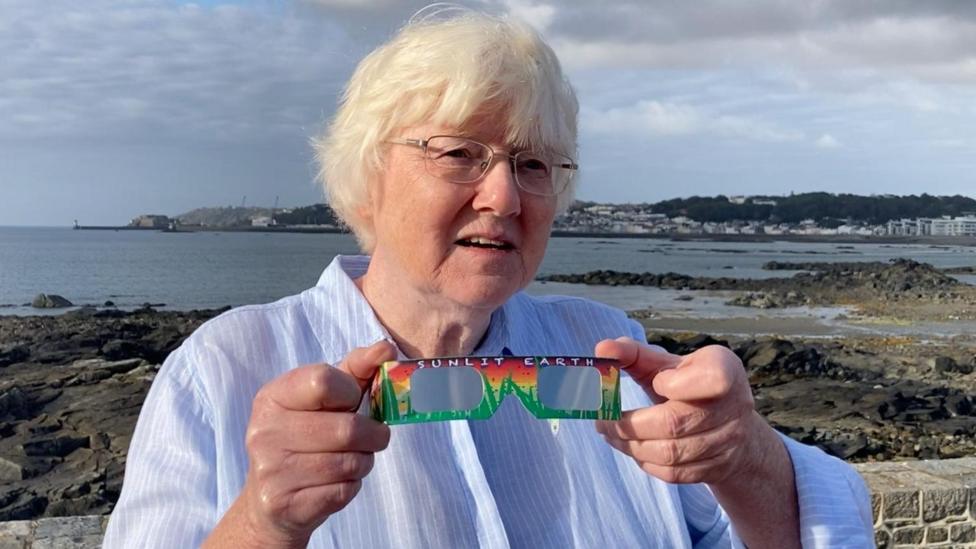
Dr Dean has separately noted that this event is a rare opportunity for the island, given that the next total eclipse visible from Guernsey is not due until 2081. More broadly, the next time the Moon obscures a similarly large portion of the Sun across the British Isles will also be in 2081, with the next full total solar eclipse in the UK not due until 2090.
Could skywatchers see a meteor as well as an eclipse?
The eclipse coincides with the peak of the Perseid meteor shower on the same evening, and the darkened sky during totality theoretically offers a brief window in which a meteor could be visible. However, this would only apply in areas witnessing full totality, such as Spain, and not in the UK, where only a partial eclipse will be seen. Even in Spain, the odds are slim. Dr Becky Smethurst, a research fellow at the Royal Astronomical Society, said catching both events together would require considerable luck.
"You would have to get very, very lucky to see a shooting star during the total eclipse."
What will observers on the ground experience?
Chris Cooke, chairman of the Plymouth Astronomical Society, said the darkness brought on by the eclipse would feel unsettling even without full totality.
"I've been chasing eclipses as long as I can really, as much as my wife would allow me to do."
"All my holidays are eclipse chasing holidays."
"So what's coming up in August is not a total eclipse from the UK, it's a partial, but this partial is where the the moon will block out the sun almost fully, but not quite."
"It's the darkest partial solar eclipse since 1999 and things will get a bit eerie."
What will the weather be like on the day?
Weather conditions across the UK are expected to be mixed for the eclipse. Much of the country should see clear skies, giving many people a good view, but areas of cloud were forecast to move into parts of north Wales, northern England, Scotland and Northern Ireland between roughly 18:00 and 19:00 BST. In parts of western Scotland and towards the north and west of Northern Ireland, that cloud could bring outbreaks of rain, potentially obscuring the view for observers in those regions.
How can people watch safely?
Health officials have repeated warnings that looking directly at the Sun during any stage of a partial eclipse carries serious risk to eyesight. According to NASA, it is never safe to view the partial phase of an eclipse without proper eye protection, since the Sun is never fully blocked outside the narrow path of totality. Even when most of the Sun's disc is covered, the remaining visible section stays bright enough to cause lasting eye damage. Viewing the eclipse through ordinary sunglasses, welding goggles, binoculars, a telescope or a phone camera is not considered safe either, unless binoculars or telescopes are fitted with a proper solar filter; anyone wishing to look directly at the event needs eclipse glasses that meet the international safety standard ISO 12312-2:2015(E).
Following the total eclipse of 1999, the Royal College of Ophthalmologists recorded around 70 cases of people suffering vision problems after watching the event, and found that roughly 40% of those affected had looked at the Sun for less than a minute. The UK Health Security Agency has issued a fresh warning ahead of this year's eclipse, cautioning that the Sun will appear dimmer than usual during the event, which can tempt people into looking at it directly and risking lasting eye damage. According to the UK Health Security Agency, this guidance was published on 23 July 2026, ahead of the eclipse.
The agency is advising the public to use certified eclipse glasses or handheld solar viewers, provided they are genuine products, rather than makeshift alternatives. Demand for eclipse glasses has been high in the run-up to the event, with a staff member at a bakery in central London reporting that around 100 pairs had been sold on the morning of Tuesday 11 August 2026 alone. It also suggested indirect viewing methods such as pinhole viewers that can easily be made at home: making a 3mm hole in a piece of paper or card and, with your back to the Sun, projecting the image onto another piece of white paper, card or a paper plate. A colander or a draining spoon can also produce multiple mini-eclipse images projected onto the ground, or the Sun's image can be projected through gaps between tree leaves, or via a simple pinhole projector built from a cardboard box.
What events and next steps are planned around the eclipse?
The eclipse takes place on 12 August 2026, and several organisations are running dedicated viewing events on the day. According to Royal Museums Greenwich, the Royal Observatory Greenwich will host solar observing at its Greenwich site from 4pm on 12 August, and will also stream the eclipse live for those unable to watch in person. That live stream has since been scheduled more precisely, with Royal Museums Greenwich's UK and Ireland broadcast set to run from 6:10pm to 8:00pm on Wednesday 12 August 2026. Public eclipse-watching events are also listed elsewhere in the country, including at Rest Bay Beach in Porthcawl, Rhossili Bay on Gower, Tooting Common in London and Stockwood Open Space Nature Reserve in Bristol, according to a UK eclipse events guide.
Once the eclipse passes over the UK, timing data compiled by Timeanddate shows the national viewing window will run from 5:59pm BST to 8:10pm BST, before the Moon continues its path onward from northern Russia towards North America, Europe and Africa, as tracked by NASA's eclipse page. In Wales specifically, the eclipse is expected to reach its maximum in Cardiff at 7:13pm BST and conclude there at 8:07pm BST, according to Timeanddate's Wales-specific data, a slightly later finish than the roughly 8:00pm end time given by Aberystwyth University for the wider region. For London specifically, Timeanddate's London page gives an end time of 8:06pm BST, closely matching the Royal Museums Greenwich figure of around 8:06pm for the capital. Beyond this event, skywatchers in Britain will have to wait until 2081 for a similarly deep partial eclipse, and until 23 September 2090 for the country's next full total solar eclipse.
Key Facts
- The partial eclipse over the South West, Wales and the Channel Islands runs from about 18:20 BST to 20:10 BST on 12 August 2026, though sources vary: Royal Museums Greenwich gives roughly 6:17pm to 8:06pm for London, Bristol and Cardiff, Aberystwyth University gives 18:10 to approximately 20:00, and Timeanddate's UK page gives a nationwide window of 5:59pm to 8:10pm BST with an England-specific start of 6:09pm BST.
- Coverage across England and Wales ranges from about 87.9% in Shetland to as high as 96.5% at Bishop Rock Lighthouse in the Isles of Scilly, with Cornwall, Devon and western Pembrokeshire generally estimated at 94-96%, London around 90-91%, and Cardiff at approximately 93.2%; the rest of Wales, Northern Ireland, parts of the West Midlands and the South West, and westernmost Scotland are expected to see 92-94%.
- Northern Spain will see full totality, with half a million visitors expected in the region according to the country's finance ministry, and totality lasting under two minutes; Barcelona and Madrid will see over 99% coverage without reaching totality.
- The Royal College of Ophthalmologists linked about 70 eyesight injury cases to the 1999 eclipse, with 40% occurring after less than a minute of unprotected viewing; eclipse glasses have been in high demand nationally in the days before the event.
- The next time the Moon obscures a similarly large share of the Sun across the British Isles will be in 2081, with the next full total solar eclipse in the UK not due until 23 September 2090.