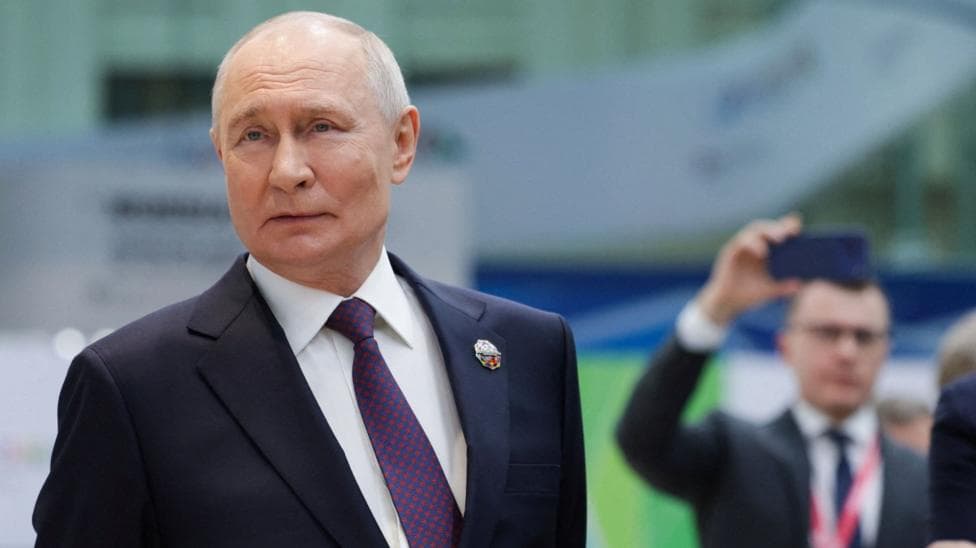
Russian President Vladimir Putin has described Elon Musk as a "real genius" and revealed that Moscow is in "close" contact with the SpaceX founder regarding satellite technology coordination. The remarks, made during the Russia-Africa Summit in Moscow on Wednesday, underscore an emerging alignment between the two countries on space infrastructure even as geopolitical tensions persist elsewhere.
According to BBC News, Putin discussed Russia's satellite internet initiative Rassvet during the summit, emphasizing the need for dialogue with American counterparts to prevent orbital interference. "He's a genius, a real genius," Putin said of Musk. "We are in close contact with our American partners, including Mr. Musk." SpaceX did not respond to requests for comment on the remarks.
Putin stressed that coordination between the two nations' satellite systems was essential.
"We and our American partners value this mutually, and despite all the political questions, we are working hard," he said.The Russian Embassy in South Africa characterized Rassvet as "Russia's Starlink alternative" and noted that it "marks only the country's first steps in this field."
How do the two satellite networks compare?
Starlink has deployed approximately 13,000 satellites into orbit, making it the dominant player in global satellite internet infrastructure. By contrast, Russia's Rassvet program operates on a much smaller scale. According to The Insider, Russia launched a second batch of 16 serial Rassvet satellites on 19 July 2026, following an initial deployment in March 2026. The program's first six experimental satellites were launched in 2023 and 2024, before the 32 serial satellites deployed in 2026.
Putin acknowledged the disparity during his remarks, noting that Musk's company had more than 5,000 satellites in orbit while Russia was "only taking its first steps." The Rassvet project is being developed by Bureau 1440, a Russian aerospace firm, with commercial service targeted to begin in 2027 and a planned constellation of more than 900 satellites by 2035.
What is the broader context of US-Russia relations?
Putin's public praise of Musk and emphasis on space cooperation come amid a period of apparent diplomatic warming between Washington and Moscow. This shift is particularly notable given that the two nations remain in a state of heightened tension nearly five years after Russia's full-scale invasion of Ukraine in February 2022.
Ukraine has historically depended on Starlink connectivity to sustain military operations and coordinate defenses against Russian forces. However, the situation changed dramatically when Ukraine's military experienced sudden Starlink connectivity disruptions last week. Musk has acknowledged that SpaceX intentionally imposed these restrictions. Musk has claimed the Trump administration ordered speed restrictions on Starlink in Ukraine, while Ukrainian President Zelenskyy has accused Trump of betrayal over the Starlink restrictions, raising concerns about the durability of American support as the conflict continues.
Recent developments suggest a recalibration of US-Russia relations under the Trump administration. Earlier this month, President Donald Trump announced he had negotiated a deal with Russia to import diesel in an effort to reduce domestic fuel prices. Trump subsequently waived certain sanctions against Russia that were scheduled to take effect. Additionally, a US citizen was released from Russian custody, with US envoy Steve Witkoff characterizing Putin as a "humanitarian."
Who is Elon Musk and what are his business interests?
Musk, who was born in South Africa before immigrating to Canada and eventually settling in the United States, has built a business empire centered on technology and space exploration. His ventures—including Tesla, SpaceX, and Starlink—are all based in America, with operations concentrated in California and Texas. The billionaire has emerged as one of the most significant political allies and financial backers of Trump and other Republican politicians, positioning him as a central figure in contemporary American politics and business.
What comes next for Rassvet?
Russia's satellite internet ambitions remain in their early stages. According to The Insider, Rassvet's commercial service is scheduled to launch in 2027, with the program aiming to deploy more than 900 satellites by 2035. The coordination discussions between Putin and Musk suggest that despite broader geopolitical divisions, both nations recognize the practical necessity of managing shared orbital space to prevent technical conflicts.