

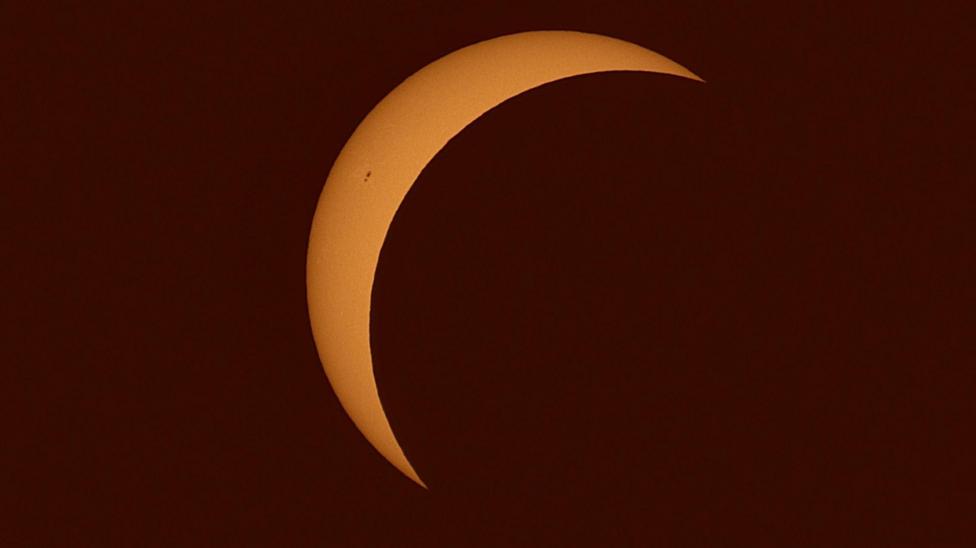
Families and stargazers across the South West gathered on the evening of 12 August 2026 to watch a rare partial solar eclipse, as the Moon passed between the Earth and the Sun to create a crescent shape in the sky. The event began at approximately 19:00 BST, with the eclipse peaking around 19:15 BST, when the Moon covered between 94% and 96% of the Sun across Devon and Cornwall.
In Sidmouth, groups of families turned out to witness the spectacle, with several children describing it as a rare and memorable event. One young girl, Charlotte, said the eclipse felt like a once-in-a-lifetime moment.
"It's really exciting because the next time I'll see one, I'll be a lot older. It's like a once in a lifetime opportunity."
Others compared the shape of the partially covered Sun to everyday objects and characters. Charlie, another spectator, described the mood among children as electric, noting the excitement that had built throughout the gathering.
"The kids haven't stopped screaming and been dancing around since we've been here."
How did people compare the eclipse's appearance?
Many onlookers reached for playful comparisons to describe the changing shape of the Sun as the Moon crossed its face. A young girl named Alice said the crescent reminded her of the video game character Pac-Man, calling the eclipse brilliant, while another child said the sight of the Sun disappearing felt somewhat unsettling.
"It kind of looks like Pac-man."
Some attendees also used the occasion to mark personal milestones, with birthdays and anniversaries falling on the same evening, adding a sense of romance and celebration to the astronomical event.
What other events took place during the eclipse?
At Pendennis Castle, Commander Dave Lee of the Royal Navy Parachute Display Team took part in a parachute jump timed to coincide with the start of the eclipse. Lee was one of five members of the Royal Navy and Royal Marines who jumped from a small aircraft at around 6,000ft (1,829m), deploying colourful canopies as they descended.

"It is really a once in a lifetime experience, you have a very real feeling of immediacy and freedom, and you get a great view."
Elsewhere, storyteller David Heathfield used the occasion to share mythology connected to eclipses from around the world, including the Japanese Shinto tale of Amano-Iwato, the sun goddess who withdrew into a cave and plunged the world into darkness.
"I had to go all the way to Japanese Shinto mythology to find it."
How did Cornwall's crowds describe the experience?
In Cornwall, spectators gathered at sites including Bude and a stone circle on the moors to observe the eclipse. One attendee in Bude said they valued being part of a shared community moment, while others at different locations described the atmosphere as unusual and dreamlike.
"I think it's very, very spiritual."
In West Penwith, a spectator named Mark observed that wildlife appeared to respond to the dimming light, with birds returning early to their roosts as the sky darkened. He noted that a flock of seagulls and choughs, which had been feeding on flying ants shortly beforehand, flew back to the cliffs as the eclipse progressed.
"All the birds have gone to bed."
How does this fit into the wider eclipse story?
The Wednesday evening event formed part of a broader wave of eclipse-watching across the country, as thousands of people across the South West and the Channel Islands turned out to watch the rare partial eclipse throughout the day. Similar scenes played out further afield, with crowds in the South East, West of England and Hertfordshire using glasses and colanders to view the eclipse safely, an event tied to the first total solar eclipse over mainland Europe in 27 years. Ahead of the event, astronomy groups in the South West and Channel Islands had organised free and ticketed viewing events to help the public watch safely.
According to the Royal Observatory, this was the UK's best partial solar eclipse in years, with coverage ranging from around 90% to 96% of the Sun depending on location, and the observatory noted that in Truro, Cornwall, coverage reached up to about 95.6% of the Sun, with the eclipse there ending at approximately 8:10pm. Separately, Timeanddate recorded the Devon event as beginning at 6:18pm, peaking at 7:15pm and concluding at around 8:08pm local time.
Following the eclipse, a photo-led roundup published by a national broadcaster's news service confirmed the event had been widely visible across Cornwall, Devon, Guernsey and Jersey, while a children's news outlet ran a picture gallery framing the event as the best partial eclipse view in south-west England and Wales.
What happens next?
No further eclipse-related events or scheduled astronomical fixtures have been reported following Wednesday's event, based on the available coverage so far.


