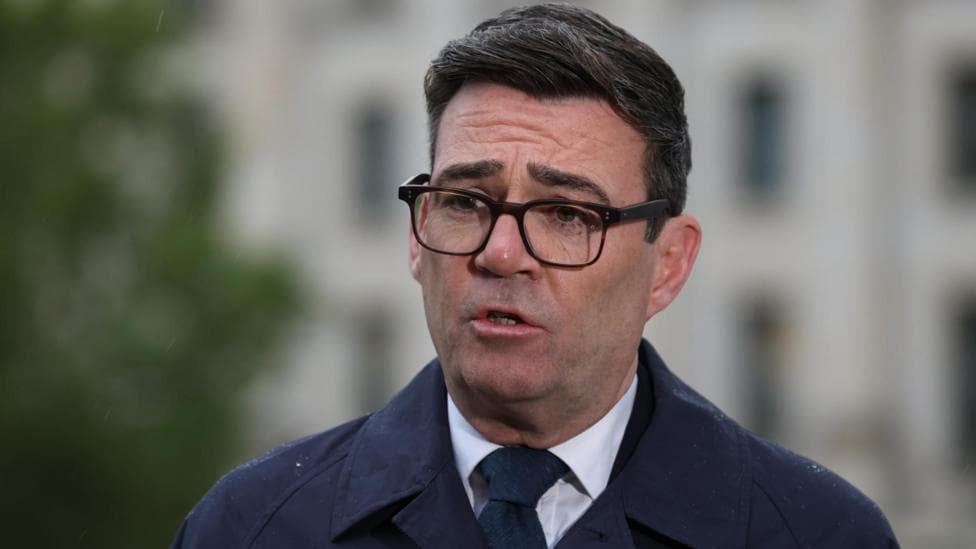
Prime Minister Andy Burnham has indicated willingness to engage in substantive debate about restoring free movement between the UK and the European Union, suggesting that a reshaped relationship with Brussels could encompass full EU membership or single market participation. Speaking to the Sunday Times, Burnham framed the discussion as evidence-based and pragmatic, distinguishing between the migration patterns of the pre-Brexit era and current demographic flows. According to BBC News, his comments have triggered sharp responses from across the political spectrum, with both Conservative and Reform UK figures criticising the prospect.
Deputy Prime Minister Angela Rayner told the BBC's Sunday with Laura Kuenssberg programme that no policy options should be excluded from consideration, emphasising that Burnham was advocating for pragmatism in pursuit of the most advantageous arrangement for Britain.
"You can't take anything off the table,"Rayner stated, adding that
"we've got to be pragmatic to get the best deal for Britain and he wants to have the conversation."
Burnham's position represents a notable evolution from Labour's 2024 election manifesto, which explicitly ruled out free movement, single market membership and a customs union. However, the Prime Minister has previously stated that any such changes would require a fresh electoral mandate, with the next general election scheduled by 2029. Earlier this year, Burnham indicated that rejoining the EU could be among options examined to reshape the UK's relationship with the bloc, marking a significant shift in the government's approach to post-Brexit relations.
What is Burnham's position on free movement?
The Prime Minister has stressed the need for a factual, evidence-based examination of migration policy.
"I think you have to have a very factual, quite evidence-based debate about this,"he told the Sunday Times, arguing that the character of migration has fundamentally changed since the 2016 referendum.
"Revolving door migration where people would come and then go back is different. The balance of migration has changed, hasn't it, since then? I think we've just got to have an honest discussion about those things."
Burnham has drawn attention to practical consequences of Britain's departure from the EU, noting that the UK's exit reduced access to European migration data, including Eurodac and related data-sharing systems. This loss of information-sharing capacity has implications for the government's ability to manage migration and security matters.
Despite his openness to discussion, Burnham has drawn firm boundaries around certain EU commitments.
"I can't see myself ever recommending anything that would involve joining the euro or Schengen,"he said. The Schengen Agreement permits passport-free travel across participating EU countries, while the euro is the common currency adopted by most EU members. The UK retained the pound during its EU membership, and the bloc has historically encouraged new members to adopt the single currency.
How have political opponents reacted?
Conservative Party leader Kemi Badenoch has dismissed Burnham's remarks as indicative of poor judgment. Writing on social media platform X, Badenoch characterised his comments as
"yet another example of Burnham's foot in mouth syndrome,"and argued that
"Most people who voted for Brexit did so because they didn't want free movement. Too many politicians have failed to understand the significance and impact of immigration on communities."
Reform UK's economy spokesperson Robert Jenrick has taken an even more critical stance, describing the proposal as fundamentally misguided.
"I think it's completely mad, the idea that this country needs more immigration,"Jenrick told the BBC, claiming that
"mass migration has been a disaster for working people, for Brits."He added that
"The last thing they want is their wages being undercut by a load of low wage, low-skilled migrants from overseas."This position represents a reversal from Jenrick's earlier stance: despite supporting the Remain campaign during the 2016 referendum when he was a Conservative MP, he now opposes free movement.
What is the Liberal Democrat position?
In contrast to Conservative and Reform UK criticism, Liberal Democrat deputy leader Daisy Cooper has endorsed the concept of restored free movement. She told the BBC that permitting freedom of movement would constitute
"a really good thing for growth"and has advocated for the UK to rejoin the single market, the customs union, and participate in the EU's defence framework.
Cooper has highlighted what she characterises as Britain's disadvantageous current position on migration. The UK is excluded from the EU's
"new asylum pact with biometric data"that could be deployed to address irregular migration across the Channel, she noted, leaving the country with
"the worst of both worlds"on immigration policy.
What is the broader context for this discussion?
Migration emerged as a central issue during the 2016 Brexit referendum campaign, with the Leave campaign emphasising concerns about EU rules permitting any citizen of member states to relocate to the UK. The question of free movement has remained contentious in British politics throughout the post-referendum period.
Burnham has reopened debate about Brexit, arguing the UK should deepen ties with the EU while leaving open the possibility of a future referendum on EU membership. On the Sunday with Laura Kuenssberg programme, Rayner articulated the government's view that an informed public discussion is essential.
"What the prime minister is saying now, and what I want, is that we have an honest conversation about the facts of what the trade-offs are to get the best deal for Britain going forward,"she said.
"The frustration for me in the previous debate we had when we had the referendum is that a lot of those facts didn't get the airtime. So I would like us to have an honest conversation about what the trade-offs could be and then put that to the people at a general election."
Burnham will push for new post-Brexit agreements on trade, energy and youth mobility at an EU summit on 20 November, claiming the deals could add £10 billion annually to the UK economy by 2040. The proposed youth experience scheme would permit young people to live, work and travel in each other's territories for up to three years.

The historical context for current negotiations extends back to the first EU–UK summit, which took place in London on 19 May 2025, where both sides agreed a strategic partnership and welcomed a renewed cooperation agenda. This foundation has enabled the government to pursue more ambitious discussions about the shape of future relations.
What happens next?
The second EU–UK summit is scheduled for 20 November 2026 in Brussels. At this gathering, leaders are expected to review progress on security, energy, agrifood, climate, people-to-people contacts, migration and law enforcement. EU Trade Commissioner Maroš Šefčovič has indicated that negotiators aim to complete youth mobility, food-trade and carbon-market agreements as a package for the summit.
Any substantive changes to the UK's relationship with the EU, including a return to free movement arrangements, would require approval from voters at a general election. Burnham has committed to honouring Labour's manifesto commitments during the upcoming negotiations, though he has signalled that the government's position may evolve following public consultation and electoral renewal of its mandate.