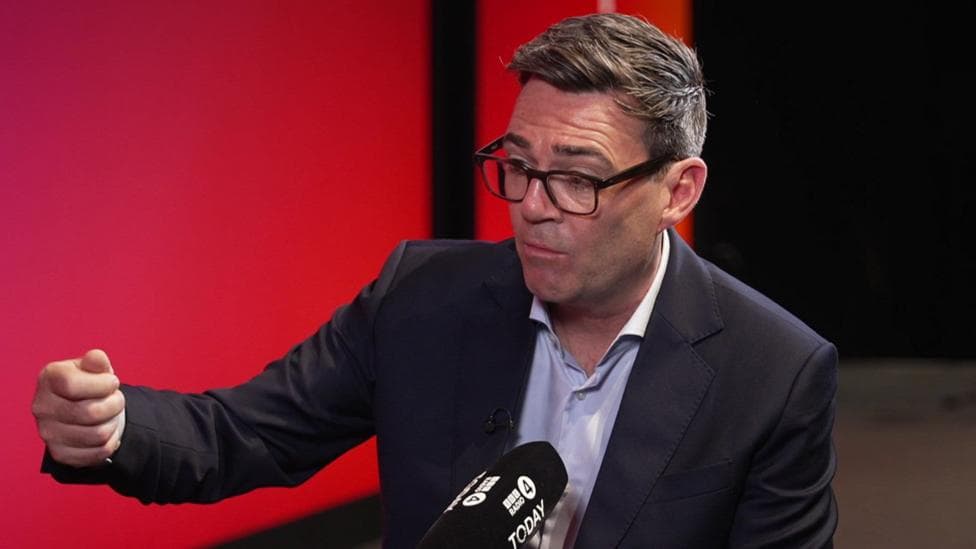
Prime Minister Andy Burnham has indicated that rejoining the European Union could be among several pathways the government examines to recalibrate the United Kingdom's relationship with the bloc, marking a significant shift in Labour's approach to Brexit.
In an interview with BBC Radio 4's Today programme, Burnham stated he wanted to "look at the options" regarding the EU relationship rather than leave the question "hanging." He outlined a spectrum of potential approaches, ranging from maintaining the status quo to pursuing full membership.
The prime minister told the broadcaster that the existing Brexit settlement had delivered "more harm than good" and he was committed to exploring "what is doable" to mend relations with Europe. This represents a notable departure from Labour's 2024 election manifesto, which pledged to "make Brexit work" while explicitly ruling out rejoining either the customs union or single market.
Burnham's comments build on remarks he made during his Labour conference speech on Tuesday, when he pledged to investigate closer ties with the EU at a rescheduled summit planned for later this year. The summit had originally been scheduled for July in Brussels but was postponed following the leadership transition within Labour.
What options is the government considering?
Burnham outlined several distinct pathways during his radio interview. He acknowledged that remaining in the current arrangement was "definitely an option, if people think this is the right place to stay." He also referenced proposals from other political figures and parties, stating: "We could look at what [former Chancellor] George Osborne has said about a customs union, we could look at what the Liberal Democrats said at their conference about the single market, or we could go all the way."
The prime minister stressed that any decision would require careful analysis of "what is doable and what would be the pros and cons of each" option. His spokesman did not rule out a future pledge to rejoin the EU, according to reporting on the summit strategy.
Public opinion appears to show appetite for closer EU engagement. A YouGov poll conducted in June found that 55 percent of respondents supported rejoining the EU, while 34 percent opposed it. The same survey revealed that 59 percent backed closer ties that stopped short of full membership, the customs union, or the single market.
How does this differ from Labour's previous position?
Burnham's willingness to examine EU membership represents a marked contrast to his predecessor Sir Keir Starmer's more cautious approach. Starmer had attempted to engineer a limited reset in relations, focusing on aligning British food standards with EU regulations, establishing a youth visa scheme, and reconnecting British industry to the EU's carbon trading system.
During his campaign as a candidate in the Makerfield by-election that returned him to Parliament, Burnham had promised not to "re-run" Brexit arguments and stated he was "not proposing that the UK considers rejoining the EU." His latest comments represent the clearest indication yet that he may make a decisive break from that position and from Labour's 2024 election platform.
In his conference speech, Burnham blamed Brexit for eroding control over both immigration and economic policy, telling delegates that the current relationship was "not good enough." He committed to using the rescheduled EU summit to present "different options" for the UK's long-term European engagement and promised to "find consensus" on a preferred approach, though he offered limited detail on how consensus would be measured or achieved.
What is the political reaction?
The Conservative Party has moved quickly to attack Burnham's position. Deputy leader Alex Burghart accused Labour of attempting to "pin the blame for their disastrous economic decisions on a vote that happened over a decade ago." Burghart also claimed the government was "already dragging us into the European Union via the back door with their EU reset," suggesting that even limited alignment measures represent a form of de facto integration.
Political observers have noted that Burnham's approach could establish a major dividing line at the next general election, which is due by August 2029. The Conservatives have signalled they will frame any move toward closer EU ties as an attempt to "reopen old wounds by restarting the battles of the Brexit years."
What happens next?
The UK-EU summit is expected to take place later this year, with Burnham indicating he will outline the range of available options for the relationship around the time of the meeting. The summit had been expected to present agreements on food and animal safety standards, a youth mobility scheme, and linking the UK and EU emissions trading systems. A specific date for the summit has not yet been announced in available reports, though Burnham has committed to setting out options for the EU relationship around the meeting.
The prime minister has also stated his intention to publish a 10-year plan to transform the UK economy at the time of the summit, positioning the EU relationship question as part of a broader economic strategy rather than as a standalone policy shift.
Key Facts
- Burnham told BBC Radio 4 he wanted to "look at the options" for the UK-EU relationship, ranging from maintaining the status quo to full membership.
- A June YouGov poll found 55% of the public supported rejoining the EU, with 59% backing closer ties short of full membership.
- The rescheduled EU summit, originally planned for July, is expected later this year and will be used to present options and seek consensus on the UK's long-term European strategy.
- Burnham's position marks a departure from Labour's 2024 election manifesto, which pledged to "make Brexit work" while ruling out rejoining the customs union or single market.
- The next general election is due by August 2029, with the EU relationship likely to become a central campaign issue.