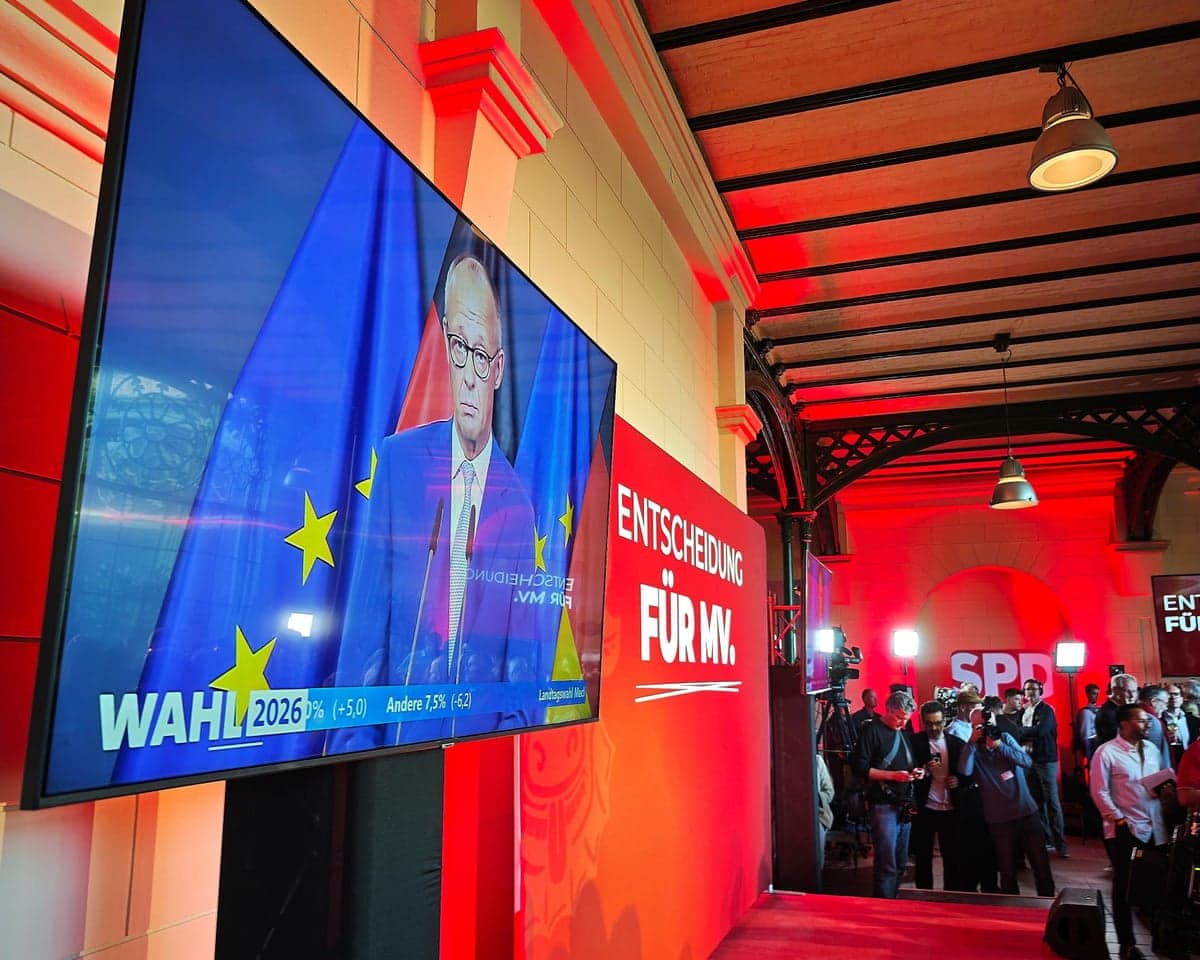
Germany's Chancellor Friedrich Merz is clinging to power after his Christian Democratic Union suffered its worst state election results since 1949, crashing below the 5% threshold in Mecklenburg-Western Pomerania on 20 September 2026 for the first time in postwar history. The far-right Alternative for Germany (AfD) surged to 38% in the northeastern state and won in Berlin, intensifying questions about Merz's political future. Despite calling the results a "disaster", Merz vowed to remain in office and push ahead with his reform agenda, a stance that analysts warn is likely to deepen unrest within his own party.
The scale of the collapse is stark. In Mecklenburg-Western Pomerania, the CDU secured just 4.9% of the vote, down from previous levels, while the AfD emerged as the top party with 38% against 35.5% for the centre-left Social Democrats. In Berlin, the CDU was displaced from city hall by the leftwing Die Linke party, which is expected to lead the next government. These twin defeats in major population centres follow the AfD's breakthrough victory in Saxony-Anhalt on 6 September, where it secured 43.8% of the vote, signalling a consolidation of far-right support across eastern Germany.
On 21 September, Merz held an early meeting with senior CDU leadership in Berlin to shore up support. He dismissed speculation over his position, insisting that his government's continuation was vital for the country's "democratic future".
"It is about nothing less, and nothing more, than the democratic future of our country,"he said, adding that his government was "determined to live up to the historic responsibilities our country is facing." He acknowledged the Mecklenburg-Western Pomerania result as "a heavy blow" and "a disaster" for the party, but insisted the coalition would endure.
However, the political pressure on Merz extends beyond the immediate aftermath of the elections. According to polling data cited by Reuters, 58% of CDU voters no longer want him in charge, compared with 36% who still back him. The backlash extends far beyond party ranks: a recent INSA poll found 78% of all respondents do not think Merz should be chancellor, reflecting the depth of public dissatisfaction with his leadership.
Is Merz's position tenable?
Some critics have already called for Merz, who has been in office for 16 months, to step down. However, party figures have signalled resistance to a change at the top. Karin Prien, the Education Minister and deputy CDU leader, told Phoenix television that
"I don't see that swapping out a leadership figure would really bring a change."She added that she does not foresee
"another personnel offer"emerging from the party.
Prien acknowledged that the government was failing to take voters' fears seriously enough, but said the government had no choice other than to continue trying to reform Germany.
"The chancellor knows he will have to change, at least in how he addresses the people. We are a strong country, we have every chance of mastering this challenge together, but I believe that cooperating with one another will be crucial for this, and for the party it means we must broaden our appeal."She argued that
"so we must now discuss with one another — together with the chancellor as a government, and on the other hand as a party — how we win more acceptance and more credibility among the population."
Nevertheless, media reports have identified two conservative state leaders as potential successors should internal pressure intensify. Hendrik Wüst and Markus Söder have been frequently named in discussions about possible replacements, though no formal challenge has yet materialised. The AfD's leadership has already begun predicting Merz's downfall. Leif-Erik Holm, the AfD's top candidate in Mecklenburg, said on 21 September:
"The chancellor certainly won't make it to the end of the year. I think the twilight of the chancellor's era has begun."When asked on 21 September how long Merz has left in office, AfD co-leader Alice Weidel predicted his departure would come soon, telling a broadcaster:
"Pretty soon, he's going to leave."
Last week, eight CDU state premiers had backed Merz in a letter released before the severity of the Mecklenburg-Western Pomerania outcome became clear. Questions remain as to how sustained their support will be, though there appear to be few candidates willing to step up to the post, which is increasingly being viewed as a poisoned chalice. On 21 September, Merz dismissed the idea that the election results were a personal rebuke.
"The reasons for these election results go far beyond my own person. We are witnessing a profound transformation of the political party system in Germany as well as in many other countries around the world."He acknowledged his role in the outcome while insisting the broader context extended beyond his individual performance:
"I know that I as an individual played a role in these state elections. But the reasons for the results go far beyond just me."

Holger Schmieding, chief economist at Berenberg bank, captured the precariousness of Merz's position:
"Friedrich Merz is fighting for his political survival. Although Merz has vowed to stay on as chancellor to spearhead the much needed pro-growth reforms, it will not be easy for him to contain the unrest within his party."
What is driving the AfD's rise?
The AfD's gains reflect a broader national backlash against mainstream politics and dissatisfaction with economic conditions. The challenge facing Merz is part of a broader national backlash against mainstream politics and slow growth. The party has capitalised on voter concerns about migration, economic stagnation, and the direction of German foreign policy, particularly regarding support for Ukraine. Its anti-immigration, "Germany first" agenda and Russian-friendly positions have found particular resonance in the former communist east.
Thousands of Germans protested against the far-right party after its breakthrough victory in Saxony-Anhalt, warning of dangers ahead of regional elections. The party's willingness to challenge the consensus on Ukraine policy has also attracted voters frustrated with the government's approach. While the AfD won the most votes in Mecklenburg-Western Pomerania, it is unlikely to govern as other parties have agreed a "firewall" of non-cooperation with the far-right party. Some branches of the party are classed as right-wing extremist by domestic intelligence, a designation it strongly rejects.
Doubts over the efficacy and fairness of the government's reform agenda — which includes an overhaul of the pension system, a reduction in overbearing bureaucracy and cuts to income tax for the less well-off — played heavily into both election campaigns. The Kremlin on 21 September waded into the election analysis, with spokesperson Dmitry Peskov calling the AfD's win in Mecklenburg a response to Berlin's refusal to buy cheap Russian gas, which has jolted the economy and caused prices to soar, contributing to voter dissatisfaction.
"Naturally, Germans, or at least some of them, are looking for an alternative to the current authorities in order to improve their situation. That is a natural process."
How does this compare to earlier setbacks?
The 20 September results follow Merz's earlier clash with AfD leader Alice Weidel in parliament over migration policy. After the AfD's historic Saxony-Anhalt victory on 6 September, Merz vowed to stay in office while clashing with Weidel over migration policy. That election had already signalled serious trouble for the chancellor, but the scale of the losses in Mecklenburg-Western Pomerania and Berlin suggests the problem is deepening rather than stabilising.
The eastern states have historically been more volatile and receptive to anti-establishment movements, but the CDU's collapse in Merkel's home state carries particular symbolic weight. It underscores how thoroughly the party's traditional support base has fractured.
What is the coalition government's response?
SPD leaders said on 21 September that they remained confident in their coalition with the CDU, but said that changes to the agenda were necessary. Lars Klingbeil, the deputy chancellor and finance minister, said:
"Saying we will ignore what the voters said to us in three state polls won't work."While the country needed reforms, he said, they
"must be fair and they need support in the population."Labour minister Bärbel Bas, also of the SPD, said the plans needed a "reality check", but said
"nothing would be more lethal than letting this coalition break apart over some technicality."
What happens next?
Merz has cancelled a planned trip to the United Nations, signalling the seriousness of the political situation at home. Final results from both state elections were confirmed in the hours following the close of polls on 20 September, with exit polls watched for whether Merz could keep enough support to avoid a leadership challenge. The CDU's internal debate over Merz's future is likely to continue into the coming days and weeks.
According to Reuters reporting, further election tests still lie ahead for Merz after the September setbacks, indicating that the leadership fight is likely to continue beyond the immediate aftermath of these state votes. The coming weeks will be critical in determining whether the party rallies behind him or whether pressure for a change mounts sufficiently to force a leadership contest.
Key facts
- The CDU achieved its worst state election result since 1949 in Mecklenburg-Western Pomerania with 4.9%, failing to clear the 5% threshold for the first time in postwar history
- The AfD won first place in both Mecklenburg-Western Pomerania (38%) and Berlin, consolidating its position as the dominant force in eastern German politics
- 58% of CDU voters and 78% of all respondents in recent polling no longer support Merz as chancellor
- Merz has cancelled his planned trip to the United Nations to manage the political crisis at home
- The SPD coalition partner has signalled it will remain in government but demands changes to the reform agenda