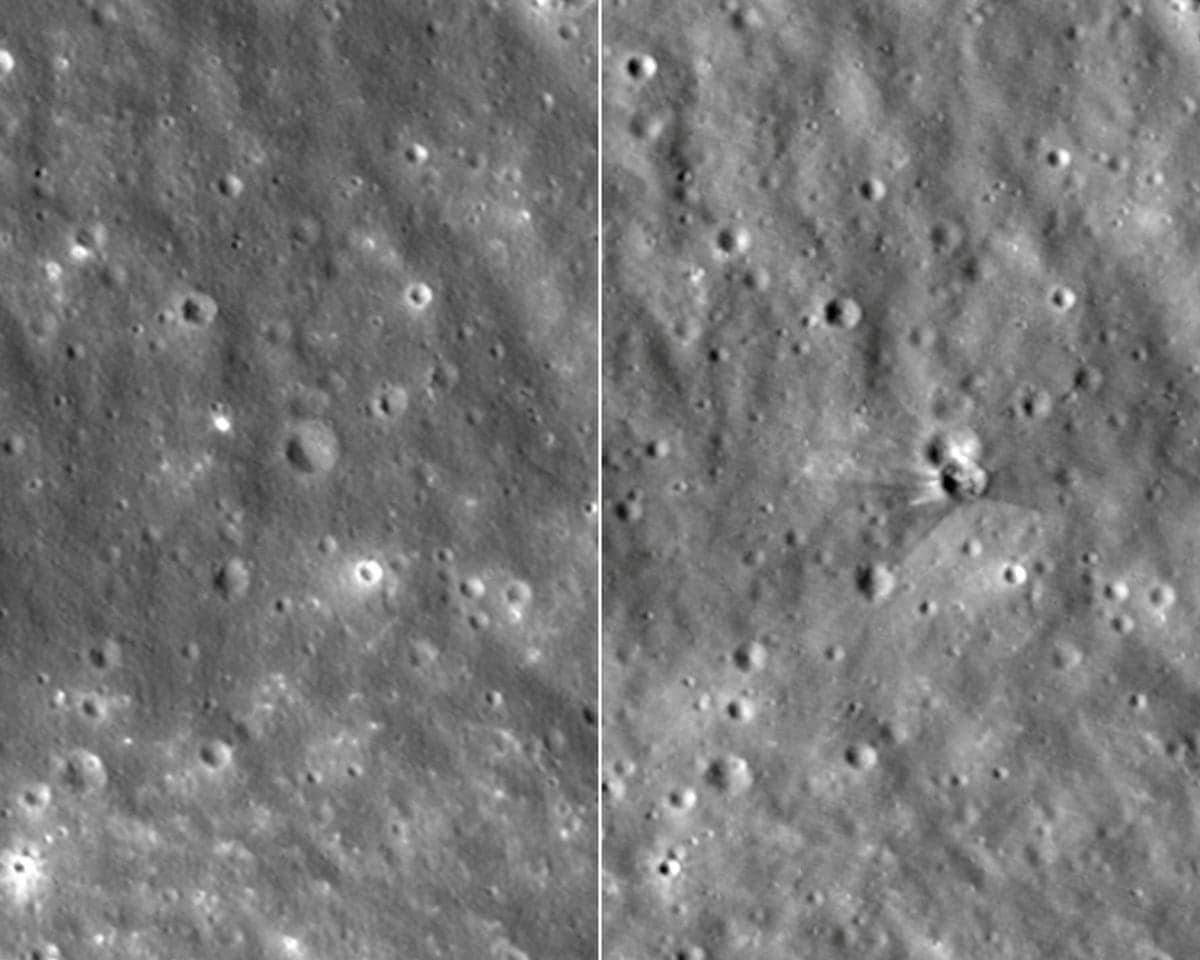
A derelict SpaceX Falcon 9 rocket upper stage collided with the lunar surface on 5 August 2026, creating a fresh impact crater near Einstein Crater. The collision occurred at approximately 02:35 ET, with the discarded booster—catalogued as 2025-010D—striking the moon after drifting for months following its original mission to deliver lunar landers. According to NASA's Lunar Reconnaissance Orbiter imaging, the impact left a visible scar approximately 60 feet wide, with preprint estimates suggesting a crater between 65 and 90 feet across.
The scientific community initially celebrated the event. Astronomers detected the debris plume through telescopes in Chile, and researchers gained a rare dataset from an accidental lunar impact. Yet Moriba Jah, a professor of aerospace engineering at the University of Texas at Austin and MacArthur fellow, argues the crater represents something far more troubling than a scientific curiosity: evidence of an industry treating the moon—and space itself—as a dumping ground without accountability.
"It's what you get when an entire industry treats the sky, and now the moon, as a place to dump what it no longer wants, and calls the dumping 'normal operations' or 'space exploration',"Jah writes. The impact, he contends, is not an isolated incident but a symptom of deeper systemic entitlement within the spacefaring industry.
Why did the rocket hit the moon?
SpaceX did not deliberately target the moon. The Falcon 9 upper stage completed its assigned task of delivering lunar landers in 2025, after which it was left in orbit. The curvature of spacetime and solar radiation pressure gradually altered its trajectory over months, steering it toward an inevitable collision with lunar terrain. According to SpaceX's statement to media outlets, the company was working with NASA on disposal solutions and aimed to be responsible with hardware left in space. However, the company also noted that controlled disposal maneuvers are not always feasible for high-energy lunar transfer missions.
The impact velocity reached approximately 5,400 miles per hour, or 8,700 kilometers per hour. Yet Jah's central argument is that SpaceX possessed the technical capability and financial resources to prevent the collision through deliberate deorbit planning—and chose not to.
"SpaceX didn't choose to hit the moon. But it did not prevent the collision, which, in an industry with the money and the trajectory software to do otherwise, is probably a choice all the same."
Is this the first time a rocket has hit the moon?
No. Rocket bodies have struck the lunar surface before, in 2022 and earlier, yet each incident has been treated as a curiosity rather than as evidence of a pattern. This repetition troubles Jah most deeply. The pattern reveals not carelessness but entitlement—the deliberate choice to abandon hardware in space because nobody with enforcement power has stopped the practice.

The broader context of orbital debris underscores the scale of the problem. Low Earth orbit now contains tens of thousands of tracked fragments and countless smaller pieces, accumulated over 60 years of launches that prioritized mission success over disposal planning. Starlink alone operates more active satellites than all other global operators combined, and the constellation continues to expand.
"We built that congestion through a very specific kind of confidence (AKA hubris): the belief that space is big enough to absorb whatever we throw into it, forever, without a bill ever coming due."Researchers estimate the moon is now littered with roughly 3,000 human-made objects, a figure that will accelerate as planned missions increase.
What makes the moon different from Earth's oceans?
The moon cannot defend itself. Unlike Earth's oceans and atmosphere, which possess natural processes to disperse or break down pollutants, the lunar surface has no air to burn up debris and no tides to wash it away. Whatever humanity deposits there remains essentially permanent. Bags of astronaut waste from the Apollo program still sit on the lunar surface decades later, silent testimony to the permanence of lunar abandonment.
Jah frames this as a colonial instinct dressed in aerospace engineering.
"Take what you want, leave what you don't, and let someone else, or something else, absorb the cost."The distinction between stewardship and ownership is crucial to his argument. Stewardship asks what we owe a place; ownership asks what we can extract before anyone stops us. Currently, ownership is winning by default because no authority with sufficient power has claimed the alternative.
What does international law say about the moon?
The 1967 Outer Space Treaty explicitly prohibits any nation or company from claiming ownership of the moon. Yet legal prohibition has not prevented the behavior of ownership. Nations and companies act as though they own the moon, extracting value and leaving consequences for others to manage.
"Nobody owned the lands where Native Americans thrived either. The problem is that we are acting out ownership's oldest habits, extraction without accounting, expansion without consequence, on a body we all agreed, on paper, to hold in common."
Jah acknowledges that some progress is underway. Certain operators now design missions with deliberate deorbit plans, and international discussions about orbital debris mitigation are advancing, albeit slowly. SpaceX and NASA were reported to be discussing protocols to manage and prevent future uncontrolled lunar stage impacts. Some engineers are genuinely trying to do better. Yet isolated best practices do not constitute governance; they function as public relations for an industry that still lacks binding rules.
What happens next?
NASA stated there was no danger to Earth from the impact and indicated it would continue tracking the booster for training and scientific observation purposes. The space agency planned to observe the impact site with lunar orbiters to refine tracking techniques and gather scientific data. However, the window for preventing widespread lunar debris accumulation is narrowing. The coming decade will see more than one hundred planned lunar missions. Without new accountability frameworks,
"who hit it this time"could become a monthly headline rather than a rare event.
Jah's final argument is a call to choose stewardship over entitlement. The moon still looks as it has for billions of years. That window will not remain open indefinitely. The industry can build the tracking systems, disposal rules, and accountability mechanisms that genuine stewardship requires. Or it can continue the pattern established on 5 August 2026: watching something humanity built emerge from the darkness, strike a place humanity does not own as though it did, and call it a light show.
Key Facts
- The Falcon 9 upper stage (2025-010D) struck the lunar surface near Einstein Crater at 02:35 ET on 5 August 2026, creating a crater approximately 60 feet wide.
- The impact velocity reached roughly 5,400 miles per hour; the collision was predictable and computable months in advance.
- The moon now contains approximately 3,000 human-made objects, with over one hundred additional missions planned for the coming decade.
- The 1967 Outer Space Treaty prohibits national or corporate ownership of the moon, yet current practice mirrors colonial extraction without accountability.
- SpaceX stated it was working with NASA on disposal solutions, though the company noted that controlled deorbit maneuvers are not always feasible for all mission types.