

The Perseid meteor shower, widely regarded as the year's most spectacular, reaches its peak overnight on Wednesday, 12 August 2026, offering skywatchers across the UK a chance to see dozens of shooting stars streak across a dark, moonless sky. The display coincides with a deep partial solar eclipse visible earlier in the evening, giving stargazers two rare astronomical events within a matter of hours. Although the eclipse and the meteor shower are entirely unrelated phenomena, their overlap on the same night has been described by astronomers as an unusually fortunate coincidence.
Royal Astronomical Society Research Fellow Dr Becky Smethurst called the alignment of the two events "the perfect cosmic coincidence of events", adding that the Perseids represent "one of the best nights for astronomy all year".
For readers wanting a fuller picture of the eclipse itself, our earlier coverage set out why the West Country is expecting its most dramatic solar eclipse since 1999, with up to 95% of the Sun obscured in Cornwall and the Isles of Scilly. Further north, we also reported on Yorkshire's preparations for its biggest solar eclipse in almost 30 years, where up to 92% coverage is expected. A more detailed regional breakdown of viewing spots and timings across the country is available in our UK eclipse guide for 2026.
What causes the Perseid meteor shower?
The Perseids occur when Earth passes through a trail of debris shed by the comet 109P/Swift-Tuttle, a body with a solid core roughly 16 miles (26km) across. Because the comet takes about 133 years to complete a single orbit of the Sun, some of the material now burning up in the atmosphere may have been shed more than a century ago. Dr Smethurst likened the phenomenon to "the Universe's own cosmic clock in a way".
The meteors are visible worldwide and take their name from the constellation Perseus, from which they appear to radiate. Earlier this year, similarly favourable conditions were forecast for the Lyrid meteor shower's peak on 22 April, when clear skies and minimal moonlight allowed for surges of up to 100 meteors an hour — a reminder that the UK has already enjoyed one strong meteor display this year before the Perseids arrived.
When and where is the best time to watch?
The Perseids have been active since mid-July and, depending on the tracking source, will continue until either 23 or 24 August 2026, though on most nights only a handful of meteors appear each hour. Activity intensifies sharply around the peak, which falls in the early hours between midnight and dawn on 12 and 13 August. According to the American Meteor Society, the shower is being tracked as active from 17 July to 24 August 2026, with the peak expected overnight between 12 and 13 August, while NASA similarly places the peak on the night of 12 August through the morning of 13 August, noting that the nights either side also offer good viewing.

The Royal Observatory Greenwich forecasts a predicted maximum rate of up to 150 meteors per hour this year, considerably higher than the "more than 100" figure often cited for a strong Perseid night, and recommends watching between midnight and 5:30am for the best results. The International Meteor Organization has pinpointed the precise predicted moment of maximum activity as 14:53 UTC on 13 August 2026.
Observers are advised to find a location away from cities and artificial lighting, since light pollution masks all but the brightest meteors. This year's peak coincides with a new moon, meaning there will be no bright moonlight to wash out fainter meteors — a point echoed by weather.com's coverage, which describes 2026 as offering near-ideal, largely moonless viewing conditions. Skywatchers should allow their eyes 20 to 30 minutes to adjust to the dark and look towards the widest unobstructed stretch of sky available.
What is the night-sky forecast for Wednesday?
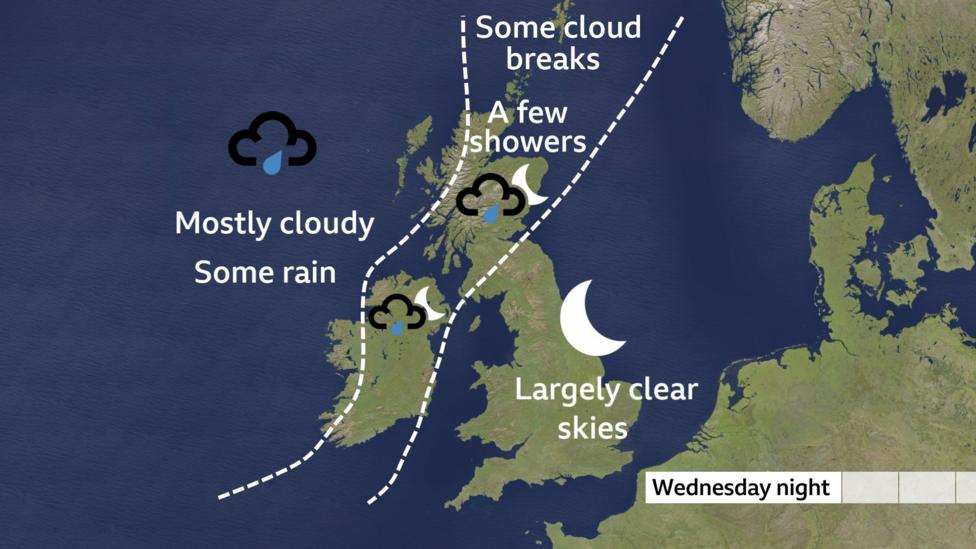
Much of England and Wales should see largely clear skies through the night, with only a slim chance of patchy mist. Those hoping to watch from the far north of England, Northern Ireland or much of Scotland may need more patience, as cloud is expected to break only intermittently, with large areas of cover and a slight risk of showers at times. In north-west Scotland in particular, an early night may prove the more sensible option, as cloud cover is likely to obscure much of the display.
Could a meteor be visible during the eclipse itself?
During a solar eclipse, the sky briefly darkens, theoretically opening a short window in which a meteor could also be spotted. However, this effect would only be pronounced in areas experiencing a total eclipse, such as parts of Spain, rather than the partial eclipse expected across the UK. Even under those more favourable conditions, Dr Smethurst cautioned that the odds remain very low.
"You would have to get very, very lucky to see a shooting star during the total eclipse," Dr Smethurst said.
Anyone viewing the eclipse is reminded that certified solar glasses must be used at all times, since looking directly at the Sun without proper eye protection can cause permanent eye damage.
What happens next?
Beyond the 12–13 August peak, the Perseids will continue to be observable at reduced rates into late August, with the American Meteor Society tracking activity through to 24 August 2026. EarthSky notes that the mornings of 12 and 13 August remain the best opportunities, with meteor rates falling away quickly once the peak has passed. NASA confirms that the strongest activity is still expected during the pre-dawn hours across the peak nights, giving early risers the best chance of a memorable display.
Key Facts
- Peak viewing window: midnight to dawn on 12–13 August 2026, with the predicted moment of maximum at 14:53 UTC on 13 August.
- Potential rates of up to 150 meteors per hour, according to the Royal Observatory Greenwich, though earlier estimates suggested over 100 per hour.
- Caused by debris from Comet Swift-Tuttle, which orbits the Sun roughly every 133 years.
- 2026's peak coincides with a new moon, providing dark skies free of moonlight interference.
- Best conditions expected across England and Wales; more cloud and rain risk in Scotland, Northern Ireland and northern England.


