With many online orders not due to arrive until later in the week and shops across the country selling out of certified eclipse glasses, a large number of people hoping to watch Wednesday's partial solar eclipse may be left without proper eyewear. Fortunately, several simple household methods can let observers view the event safely without any specialist equipment.
The eclipse, which will be visible as a partial event across the UK on 12 August 2026, falls outside the path of totality but is still being described as the most significant solar eclipse to affect the country since 1999, when mainland Europe last experienced a total solar eclipse.
Demand for protective glasses has outstripped supply in recent days, with retailers from London to Cornwall reporting empty shelves ahead of the event. According to a report on the shortage of certified eclipse glasses, the eclipse is expected to obscure up to 90% of the Sun in some areas, making it the UK's biggest since 1999, and health officials have warned against improvising with unsafe alternatives.
The risks of getting it wrong are real. One man who was partially blinded after watching the 1999 eclipse without proper protection is now urging people to take precautions this time, warning that experts say even brief unprotected viewing during a partial phase can cause lasting eye damage.
Why can't I just use sunglasses instead?
Ordinary sunglasses or dark goggles do not provide enough protection against ultraviolet light when looking directly at the Sun, and using them instead of certified filters risks serious and permanent damage to eyesight, according to the Royal Astronomical Society. The organisation stresses that under no circumstances should anyone look directly at the Sun without equipment specifically designed for solar viewing.
This warning is echoed by wider safety guidance on eclipse viewing. Nasa states that the only safe way to observe the Sun without a certified filter is through indirect projection methods, since looking directly at any visible portion of the Sun during a non-total phase is never safe, according to Nasa's eclipse safety guidance. Separately, the National Park Service has said it is never safe to view the Sun without a solar filter during partial or annular phases, according to the National Park Service's eclipse safety advice.
How can I make a pinhole projector at home?
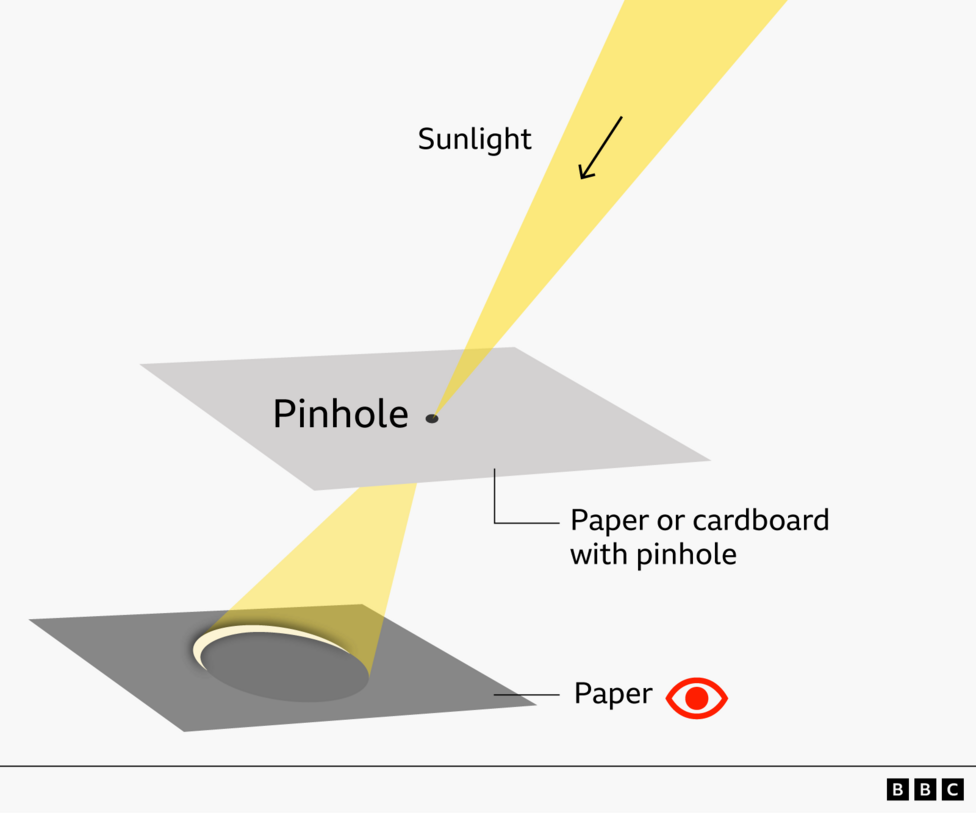
A pinhole projector can be made using little more than a piece of card, a sheet of paper and a pen, according to the Royal Astronomical Society. A small hole is pushed through the centre of the card using the tip of a ballpoint pen, then, holding the card in one hand and a blank sheet of paper in the other, the viewer stands with their back to the Sun and lines up the card so that a projected image of the Sun appears on the paper below.
This method effectively recreates the eclipse in miniature, showing the shadow of the Moon crossing the Sun as it is projected onto the paper. Nasa's own guidance describes a similar pinhole projector technique, along with a pinhole viewer box, as safe indirect ways to observe the event, according to Nasa's eclipse viewing safety page.
What about using a kitchen colander?
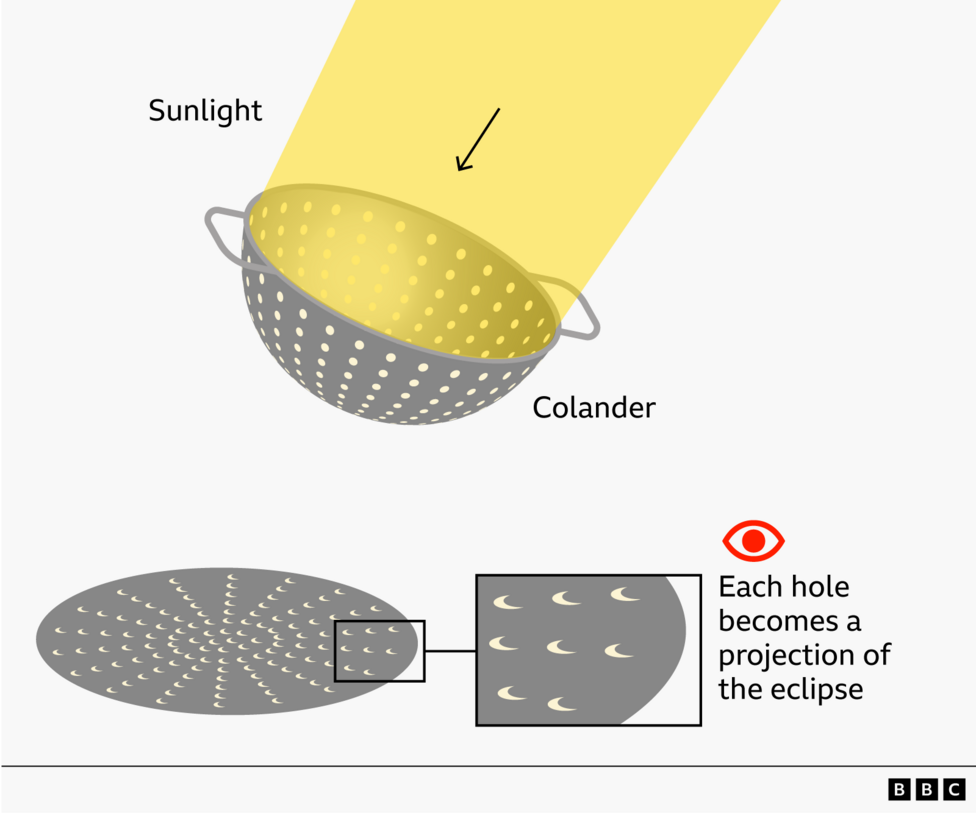
A colander can achieve a similar effect to the card-and-pen projector, and produces a far more striking result. David Jones, a consultant ophthalmologist at the Royal Cornwall Hospital Trust, has described it as his preferred method for watching an eclipse safely.
"If you hold the colander to the Sun and you look away from the Sun, protecting your eyes, you can make not just one picture of the Sun but a hundred all at once."
In a demonstration shared on social media, Mr Jones held a blank sheet of paper behind a colander pointed towards the Sun, producing a kaleidoscope of small crescent-shaped images showing the eclipse in progress. The Royal Astronomical Society's own eclipse booklet confirms that a colander can be used in exactly this way, acting like dozens of pinhole projectors at once and producing multiple eclipse images on a single sheet of paper, according to the society's eclipse safety booklet.
How do I build a pinhole viewer box?
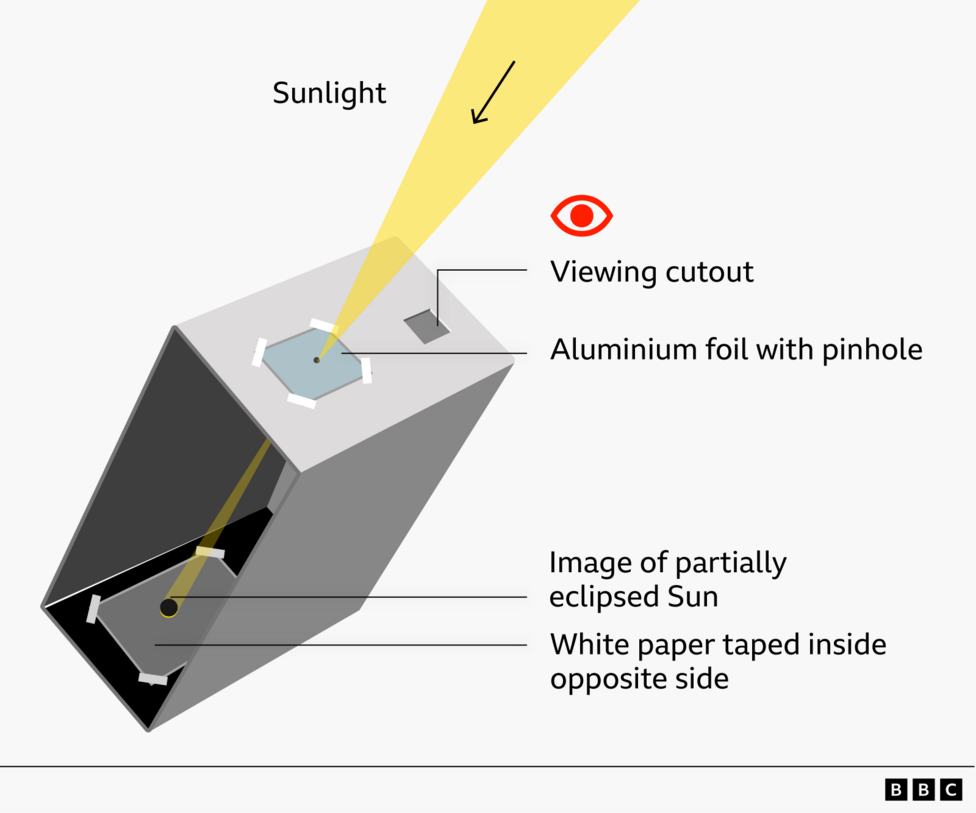
An empty cereal box can be turned into a pinhole viewer, which works on the same principle as the card projector but tends to produce a clearer image, since the box blocks out surrounding daylight and lets in only the light travelling from the direction of the Sun.
To make one, a piece of paper is cut to fit the bottom of the box and taped inside to act as a screen. The box is then closed and taped shut, before two small squares are cut into the top: one left open so the viewer can see the screen inside, and the other covered with a piece of foil with a single pinhole made using a pin or needle.
Standing with their back to the Sun, the viewer looks through the open square with one eye and lines up the foil's pinhole with the Sun until an image appears on the paper screen inside. Guidance from the Exploratorium science museum suggests using a longer box or tube for a sharper image, and recommends fitting white paper at the viewing end to improve the quality of the projection, according to the Exploratorium's eclipse viewing guide.
Can I just film it on my phone instead?
Pointing a mobile phone camera directly at the Sun is not recommended, according to Nasa, which warns that doing so without protection risks damaging the phone's sensors as well as the viewer's eyes if they glance at the Sun to line up the shot.
"To take images when the Sun is partially eclipsed, you'll need to use a special solar filter to protect your camera, just as you'll need a pair of solar viewing glasses (also called eclipse glasses) to protect your eyes."
"This is especially true if you're using any sort of magnifying lens attachment on the phone."
Where and when will the eclipse be visible in the UK?
The partial eclipse will become visible across the UK and mainland Europe in the evening of 12 August 2026, meaning it will sit low in the sky. The Royal Astronomical Society recommends finding an elevated spot with a clear, unobstructed view of the western horizon for the best chance of seeing it.
Regional viewing has already been arranged in some parts of the country. According to a report on eclipse-watching events in the South West and Channel Islands, astronomy groups in the area are holding free and ticketed gatherings to help residents observe the deepest partial eclipse the UK has seen since 1999. A separate UK-wide eclipse viewing guide notes that coverage could reach as high as 96% in some regions, with additional detail on viewing spots in North West England and updated timings for the day.
What happens after Wednesday's eclipse?
Once the 12 August 2026 eclipse has passed, attention is likely to turn to future sky events, though no further UK eclipse dates were included in current guidance. In the meantime, astronomy groups and local events organised around the country are expected to continue offering supervised, safe viewing opportunities for anyone without their own certified glasses.
Key Facts
- The UK will see a partial solar eclipse on 12 August 2026, its most significant since 1999.
- Certified eclipse glasses have sold out at many retailers, prompting warnings against unsafe alternatives.
- Safe household viewing methods include a pinhole projector, a kitchen colander and a cardboard pinhole viewer box.
- Experts including Nasa and the Royal Astronomical Society warn against looking directly at the Sun or using ordinary sunglasses.
- The eclipse will appear low in the sky during the evening, so an elevated spot with a clear western horizon is recommended.