The Singapore Grand Prix has been designated a heat-hazard race, marking the second consecutive weekend with this official status and the fourth occurrence during the 2026 Formula 1 season. The designation permits teams to equip their vehicles with cooling apparatus that circulates liquid through a vest worn by drivers to regulate cockpit temperatures during competition.
A heat-hazard classification is granted when forecasts indicate temperatures will surpass 31 degrees Celsius at any point during racing. According to local reporting, the FIA's heat-hazard rules apply to both the sprint and the Grand Prix following the official forecast, with race director Rui Marques issuing the notice under Article B1.5.10 of the regulations. This protocol was first introduced in 2025.
Singapore's position near the equator has established it as one of motorsport's most physically demanding venues for competitors. During the 2024 event, George Russell and Lewis Hamilton both required medical attention for heat exhaustion following the race. Ambient temperatures in the city typically range between 31 and 33 degrees Celsius throughout the race weekend, accompanied by elevated humidity and daily precipitation risk. Even after the event begins in the evening, temperatures remain around 30 degrees Celsius.
The cooling system is optional rather than compulsory. Drivers who decline to use it must carry 5 kilograms of ballast in their vehicle to prevent any competitive advantage. The apparatus comprises a cooling tank and pump—typically positioned in the car's nose—that delivers chilled liquid, commonly glycol, through a network of tubes integrated into a fireproof top worn beneath driver overalls.
Why some teams reject the cooling system
Several teams and drivers choose not to deploy the cooling technology due to significant practical limitations. Maintaining liquid at sufficiently low temperatures throughout an entire race presents a substantial engineering challenge, a difficulty magnified in Singapore because it hosts the season's longest race distance. Additionally, some drivers find the cooling top restrictive and uncomfortable within the confined cockpit environment.
When the liquid cannot maintain adequate coolness, it warms to vehicle temperature, which substantially exceeds ambient conditions. Cockpit temperatures in Formula 1 cars frequently exceed 40 degrees Celsius. Mercedes has opted against implementing the system, instead prioritising the resources toward vehicle performance development. Mercedes deputy team principal Bradley Lord stated:
We didn't believe that allowance was sufficient for us to be able to develop a solution that would be robust enough to last for the entire race.
The FIA has established cost-cap allowances to incentivise development: $50,000 (£38,000) for teams capable of maintaining liquid coolness throughout a complete grand prix, and an additional $75,000 (£57,000) for those achieving comfort improvements to the cooling top. Lord characterised this allowance as
small, reflecting Mercedes' assessment that the financial provision was inadequate for their engineering objectives.
How does Singapore's heat compare to other venues?
Singapore joins the Austrian, Italian, and Malaysian-hosted Bahrain Grand Prix in receiving heat-hazard designation during 2026. The heat-hazard protocol itself emerged from extreme conditions experienced at previous events. According to racing analysis, the FIA's heat-hazard protocol traces back to the 2023 Qatar Grand Prix, where cockpit temperatures exceeded 50 degrees Celsius, leading to Logan Sargeant's retirement due to dehydration and Alex Albon's hospitalisation.
What additional challenges face drivers this year?
Beyond extreme heat, Singapore faces an additional environmental concern. According to official reports, haze is affecting the city, with the Pollutant Standards Index ranging between 108 and 154 across Singapore at 1 p.m. on 8 October. Race organisers have established contingency measures including N95 masks if conditions deteriorate further. The FIA stated that current haze conditions pose no risk to the event's execution, though worsening air quality could potentially restrict outdoor activities.
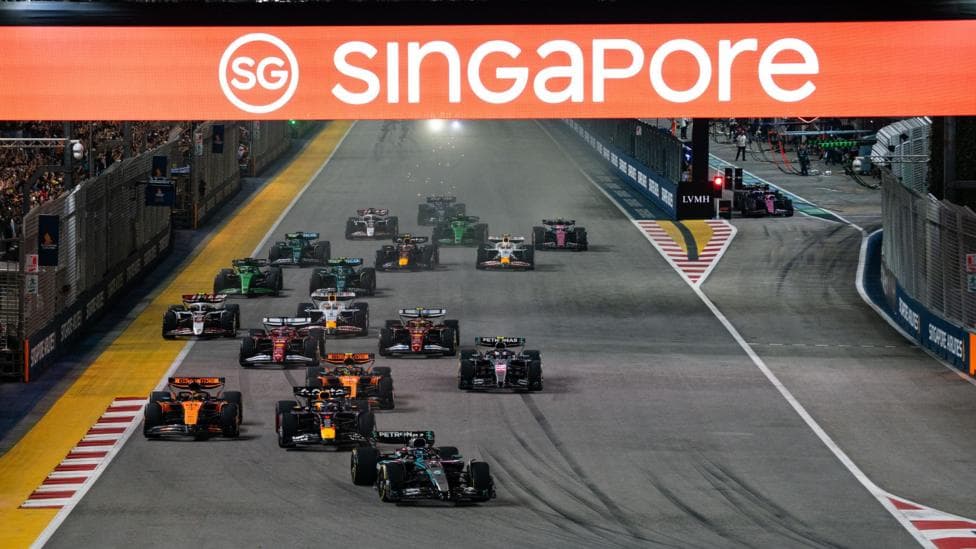
The 2026 Singapore weekend introduces a sprint format for the first time, adding an additional competitive session to the traditional Grand Prix structure and intensifying the physical demands on drivers across two racing days.
What happens next
The sprint is scheduled for 10 October and the Grand Prix for 11 October. Following Singapore, the championship moves to the United States Grand Prix in Austin, scheduled for 23–25 October.
Key Facts
- Heat-hazard status has been declared four times during the 2026 season, with Singapore marking the second consecutive weekend with this designation
- Cooling vests are optional; drivers declining them must carry 5 kg ballast to maintain competitive parity
- Singapore hosts the season's longest race distance, complicating efforts to maintain cooling-liquid temperature throughout competition
- The heat-hazard protocol originated following the 2023 Qatar Grand Prix, where cockpit temperatures exceeded 50°C and caused driver medical emergencies
- Air quality concerns from haze add to heat challenges, though organisers and the FIA have confirmed no impact on race operations