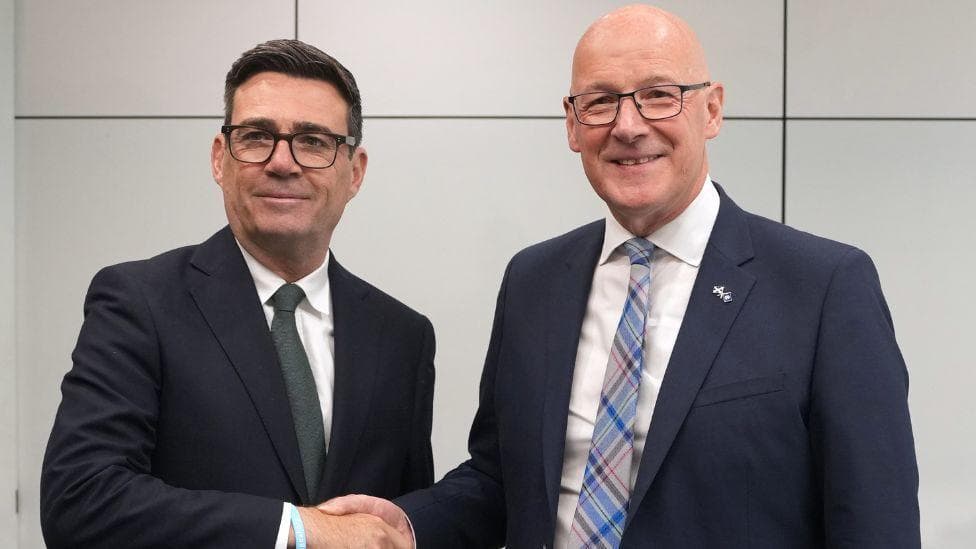
First Minister John Swinney has expressed serious doubts about whether the United Kingdom possesses adequate defences against potential Russian military activity, particularly in waters surrounding Scotland. The SNP leader criticised the UK government's defensive posture and said he was deeply concerned by security warnings issued this week by MI5 chief Sir Ken McCallum, who identified Russia as the nation's primary adversary.
Speaking to a national broadcaster ahead of the SNP's annual conference, Swinney highlighted what he described as a critical "lack of coastal and offshore protection" in vulnerable areas off Scotland's coast. He specifically named waters north of Shetland as a zone experiencing significant Russian activity, arguing that the UK's military presence there falls far short of what is required in the current security environment.
"I don't think we've got nearly the presence in those areas that we require today," Swinney told the broadcaster. "There's an obligation on the United Kingdom government to make sure that the country is safe. And I don't think the defence posture of the United Kingdom enables me to have that confidence."
McCallum's recent assessment of the threat landscape has taken on heightened significance given the escalating pattern of Russian activity. According to MI5's latest threat analysis, state-threat cases have quadrupled over the past decade, with the intelligence agency now dedicating more resources to countering state threats than it did during the Cold War. The spy chief cited concrete examples of Russian hybrid warfare tactics, including a cyberattack on Polish energy infrastructure and an attempted drone attack on a cargo plane in Germany.
The deterioration in Russia's military position has forced Moscow to adopt increasingly unconventional tactics. According to intelligence reports, more than 1,000 Russian officials have been expelled from embassies since Russia's full-scale invasion of Ukraine began in February 2022, leaving the Kremlin more dependent on local volunteers and criminal proxies to conduct operations abroad. This shift reflects Moscow's constrained resources and limited military progress in Ukraine, which security analysts link directly to the rise in alleged hybrid threats targeting Britain and its allies.
Does independence weaken Scotland's security?
Swinney firmly rejected suggestions that Scottish independence would compromise the nation's defence capabilities. Instead, he argued that separation from the UK would grant Scotland "more choices" in how it approaches security and defence partnerships. The First Minister emphasised his long-standing commitment to international defence cooperation, pointing to examples such as Canada's participation in the EU's SAFE defence programme as a model for how independent nations can maintain robust security arrangements.
Scotland currently hosts the UK's nuclear submarine fleet at Faslane, west of Glasgow. While the SNP opposes the presence of nuclear weapons on Scottish soil and has campaigned for their removal, the party supports an independent Scotland joining NATO, which would provide security guarantees through the alliance's collective defence framework.
UK government's defence commitment
Prime Minister Andy Burnham has stated that his government remains committed to investing substantially in defence capabilities, including maintaining the nuclear deterrent, while avoiding actions that might escalate tensions with Russia. During a speech at the UN General Assembly last month, Burnham outlined his administration's approach to security, saying:
"We will invest in defence and build up the UK's hard power and deterrence. But we will not play Russia's game of trading escalatory rhetoric. Unlike Russia, we do not seek confrontation."
SNP conference and political context
Swinney's remarks come as the SNP prepares to hold its 92nd annual conference in Aberdeen from 15 to 17 October 2026 at P&J Live. The gathering will see party members debate a range of policy issues, with Swinney delivering his keynote address on Saturday afternoon. Burnham has also chosen this weekend to visit Scotland, planning to travel to the central belt to discuss devolution proposals aimed at transferring power to local communities. Swinney said the Prime Minister had not yet confirmed his attendance at the SNP conference, though the First Minister had extended an invitation.
Independence campaign and referendum prospects
Ahead of the conference, the SNP announced the launch of a new independence campaign featuring a national day of action, digital and broadcast advertising, and an independence survey to be delivered to nearly 1.5 million households. The Scottish government is targeting 2031 as the date for holding a second independence referendum, though the UK Supreme Court has ruled that such a vote can only proceed with Westminster's consent.
Swinney has pointed to the record number of pro-independence MSPs elected to the Scottish Parliament in May as evidence of public support for another referendum. However, the proportion of votes cast for pro-independence parties fell from approximately 50 per cent in 2021 to around 41 per cent in the most recent election, complicating the SNP's case for an imminent vote.
Burnham stated in the House of Commons last month that a second referendum could be held once a clear consensus emerged and public opinion had shifted decisively. He later qualified this position by insisting that no such consensus currently exists, describing a second referendum as remaining "off limits" for the foreseeable future. In a speech to the Labour Party conference, Burnham made a pointed reference to Swinney, declaring himself "utterly determined" to prove the SNP leader wrong in his prediction that Burnham would be the last Prime Minister of the United Kingdom.
The First Minister has also seized on Burnham's recent willingness to reopen the question of Britain's relationship with the European Union as a precedent. Swinney told the broadcaster:
"I think it's an interesting precedent that if we can reopen an issue that's been decided by a referendum, then we can also reopen Scottish independence."Burnham had announced plans to secure improved trade terms with the EU for Scottish producers of salmon, shellfish, and seed potatoes, and has indicated openness to discussing even closer ties with the bloc without ruling out a future referendum on rejoining.
NHS winter preparedness concerns
During the same interview, Swinney was pressed on the Scottish National Health Service's readiness for winter pressures. Dr Fiona Hunter, vice-chair of the Royal College of Emergency Medicine in Scotland, had warned of "unsafe levels of care" and a "toxic normalisation" of corridor care in hospitals, telling the broadcaster she was "completely terrified" of the approaching winter season.
The First Minister acknowledged the gravity of these concerns, saying he could "hear, understand and appreciate" the challenges facing the health system. He confirmed that the Scottish government recognised "significant challenges" within the NHS but stated that hospital flow plans had been designed to reduce pressures and that officials intended to eliminate corridor care "at the earliest possible opportunity".