

A Lancashire mother who runs a free school uniform exchange has said she doubts a new legal limit on branded uniform items will meaningfully reduce what families spend, arguing that peer pressure will push parents to buy branded items anyway. Michaela Wilson, who founded the Pendle In And Out Of School Clothes Project in Colne four years ago, made the comments ahead of the rule change taking effect at the start of the new school year in September.
From September 2026, schools in England will be restricted to requiring no more than three branded uniform items, such as a blazer, jumper or piece of sportswear, plus a tie, under changes the government says are designed to bring down costs for families.
Why does she doubt the new rules will help?
Wilson said the change amounts to a gesture rather than a genuine fix, and questioned why schools do not simply allow generic clothing with an attachable emblem instead of requiring branded garments outright.
"Schools could just say, 'you need a black jogging suit for PE' - and parents could buy a badge, iron it on, and there you go," she said.
She argued that children rarely want to be different from their classmates, meaning families will still end up buying full branded outfits even if only a handful of items are technically compulsory.
"Children don't want to pick one, or three items, for their school uniform - they want everything the same as their friends. They're going to want all of it matching. So when they go to school, it's not going to be just the three branded things, you're going to have to fork out for the full items."
"They [pupils] just want to be the same as everybody else. They don't want to stand out and run around in a pair of Asda shorts if everybody else has got the school emblem ones."
She added that sports kit is a particular pressure point, since children involved in team activities often feel compelled to match their peers exactly.
"They want the full rugby kit if they're playing rugby, they need the football boots, they need the branded football socks if they're playing in the team - and it all adds up."
What is the Pendle project and how does it work?
Wilson set up the community clothing bank at Colne Market four years ago to give struggling families free access to school uniform and children's clothing, without any formal application process.
She said the scheme began as a short-term measure over one summer but has continued ever since, with donations arriving steadily at the end of each school term.

"It was just going to be a temporary thing over the summer, and four years later we're still at it."
"At the end of term I get loads and loads of bags. We've got a small space that we've been given by the local council, and we just hang it all up, nice and neat and tidy, and people are welcome to come and fill a bag with whatever they want. It's all free."
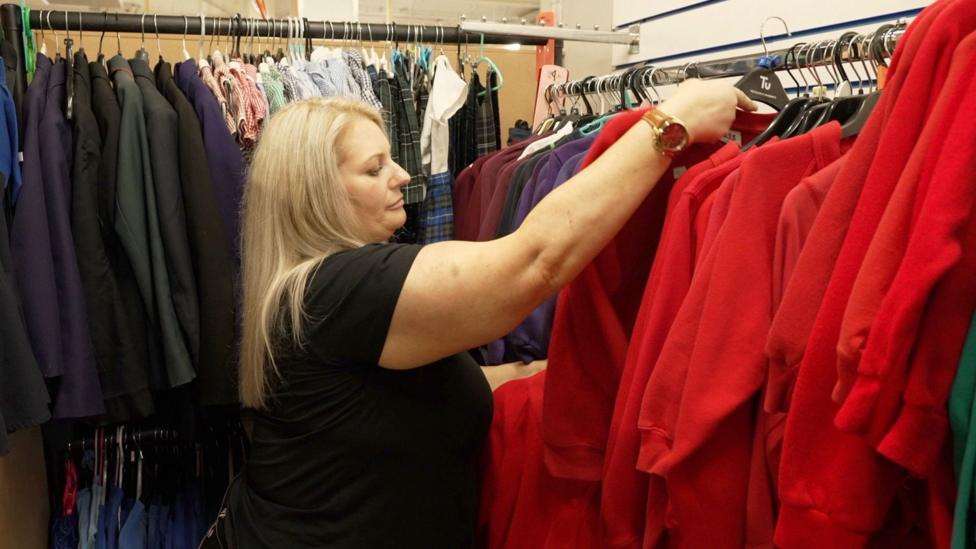
Wilson described the project as a significant recycling effort, allowing families to pass on outgrown uniform and pick up the next size along, rather than sending it to waste.
"All that school uniform would end up in landfill otherwise."
Similar community responses have emerged elsewhere in England as the September deadline approaches. In Peterborough, more than 600 people queued at a uniform swap shop for free second-hand clothing, an event organisers are now considering repeating regularly, according to earlier coverage of the Peterborough swap shop. In Devon, two mothers launched a similar free exchange in Tavistock, as detailed in a report on the Tavistock uniform swap. Separately, a Hull secondary school has introduced pre-term uniform approval sessions using green stickers to confirm compliant items before the new rules take hold, as covered in coverage of uniform checks at Sirius Academy West.
Is the stigma around second-hand uniform disappearing?
Wilson said attitudes towards reused clothing have shifted noticeably, particularly among younger people.
"Teenagers, even more than adults, have embraced the whole second-hand culture. We get teenagers coming and getting their own uniform."
How much could families actually save?
According to the Department for Education, average total spending on school uniform in the 2023-24 school year was just under £250, with PE kit alone costing approximately £140. A government spokesperson said some families could save up to £50 per child once the new three-item limit takes effect, and that the government is supporting schools to take further steps to reduce the cost of individual uniform items.
Government guidance on the policy states that secondary and middle schools will be permitted to require up to four compulsory branded items where one of them is a tie, while primary schools remain capped at three branded items, according to official government guidance on school uniform costs. Separate government analysis estimates the changes will save families around £73 million per year in total and benefit approximately 4.2 million children nationwide, according to a government announcement on uniform cost savings. More recent departmental figures put the average full uniform and PE kit cost at £442 for a secondary school pupil and £343 for a primary school pupil, according to a national broadcaster's report on uniform costs. Our earlier coverage of the policy is available in a breakdown of potential savings from the new uniform cap.
What happens next?
The uniform limit is being introduced through the government's Children's Wellbeing and Schools Bill, which was still progressing through the House of Lords at the time the policy was announced, according to the government's announcement on the legislation. The bill builds on statutory guidance first introduced in 2021, which already required schools to keep uniform costs reasonable and to limit branded items where possible, according to earlier reporting on 2021 uniform cost guidance. Parliament's own briefing describes the broader reform as an effort to allow more generic clothing items and prevent schools from unnecessarily restricting where parents can buy uniform, according to a parliamentary research briefing on uniform costs. The new limits are due to take effect in September 2026, though the Children's Wellbeing and Schools Bill must still complete its full passage through Parliament before the changes are formally enacted in law.
Key Facts
- From September 2026, English schools will be limited to three branded uniform items, or four including a tie for secondary and middle schools.
- Michaela Wilson's free uniform exchange in Colne has operated for four years since being set up as a temporary summer measure.
- The Department for Education says average uniform spending was just under £250 in 2023-24, with PE kit costing around £140.
- Government estimates suggest the changes could save families roughly £73 million a year and benefit about 4.2 million children.
- The policy is being delivered through the Children's Wellbeing and Schools Bill, which had not yet completed its parliamentary passage.


