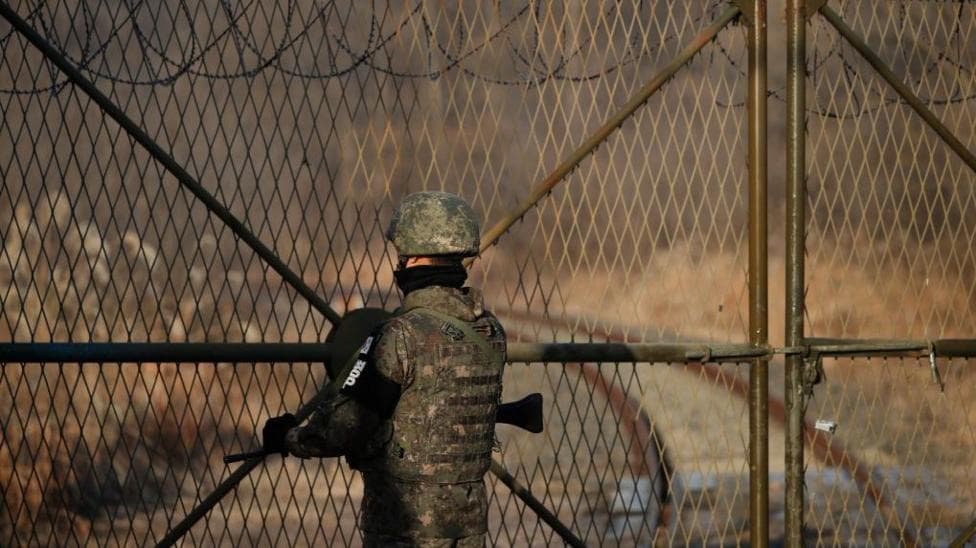
Three South Korean military personnel sustained injuries from mine explosions in the Demilitarised Zone (DMZ) on 21 September, triggering a sharp diplomatic confrontation between Seoul and Pyongyang over responsibility for the incident.
South Korea's military demanded an apology from North Korea on Tuesday, asserting that landmine detonations along their shared border violated a 1953 armistice agreement that ended active combat in the Korean War. The blasts occurred on the South Korean side of the DMZ, a 4-kilometre-wide buffer zone containing the Military Demarcation Line that marks the land border between the two nations.
Investigators discovered that two mines detonated approximately 10 metres south of the Military Demarcation Line, with one of the three injured officers losing his foot. A third unexploded mine was also recovered at the site.
What evidence points to North Korean responsibility?
South Korea stated that the blasts were "highly likely" caused by North Korean mines planted to fortify the border. The United Nations Command, which conducted joint on-site investigations with the South Korean military, confirmed that investigators identified an active North Korean anti-personnel mine on the South Korean side of the Military Demarcation Line. According to the Joint Chiefs of Staff, the mines used TNT but lacked metal fragments, a characteristic distinguishing them from South Korean mines.
South Korean Defence Minister Kang Shin-chul characterised the blasts as a "clear" violation of the 1953 armistice. In a statement on Wednesday, Seoul called for North Korea to apologise and cease fortification activities along the border immediately.
How has North Korea responded?
Pyongyang has categorically denied involvement, dismissing Seoul's accusations as "groundless" and a "farce" designed to escalate tensions. Kim Yo Jong, the influential sister of North Korean leader Kim Jong Un, accused South Korea of "cooking up" the claims for "political and military provocation".
Kim denied suggestions that North Korean had crossed the border to plant the mines, calling it "a deliberate and planned strained assertion to shift the responsibility for escalating tension" to North Korea.
In her statement published in state media on Wednesday, Kim also warned the South to be "prepared for paying price for the farce of their own making." She referenced a 2015 incident in which two South Korean soldiers were maimed by landmines while patrolling the DMZ, claiming Seoul had used that episode as a "pretext" to escalate tensions and was employing the same strategy now.
What is the historical context?
The 1953 armistice created the DMZ following the Korean War, establishing a demilitarised buffer zone between the two nations. Sporadic clashes and mine explosions have punctuated the decades since, though relations have deteriorated markedly since 2015.
The 2015 landmine incident resulted in South Korea accusing North Korea of secretly planting mines near a South Korean guard post—a claim Pyongyang denied at the time. That episode occurred during a period when the two Koreas maintained low-level communication channels that no longer exist today.
This deterioration in relations comes as South Korean President Lee Jae Myung has proposed formal talks with North Korea to end the technically ongoing Korean War, offering a security framework and renewed dialogue on denuclearisation.
What do analysts say about escalation risks?
Christopher Green, a senior consultant with Crisis Group, characterises the situation as increasingly precarious. He states that "The North Koreans have been wilfully attempting to harden the border [and] eliminate inter-Korean relations". As a result, he explains, the two Koreas no longer share the "same low-level communication" that existed in 2015.
"Accidental escalation on the Korean Peninsula is always just a few steps away, and it's fewer steps now than it was in 2015," he says.
The absence of established communication channels means that incidents like the September blasts carry heightened risk of unintended escalation, particularly given the mutual accusations and hardened positions on both sides.
What is the investigation status?
A joint investigation team comprising approximately 40 officials began searching the blast area on 27 September. Opposition lawmakers had called for transparency regarding the mine's origin and the investigation's methodology.
South Korea's military announced it would conduct further searches and publicly disclose the investigation's outcome. The final findings are expected to determine whether the mines were deliberately planted or had drifted across the border over time.
The United Nations Command said it would address the alleged violation of the 1953 armistice "through established Armistice mechanisms". In a statement, the UNC reaffirmed its commitment to "maintaining and enforcing the Armistice Agreement and fulfilling its responsibilities to preserve stability and prevent escalation on the Korean Peninsula."
Key Facts
- Three South Korean soldiers were injured on 21 September when mines detonated approximately 10 metres south of the Military Demarcation Line; one officer lost his foot.
- Investigators recovered a North Korean anti-personnel mine at the site, with TNT composition and no metal fragments—characteristics distinguishing it from South Korean mines.
- North Korea denies planting the mines and accuses South Korea of fabricating claims to escalate tensions.
- Communication channels between the two nations have deteriorated significantly since a similar 2015 incident, increasing the risk of unintended escalation.
- A joint investigation team of 40 officials is conducting further searches, with final findings expected to clarify whether the mines were deliberately planted or had drifted.