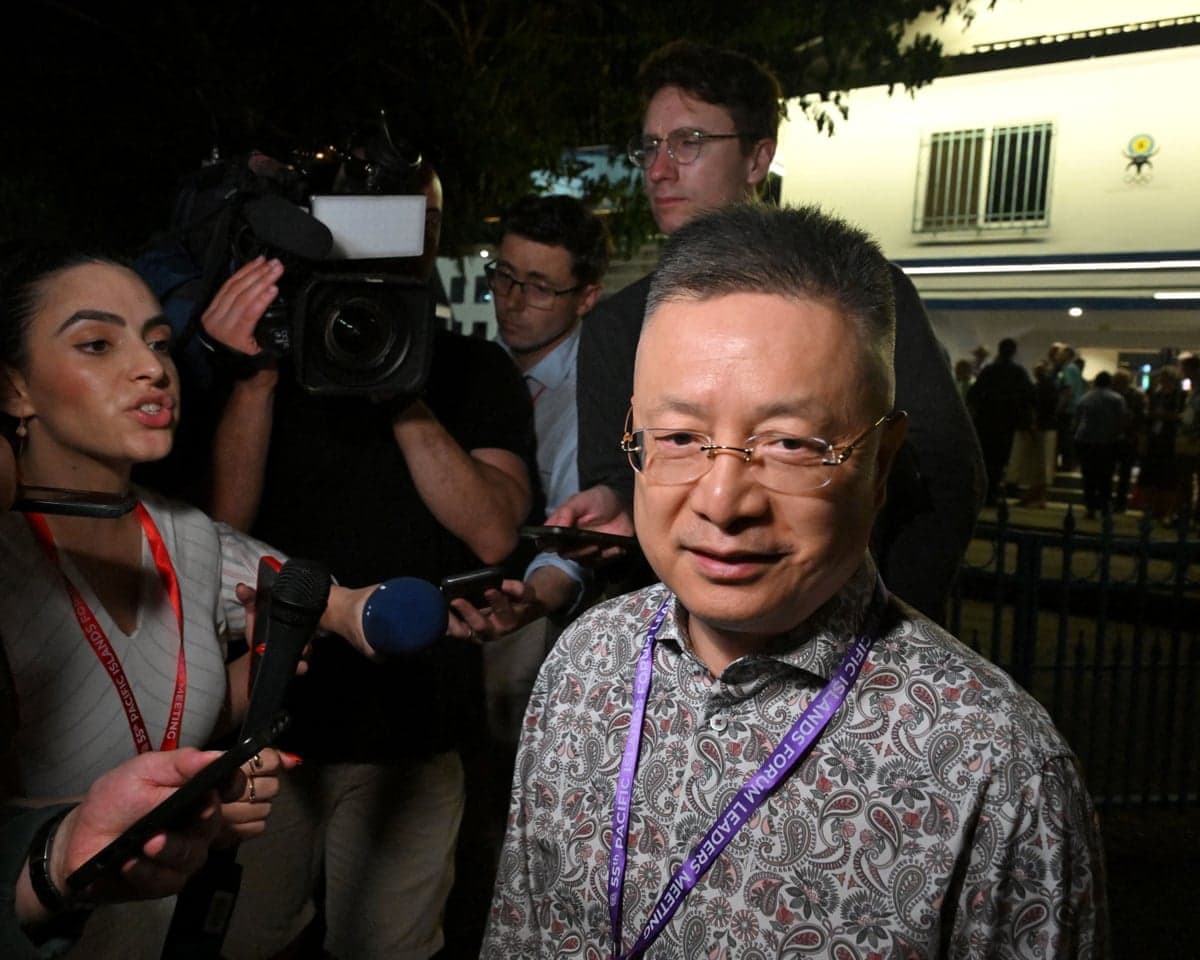
Beijing has warned of unspecified repercussions after Taiwan's foreign minister attended the opening ceremony of the Pacific Islands Forum Leaders' Meeting in Palau on 31 August 2026, intensifying China-Taiwan tensions at a gathering intended to project regional unity. The dispute has become a focal point of the summit, which runs through 4 September in Koror under the theme "B.E.L.A.U. — Building Economies: Life. Action. Unity."
Qian Bo, China's special envoy for Pacific island affairs, objected sharply to Taiwan's participation.
There will always be consequences,he said on 1 September, adding
It's not a threatwhile declining to elaborate on what those consequences might entail.
This is objected to by all, so this should not have happened. We think it's very inappropriate to do so,he told reporters after the opening ceremony.
China regards Taiwan as part of its own territory, and Beijing has made clear its displeasure with Taipei's role at the forum. According to , China had previously argued that Taiwan had "no qualifications" to take part in the gathering. Beijing indicated that Qian Bo would deliver a formal statement at the Pacific partners' dialogue on 2 September, signalling that China plans to pursue its objections beyond the opening-ceremony remarks.
Taiwan's foreign minister, Lin Chia-lung, was invited to participate in side events and bilateral meetings rather than as a formal dialogue partner.
Taiwan is honoured to serve as a partner in the Pacific, continuing to stand with everyone and work together to make the Pacific more prosperous and peaceful,he said on 1 September. According to , Taiwan's forum-related activities include the Taiwan/ROC-Forum Countries Dialogue and the Pacific Prosperity Exhibit. Taiwan holds development partner status with the forum, distinct from the formal dialogue partnership that China maintains. The forum recognises 21 dialogue partners in total, including the United States, European Union, Britain, Canada, India and Japan.
Who determines forum participation?
Australia and New Zealand have firmly rejected China's assertion that it should have a say in who attends the forum. Prime Minister Anthony Albanese stated that
The Pacific Islands Forum determines what happens here, not any other country.He characterised the gathering as
primarily a gathering of the Pacific familyand expressed his intention to focus on constructive engagement.
New Zealand's foreign minister, Winston Peters, reinforced this position by declaring that the forum does not take direction from countries outside its membership. The 18-member group comprises Australia, New Zealand and Pacific island nations.

How has China's influence shifted in the Pacific?
Beijing has systematically reduced the number of Pacific island states maintaining formal diplomatic relations with Taiwan. Only three nations now recognise Taipei: Palau, Tuvalu and the Marshall Islands. This erosion of Taiwan's diplomatic footprint reflects China's broader strategic push to isolate the island across the Indo-Pacific region.
This dispute occurs against a backdrop of intensifying great-power competition in the Pacific. Australia, New Zealand and the United States have long viewed the region as falling within their sphere of influence and have grown increasingly concerned about China's expanding military and economic presence. China's recent ballistic missile tests in the South Pacific have raised regional security concerns, prompting Australia and its partners to strengthen defence and development ties with island nations to deter any permanent Chinese military deployment.
In a sign of this coordinated effort, New Zealand and the United States announced on 2 September during the summit that they would jointly fund a major upgrade of a Second World War-era port facility on a Cook Islands atoll, underscoring their commitment to deepening infrastructure and security partnerships across the region.
Why are some Pacific leaders absent?
Several significant Pacific leaders did not attend the summit in person. The prime ministers of Fiji, Vanuatu, Samoa and Solomon Islands, as well as the president of Kiribati, sent ministers to represent their nations instead. This reduced attendance reflects broader political dynamics within the Pacific community, though the forum proceeded with its full agenda under the leadership of Palau President Surangel Whipps Jr.
What happens next?
The Pacific Islands Forum Leaders' Meeting and associated dialogue sessions are scheduled to continue through 4 September 2026. Taiwan's participation in forum-related events will extend throughout this period, meaning the China-Taiwan dispute is likely to remain a significant undercurrent of the summit as discussions progress on regional economic development, security cooperation and climate resilience.
Key Facts
- China's special envoy warned of unspecified "consequences" for Taiwan's attendance at the opening ceremony on 31 August 2026
- Australia and New Zealand rejected China's assertion that it should determine forum participation, affirming the forum's autonomy
- Taiwan holds development partner status and participated in side events and bilateral meetings, not as a formal dialogue partner
- Only three Pacific island nations—Palau, Tuvalu and the Marshall Islands—maintain formal diplomatic ties with Taiwan
- The summit runs through 4 September 2026 in Koror, Palau, under the theme "Building Economies: Life. Action. Unity."