

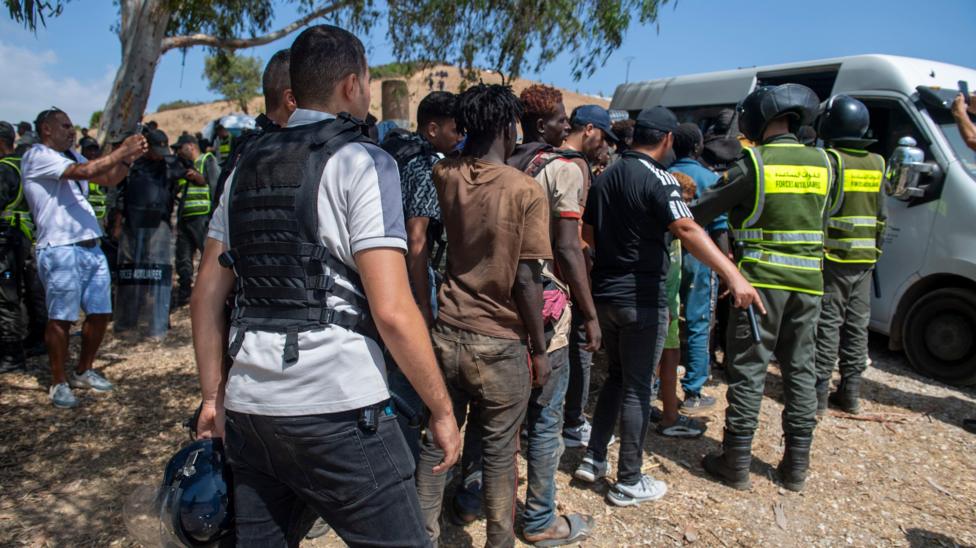
Moroccan authorities detained 111 people on Saturday, 9 August 2026, after intercepting a group attempting to reach the Spanish exclave of Ceuta near the town of Fnideq, according to security sources cited by Spanish media and a news agency. The operation came two weeks after roughly 78,000 migrants entered Ceuta by sea in a matter of hours, an event that left 100 people dead according to the city's mayor, who noted that most of those who arrived had since returned to Morocco.
Officials had braced for a repeat of that surge after unverified social media posts circulated calling for a fresh mass crossing over the weekend. Moroccan security sources said most of the 111 people detained near Fnideq — also known by its Spanish name, Castillejos, roughly 3km from the border — came from countries in sub-Saharan Africa.
Why did Morocco tighten security this weekend?
Authorities acted after online posts urged a coordinated attempt to cross into Ceuta, prompting Rabat to warn it would pursue legal action against anyone found organising or joining such an effort. Earlier in the week, the Moroccan government said it was tracking what it described as:
the circulation of social media posts and messages of unknown origin
Riot police were deployed to disperse crowds gathering on hills near the crossing point, reportedly using tear gas to break up the groups before they could reach the border.
What extra measures were put in place at the border?
Beyond the metal fencing and floating barrier Morocco installed earlier in the week, army personnel, naval speedboats and surveillance drones were sent to reinforce the frontier on Saturday. Spain matched this with more than 1,500 security officers assigned to patrol the area on its side.
The Spanish newspaper El País reported that security at the breakwater entrance was:

10 times stronger than the previous day
How has the crisis affected relations within the EU?
Although the situation had eased since the initial surge in late July, it left lasting strain among European Union countries that share open borders under the Schengen arrangement, alongside criticism directed at Madrid's handling of the influx. Italy suspended its Schengen arrangement with Spain, a move supported by Finland and Denmark, while the Czech Republic pushed for Spain's Schengen membership to be temporarily suspended — even though Spanish Prime Minister Pedro Sánchez pointed out that Ceuta itself falls outside the Schengen zone.
Italy's Foreign Minister Antonio Tajani said on Saturday that his government had feared:
risk of a new wave of arrivals in Ceuta
He added:
We're not waging any kind of "battle" against Spain; we're simply carefully controlling arrivals.
Instead of worrying about us, Spain should worry about Morocco: that's where the problems are coming from, certainly not from our controls.
What triggered the original influx?
The unrest traces back to late July 2026, when at least 18 people died as about 49,000 migrants crossed into Ceuta within roughly 24 hours, an event that plunged Spain into political turmoil and drew criticism from other EU leaders. Officials later said the number who crossed in that period reached closer to 60,000, with tens of thousands entering by swimming or using inflatable rafts, overwhelming local resources before more than 25,000 returned voluntarily to Morocco.
According to , social media rumours combined with economic hardship in Morocco were significant factors behind the original rush, with many of those crossing being young Moroccan men. A separate report from CNN noted that a Spanish Supreme Court ruling had weakened a key legal deterrent against irregular migration, a decision Morocco later argued Spain should have anticipated, according to . Spain has since estimated that about 69,500 migrants returned to Morocco following the surge, per the same news agency's reporting from 3 August 2026.
Al Jazeera reported that as of 12 August 2026, roughly 2,000 people remained in Ceuta, including approximately 1,000 minors who cannot be deported under Spanish law, according to Al Jazeera's coverage. Ceuta's leader said on 13 August 2026 that the territory remained under strain and called for a dedicated migrant detention centre to manage any future arrivals, as reported by Euronews.
What happens next?
Local authorities in Ceuta were reportedly preparing additional preventive security measures around 15 August 2026 in response to fresh online calls for another attempted crossing, according to Euronews. Morocco's Interior Ministry confirmed on 12 August 2026 that it had reinforced security along both the Ceuta and Melilla borders and was continuing to monitor what it described as a new disinformation campaign encouraging mass crossings, with officials saying they would prosecute any organisers or participants, per Al Jazeera.
Key Facts
- 111 people were detained near Fnideq on 9 August 2026, most from sub-Saharan Africa.
- The detentions followed a surge in late July in which roughly 78,000 migrants entered Ceuta, with 100 deaths reported by the city's mayor.
- Spain deployed more than 1,500 officers, while Morocco sent army units, speedboats and drones to the border.
- Italy, Finland and Denmark took steps against Spain's Schengen arrangement amid the fallout.
- About 2,000 people, including roughly 1,000 minors, remained in Ceuta as of 12 August 2026.


