

Zambia's Electoral Commission declared President Hakainde Hichilema the winner of a second five-year term on 18 August 2026, crediting him with roughly 60% of the vote. His nearest rival, Brian Mundubile, was placed on 38%, while a further twelve candidates shared the remainder.
According to , officials released the outcome after confirming Hichilema had cleared the 50% threshold required to avoid a runoff vote. Xinhua reported that a small number of constituencies had yet to be formally announced at the time, though officials said this would not change the overall result.
The figures released by the commission differ from earlier tallies circulating during the count. had previously reported Hichilema on 54.82% against Mundubile's 43% at one stage of the process, while a separate results log compiled from the commission's own data recorded Hichilema with 2,967,326 votes to Mundubile's 1,856,217, and put the constituency split at 124 to 102 in the president's favour, according to the electoral results tracker.
The declaration followed a turbulent few days in which Mundubile, 55, briefly claimed victory himself and alleged, without offering evidence, that the count had been marred by irregularities.
Speaking after his win was confirmed, Hichilema, 64, told supporters:
We are truly humbled by the trust you have placed in our hands.
He argued the vote demonstrated the strength of Zambian institutions, describing the country as one that resolves its disputes through the ballot rather than through conflict, and added a direct message to those who had backed other candidates.
To those citizens who preferred the ideas presented by our opponents, we hear you, and we will continue to work for you.
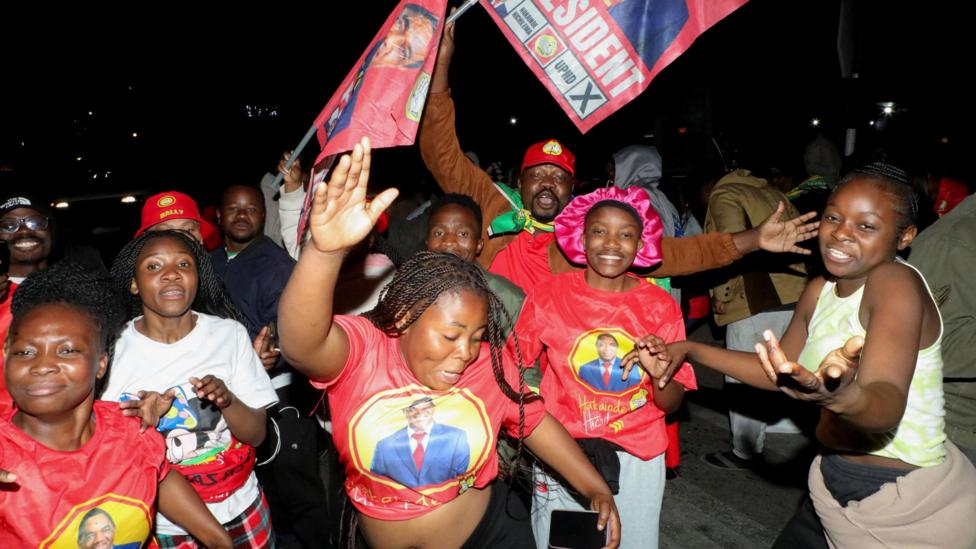
Crowds of Hichilema supporters, wearing the red of his United Party for National Development, gathered in the streets of the capital, Lusaka, to mark the announcement.
How did the opposition respond?
It remains unclear whether Mundubile's camp intends to formally contest the result through the courts. He has separately alleged that discrepancies emerged between figures posted at individual polling stations and those later announced by the commission, and claimed soldiers had been present at tallying centres.

He also gave a detailed account of a raid at his Lusaka residence, describing how armed personnel used an armoured vehicle to force open his gate before breaking doors and windows and opening fire. He rejected official claims that heavy weapons or an armed militia had been found at the property, telling a national broadcaster on the Monday following the raid:
So they came in to kill us.
Mulambo Haimbe, who served as Hichilema's election agent and is a senior figure in the ruling party, disputed Mundubile's characterisation of events, saying his account was inaccurate. Speaking to a breakfast radio programme on the Tuesday after the raid, Haimbe said criminal charges were being prepared against those detained, and added that any legal challenge to the election outcome would ultimately be a matter for the courts to decide.
What happened during the arrests of opposition figures?
Zambian police said 11 people were detained in connection with an alleged plot to incite an insurrection, according to a report from a national broadcaster. Authorities alleged the group had links to unlawful military training camps and involvement from foreign nationals, claims Mundubile has dismissed as fabricated.
This was not Mundubile's first brush with the law during the campaign period. A report published in March by an election-monitoring group noted that he had previously been arrested and charged under Zambia's cyber legislation over alleged hate-speech conduct, a case that drew criticism from rights observers at the time, according to a joint monitoring report.
Why did international observers raise concerns?
The electoral commission had briefly halted counting and the release of results the day after polling, citing reports of violence directed at polling staff and the theft of marked ballots in some regions, before lifting the suspension later the same day.
Regional and international monitoring teams broadly characterised polling day as calm and urged all parties to accept the official process, while flagging worries about last-minute changes to electoral rules and restricted media access before the vote. Samuel Tembenu, a former Malawian minister who headed the observer mission from the southern African regional bloc, said his team had documented but could not independently verify claims of intimidation, abduction, assault and property damage across five provinces. Observers additionally warned that the temporary pause in counting risked undermining both the credibility of the process and public confidence in it, while a European Union observation team cautioned that limits placed on opposition campaigning may have produced what it called an uneven contest.

What is the wider context for Zambia's elections?
Zambia has maintained an unbroken record of peaceful transitions of power since multiparty democracy was restored in 1991, with successive presidents changing hands through the ballot box rather than through unrest.
What happens next?
had earlier indicated that a runoff would only have been necessary within 37 days of the initial vote had no candidate secured an outright majority, a scenario avoided once Hichilema's tally passed the 50% mark. Full constituency-level results were expected to be finalised in the days following the announcement. Separately, the joint monitoring report indicated that Mundubile was due to appear in court following his earlier release on police bond in connection with the cyber-law case.


