

The UK government has identified the first 43 electricity transmission projects across Britain whose nearby residents will qualify for an annual £250 discount on their energy bills. Households living within 1,600ft (500m) of these upgraded pylons and substations will be eligible for the payment for up to a decade, under a scheme informally known as "pounds for pylons". Roughly two-thirds of the qualifying projects are located in Scotland, reflecting the concentration of new wind-power infrastructure there, though major schemes are also planned in areas north of London, East Anglia, the Midlands and North Wales.
This latest announcement builds on a much larger programme already under way. As reported in our earlier coverage of Britain's £60bn grid overhaul, the country is constructing new high-voltage lines and subsea cables to move renewable power generated in northern Scotland down to southern England, a project that has repeatedly run into local opposition and planning complications. Separately, we have previously examined how network investment costs, not just global conflicts, are pushing up UK energy bills, a trend this new discount scheme is partly designed to offset for those living closest to the new infrastructure.
How will the discount actually be paid?
Most eligible households will not need to do anything, as the £250 credit will be applied automatically to their electricity bill twice a year. Some customers, including those on commercial meters, may instead need to submit an application. The first payments are due to begin early next year, with suppliers or the energy regulator Ofgem expected to contact qualifying customers with further details. Officials have estimated that between 120,000 and 160,000 households could ultimately benefit as further transmission projects are added to the scheme. The scheme itself is funded by a small levy spread across all bill-payers, adding approximately 80p a year to the average household energy bill.
Which projects and areas are covered?
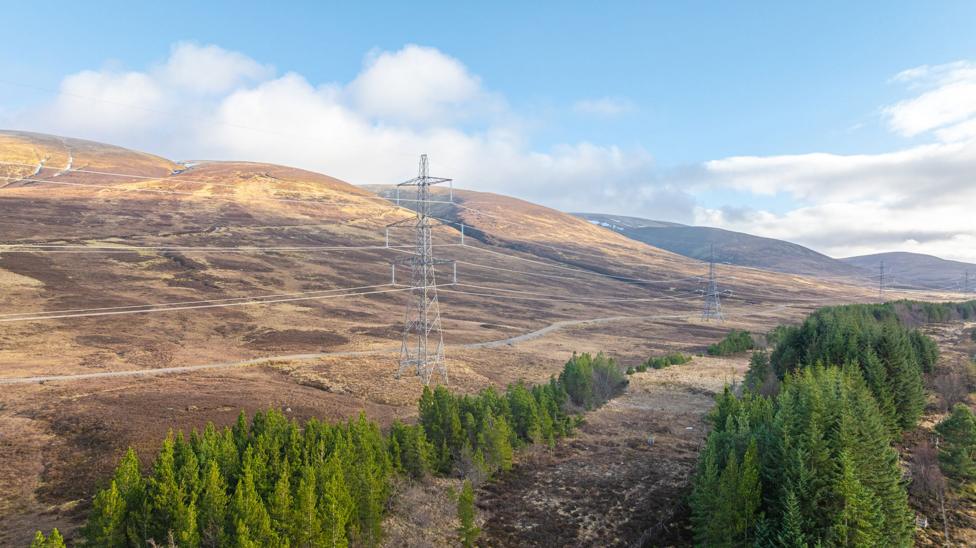
The 43 projects named cover a mix of new overhead cables, underground cabling, substations and converter stations used in electricity transmission. The Beauly to Denny line running from the Highlands to central Scotland, which became operational in 2015, offers a preview of what many of the newer projects will look like once complete.
What are ministers saying about the scheme?
UK Energy Minister Michael Shanks has framed the grid upgrade as essential to national energy strategy, arguing that modernising infrastructure largely built in the 1960s is central to cutting bills and boosting growth.
It is a moment of national renewal – upgrading what was built largely in the 1960s for the modern age and is our route to bringing down electricity bills for households across the country.
He also stressed the government's intention to ensure that communities hosting new pylons see direct financial benefit.

It's vital we build again as a country and we are determined those communities which host pylons should benefit, which is why we're bringing down the energy bills of those hosting this vital national infrastructure.
The Department for Energy Security and Net Zero says the existing grid was designed for a period when electricity came mainly from coal and gas-fired power stations, and now requires substantial upgrading to handle the growing share of renewable generation. Ministers have also pointed out that limited network capacity currently means some wind farms are paid to switch off, because there is not enough infrastructure to carry their electricity to the households and businesses that need it.
Why do some residents oppose the plans?
Rural campaigners argue that no fixed sum can adequately compensate for the loss of landscape and amenity caused by new pylons. Kate Matthews, of the Save Our Mearns campaign group opposing plans for upgraded pylons in north-east Scotland, including the Kintore to Tealing project, was strongly critical of the discount scheme.
£2,500 off electricity bills over 10 years is a slap in the face for residents facing ruined businesses and unsellable homes.
This government is either massively out of touch or is showing their contempt for affected residents and energy consumers.
Matthews said the proposals had already caused what she described as "mental anguish" among residents, who now face roughly a decade of construction disruption, including noise, road closures and heavy traffic, followed by long-term change to their surroundings.
Then a lifetime of pylons impacting on their environment, agriculture, tourism, property values, physical and visual amenity to name a few.
How tall will the new pylons be?
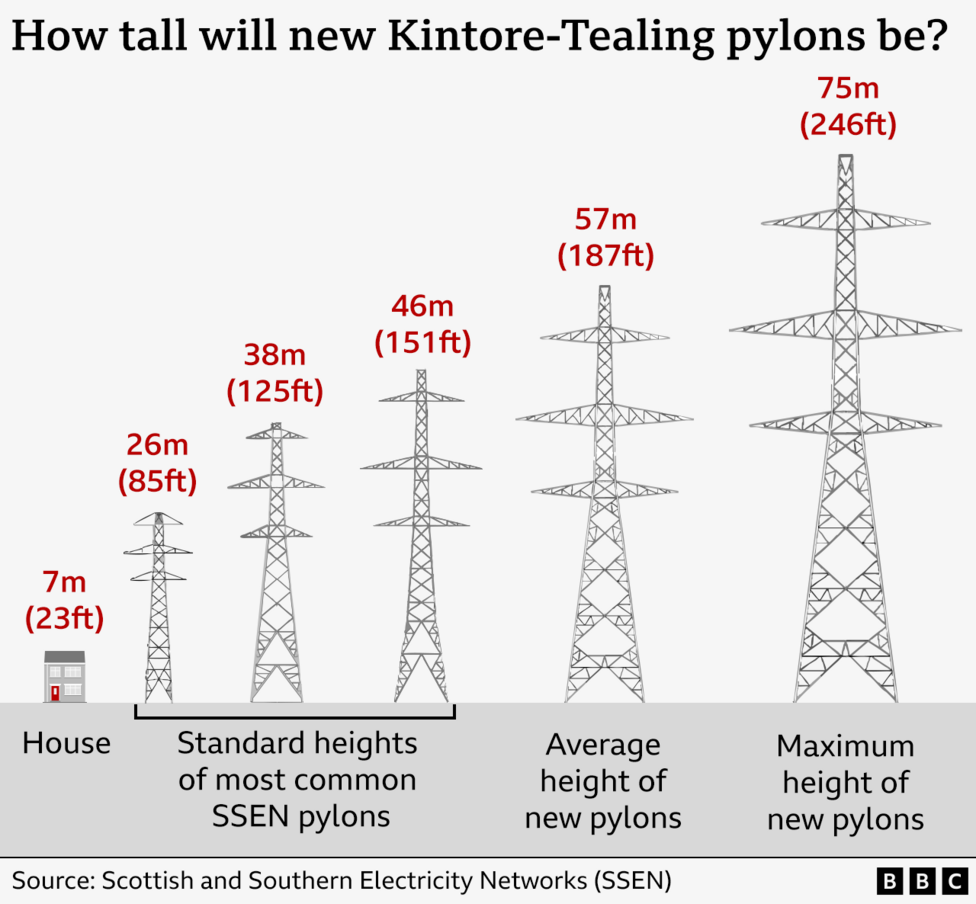
The height of the new structures will vary by location and function. In north-east Scotland, some of the proposed lattice pylons are expected to reach around 187ft (57m), comparable to the existing Beauly to Denny line, where towers range between 138ft (42m) and 213ft (65m). Campaign groups have called for a greater proportion of the network to be placed underground instead, though National Grid and transmission companies maintain that undergrounding is considerably more expensive and makes future maintenance more difficult.
What extra community funding has been announced?
Beyond the household discount, the government has outlined a separate and considerably larger community benefits package tied to the same projects. According to government guidance, communities hosting new infrastructure could receive £200,000 for every kilometre of overhead cable built and £530,000 for each new substation. As an example of the scale involved, the same guidance cites SSEN Transmission's power line between Tealing and Aberdeenshire as a project that could generate more than £23 million in local community funding on its own. The guidance covering these community funds is expected to take effect as soon as it is formally published, with officials indicating this could happen within days of the scheme's announcement.
What happens next?
The household discount scheme is expected to be placed on a formal legal footing through the government's Planning and Infrastructure Bill, according to official government guidance, giving it statutory backing rather than relying solely on administrative arrangements. Bill discounts themselves are still expected to begin in 2026, in line with the government's original timetable, with eligible households to be contacted directly by their supplier or by Ofgem once payments are ready to start.
Key Facts
- 43 transmission projects across Britain currently qualify for the £250-a-year household discount.
- Households within 1,600ft (500m) of qualifying pylons or substations can receive the payment for up to 10 years, worth £2,500 in total.
- Around 80p a year is added to all energy bills nationally to fund the scheme.
- Between 120,000 and 160,000 households could eventually qualify as more projects are added.
- Separate community funding could provide £200,000 per kilometre of overhead cable and £530,000 per substation, according to government guidance.


