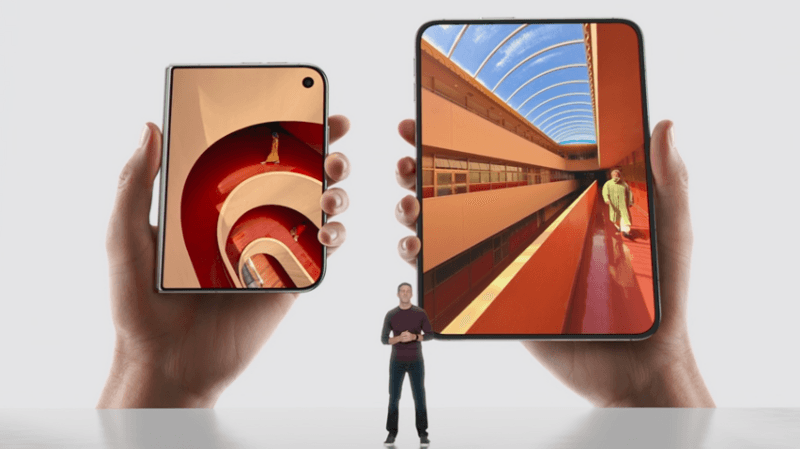
Apple has introduced its first foldable iPhone, marking a significant shift in the company's product strategy under newly appointed Chief Executive John Ternus. The device, called the Duo, carries a starting price of $2,000 (£1,475), with the highest-capacity model reaching $3,200 (£2,360), positioning it among the most expensive smartphones available today.
The Duo features a book-style design that unfolds to resemble a compact iPad and folds to present a wider iPhone-like form factor.
Ternus described the folding mechanism as "fluid and completely intuitive" and said the device was "inspired by the iPad."
He emphasized that Apple sought to differentiate its approach from competitors, stating that rival foldables "feel like two phones stuck together... making a larger screen feel much smaller."
According to Ternus, the Duo represents "the result of a series of remarkable innovations that we think will redefine the experience of using a foldable phone."
The foldable iPhone has undergone development within Apple for several years. According to reporting from April 2026, the device remained on track for a September launch despite earlier manufacturing concerns. The device has carried the internal code name V68 during its development phase.
Ternus assumed the chief executive role after Tim Cook stepped down, entering his second week in the position at the time of the announcement. The timing of Ternus's promotion and the foldable's launch is unlikely to be coincidental. Ben Wood, chief analyst at technology research firm FDM, suggested that Ternus's elevation to the top job was specifically timed
"to coincide with what will be arguably one of the biggest iPhone launches for many years,"adding that
"nothing happens by accident at Apple."
Ternus spent many years as a senior executive within Apple's hardware division before being selected as Cook's successor earlier in the year, giving him direct involvement in the foldable's development.
How does this address Apple's innovation concerns?
The foldable design represents Apple's most significant attempt to address longstanding criticism that the company has not delivered a major product breakthrough or genuinely innovative feature since the original iPhone launched in 2007. Altering the fundamental form factor of the iPhone—the company's flagship product and source of more than half its annual revenue—signals an effort to reignite consumer excitement.
However, industry analysts remain cautious about the device's commercial prospects. Dipanjan Chatterjee, an analyst at Forrester, warned that
"the foldable risks becoming a premium-priced ornament in the portfolio, imparting badge value but not meaningful growth."Chatterjee drew parallels to Apple's Vision Pro headset, which the company priced at $3,699 and which has not achieved significant market adoption, though he acknowledged the foldable could alternatively follow the trajectory of the Apple Watch—a product that, while less popular than the iPhone, sells to millions of customers annually.
What is the broader market context?
The foldable smartphone category remains niche. According to FDM data, foldable devices from manufacturers including Samsung and Huawei currently represent only 2% of global smartphone sales. Even with Apple's entry into the market expected to drive substantial interest and demand, industry projections suggest the category could reach only 4% of total smartphone sales within the next decade.
The iPhone has remained Apple's dominant product line, consistently accounting for more than half of the company's annual sales. In recent quarters, Apple has emphasized that iPhone demand continues to strengthen, with the most recent version becoming the company's most successful product launch to date. This backdrop makes the introduction of a foldable variant a strategic bet on whether consumers will embrace a new form factor at a premium price point.
The foldable market has begun to mature with competitors offering alternatives. Honor's Magic V6, for example, combines a slim design with strong performance and solid cameras, though its software remains unpolished for a device priced above £1,500.
Apple has also faced headwinds in its broader business. The company previously warned of future supply constraints affecting Macs, iPhones and iPads, and indicated plans to raise product prices due to soaring memory chip costs driven by artificial intelligence demand and supply issues.
What happens next?
Apple is scheduled to hold an event on September 9, 2026, where the foldable iPhone is expected to be formally unveiled alongside the iPhone 18 Pro lineup. Pre-orders are anticipated to open on September 12, 2026, with an on-sale date expected around September 18, 2026. The launch will serve as a public debut for Ternus in his new leadership role, underscoring the significance Apple places on this product introduction.
Key Facts
- The foldable iPhone Duo starts at $2,000 with the largest storage option reaching $3,200
- The device features a book-style design with an internal display of approximately 7.8 inches and an outer display of about 5.5 inches
- Foldable smartphones currently represent 2% of global smartphone sales, with projections suggesting growth to only 4% within a decade
- The foldable has been in development at Apple for several years and carries the internal code name V68
- The announcement marks the first major product launch under new CEO John Ternus, who took office after Tim Cook stepped down