

As the six-week school break stretches ahead, parents across the UK are experimenting with alarms, curfews and household rules to stop screens dominating their children's days. Cerys Colven, a mother of two from Brynhoffnant, Ceredigion, sets an alarm on a smart speaker so the device — not her — takes the blame when screen time ends.
Research from Vodafone suggests young people could spend 42% more time on their phones during the holidays than during term time, underlining why so many families are searching for strategies to keep devices in check over the summer.
Cerys said her older son asks to play on consoles such as a Switch or PlayStation more often because his friends do, though she sees value in some of what screens offer.
"Especially with my oldest son, his friends like to play on things like the Switch or Playstation or whatever, so he asks a lot more often to go on it," Cerys said.
"But i think there's a lot of different games and apps where the kids can learn different things, talk to different people as well."
Ahead of the summer break, the UK government published new guidance on screen use, referencing research showing that 24% of parents of three- to five-year-olds struggle to limit their child's time on devices. Cerys, mother to Macsen and Elis, said that although screens have a place in her sons' lives, keeping that time within bounds is an ongoing challenge — even though both boys also enjoy playing outdoors.
How much time are children actually spending on screens?
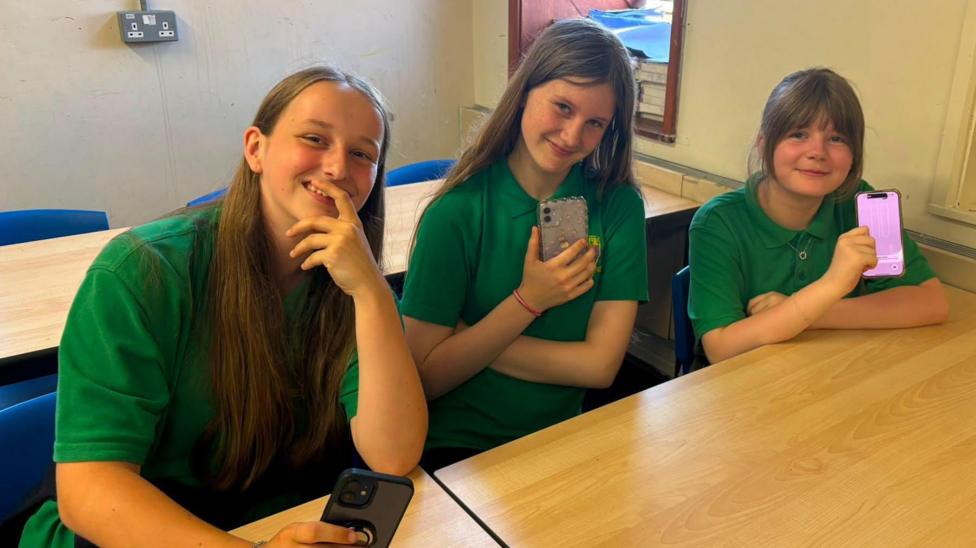
At Ysgol Dyffryn Nantlle in Gwynedd, pupils marked their final week of term by reflecting on how they expect to spend the holidays. Skye, a Year 10 pupil, said her phone's own data shows she spends roughly seven hours and 20 minutes on it on an average day. Her parents do not monitor her usage directly, but she must put the phone away by 20:00 BST.
"Sometimes I think, 'I just want to be on it for longer'," she said.
Skye received her first phone at age 11 and believes that starting later has shaped a healthier relationship with technology than her younger brother, who has had a phone since he was three.
"My brother- he's had a phone since he was three, and I only had mine when I was 11," she added.
"So I think that he has strong feelings when it comes to his phone."
Her classmate Awen spends just over an hour a day on her phone, mostly listening to music and messaging friends, and must ask her parents' permission before going online.
"I have to ask my parents' permission to go on my phone," she said.
Despite what usage data might suggest, Awen expects to cut back over the summer in favour of family time and reading.
What rules do families rely on to manage device use?
Osian, also a pupil at Ysgol Dyffryn Nantlle, has no formal restrictions at home but says his parents keep a close eye on how much time he spends on his phone and gaming devices.
"It's sunnier so I think I'll spend more time outside, but if my mam sees me on my phone too much one day, or one week, then she does take it away," he said.
Osian estimated he spends about three hours a day on a gaming device, which he said can leave him with headaches and in a bad mood.

"I'd like to see more sun [over the holidays] so I don't have to go on my phone as often," he added.

Approaches like these echo advice from the United States, where the Federal Trade Commission's 2026 summer guide recommends that parents use built-in parental control tools — such as Apple Family Sharing, Google Family Link and Microsoft Family Safety — to set limits, restrict content and review activity, according to the FTC's guidance. The same guide also suggests setting passcodes on shared devices or creating separate profiles so children cannot stream, scroll or make purchases under a parent's account without permission.
Why does parents' own screen habit matter?
Child psychologist Dr Nia Williams said a temporary rise in screen use over the holidays is unlikely to cause lasting harm, though it can affect children's behaviour and sleep quality in the short term.
"If parents are working over the summer holidays, then of course it will be more difficult to control how long your child spends on screens," she said.
"There's also the added cost of summer holidays."
"We need to remember that holidays - they aren't long, so when children go back to their routine, then all the better."
According to Dr Williams, one of the most significant factors is how much time parents themselves spend on screens, since children often mirror that behaviour.
"Monkey see, monkey do - so if [parents] spend a lot of time on the phone, then the kids might do the same," she added.
"I've seen parents set up no technology zones- like no phones at the dinning table."

That guidance aligns with recommendations from Baylor College of Medicine, whose June 2026 parenting advice encourages parents to learn about their children's favourite apps, model sensible time limits themselves, and consider drawing up a family media plan, according to Baylor College of Medicine. Baylor's guidance also recommends screen-free zones such as bedrooms and dinner tables, along with wind-down activities that keep devices off for at least an hour before bedtime.
Dr Williams also encouraged families to seek out free local events to make the most of the summer weather, adding that screen time is not inherently negative as long as it remains balanced with other activities.
"Too much screen time can have a negative effect, but there are also positives from spending time on screens, so just as long as a healthy balance is happening," she said.
How does this fit into the wider debate on children and screens?
The issue of managing children's device use has been building for months. Earlier coverage outlined five effective strategies for managing children's screen time, noting that the UK government is planning a social media curfew for teenagers that would disable addictive app features, alongside expert calls for realistic limits, collaboration with children and modelling good habits. A related study examined how limiting social media affects teenagers' mental health, with research from Bradford exploring the impact of proposed age restrictions and curfews ahead of the new rules taking effect.
Separately, other families have reported that the summer break itself is placing pressure on household budgets and routines, with parents describing rising childcare costs and strain during the six-week holiday, including some juggling work before dawn and after dark. Suggestions for keeping children entertained without heavy reliance on screens have also been offered in a separate piece on affordable and memorable summer activities for families.
What else are experts suggesting for the rest of the holidays?
Beyond technical controls, some organisations are urging parents to plan ahead rather than react to daily disputes over devices. The Child Mind Institute's summer guidance advises parents to identify the risks they most want to avoid, set clear wellness goals, and put practical routines in place to head off repeated screen-time conflicts, according to the Child Mind Institute. Meanwhile, a June 2026 article in Psychology Today reported that many families find screen-free mornings useful, preferring to allow device use later in the day once children have had time for active play, according to Psychology Today.
The FTC's summer screen-time resource remains available to parents throughout 2026 as an ongoing tool for building a family media plan, rather than being tied to a single deadline or event, according to the FTC.
Key Facts
- Young people could spend 42% more time on phones during the summer holidays than in term time, according to Vodafone research.
- 24% of parents of three- to five-year-olds say they find it hard to control their child's screen time, per UK government-cited research.
- Skye, a Year 10 pupil, spends about seven hours and 20 minutes a day on her phone; Awen spends just over an hour; Osian spends around three hours daily on a gaming device.
- The FTC's 2026 summer guide recommends built-in tools like Apple Family Sharing, Google Family Link and Microsoft Family Safety to manage children's device use.
- Baylor College of Medicine advises screen-free zones and an hour of screen-free wind-down time before bed.


