Firefighters are struggling to contain wildfires in south-west France as strong winds push flames towards the city of Bordeaux, with one official saying they "are far from having the fire under control." More than 250,000 people in France and Spain have fled fires that have been raging for days, as winds and high temperatures hamper efforts to contain them.
Overnight, seven towns west of Bordeaux were told to evacuate residents. In Spain, where a state of emergency has been declared, a change in weather conditions has helped firefighters outside Madrid.
Spanish PM Pedro Sánchez admitted there are "complex times ahead". Meanwhile, authorities in València confirmed the death of a man in a fire.
Believed to be in his 70s, the man was found dead in his car by firefighters as they extinguished a fire in the Salt de l'Aigua ravine in Manises, according to local media reports.
How severe is the situation in south-west France?
In France, around 200,000 people have been evacuated in the south-western Gironde and Landes regions. France has mobilised its military to help with the response, and extra reinforcements from the army have been sent to help firefighters by clearing brush and creating fire breaks.
As of Saturday morning, the wildfire was around 40km to 50km (25 to 30 miles) away from Bordeaux. Still, the wind was blowing smoke towards the city and people reported an acrid smell in the air.
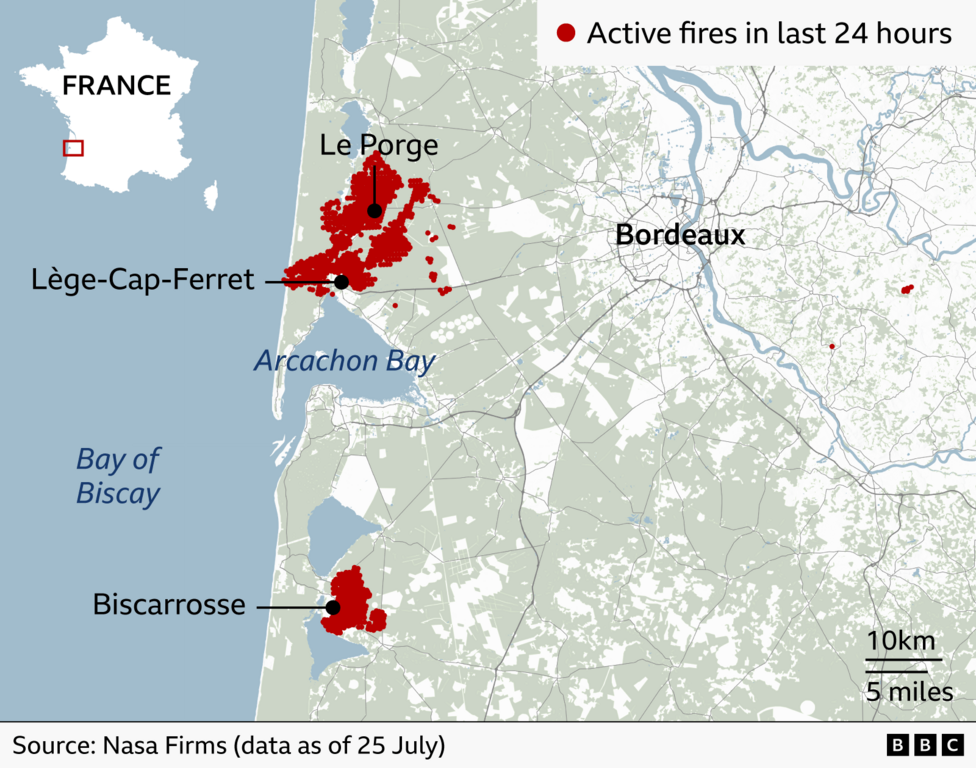
One tourist who fled an approaching wildfire near Bordeaux with his family described the scale of the blaze as "frightening". Spencer Randall told the BBC his family evacuated in the early hours of Saturday to an area 100 miles east, but they can "still smell the wildfires from here".
"It's quite strong winds fanning the flames, just terrifying,"
A British couple holidaying in Bordeaux said they noticed the flames get worse on Friday night, as the fire approached.
"At about seven o'clock you could smell smoke. We thought someone was having a barbecue,"
Maisie told beat from their holiday rental. Her partner, Caleb, said the ash has now covered the pool in the house and turned their feet black when walking outside.
The smoke "really hits your lungs right away",
they added.
Nearby, in Saint-Aubin-de-Médoc, residents evacuating said the situation was "stressful", with one local describing it a "disaster".
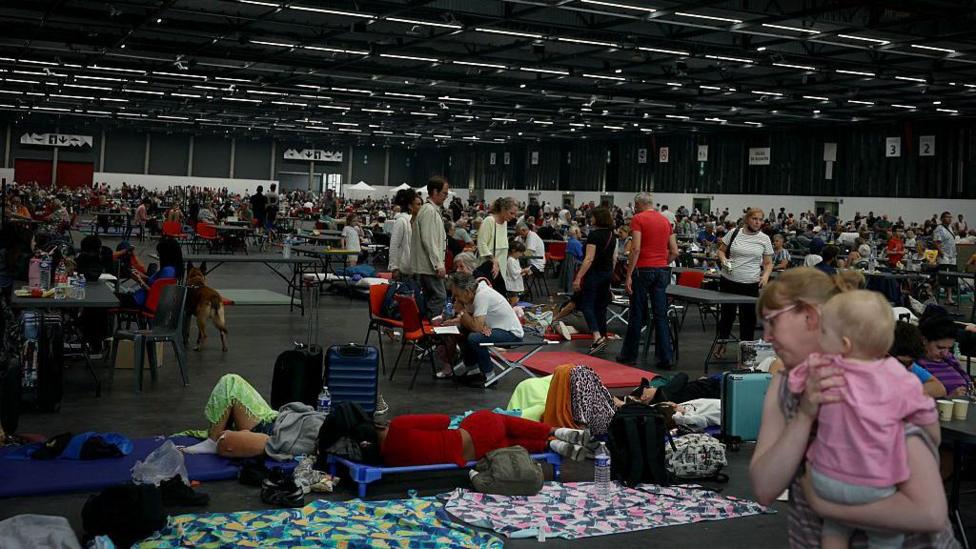
The final leg of the Tour de France, due to take place Sunday, has been shortened from 133km (83 miles) to 89km (55 miles) so that security forces can be redeployed to areas affected by wildfires, organisers and police have said.
French President Emmanuel Macron is set to have an emergency meeting with ministers as 30 or so fires rage across the country - a situation which the government said is totally unprecedented.
Watch: Anxiety as locals forced to evacuate Saint-Aubin-de-Médoc

What is happening around Madrid?
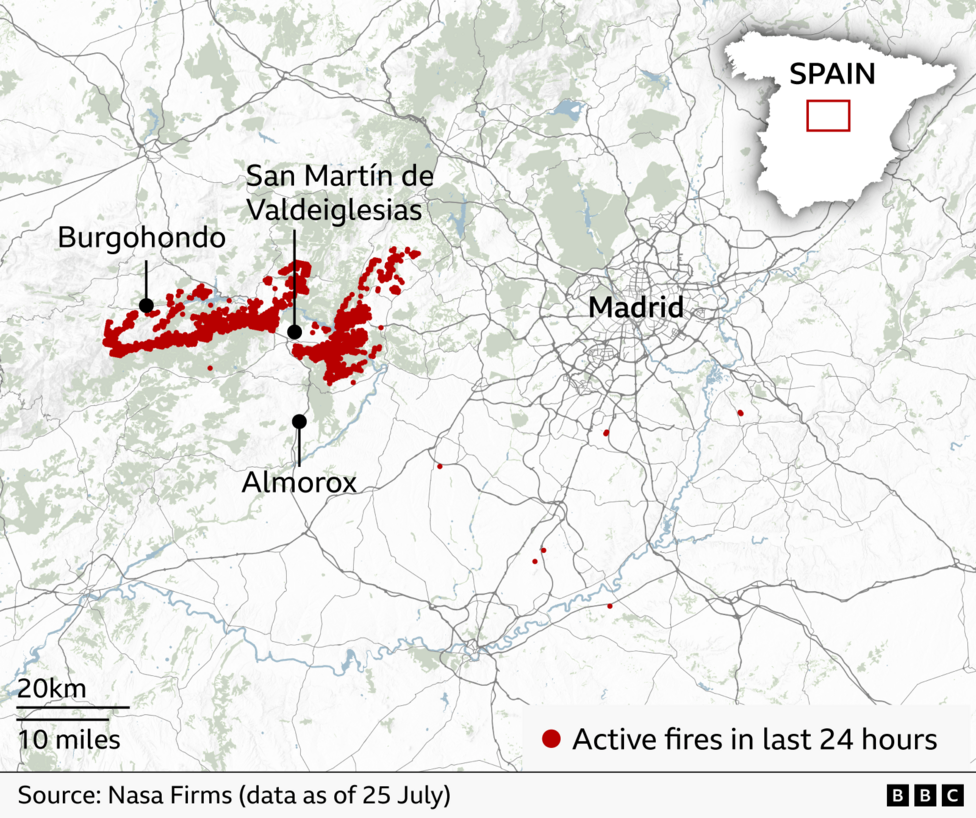
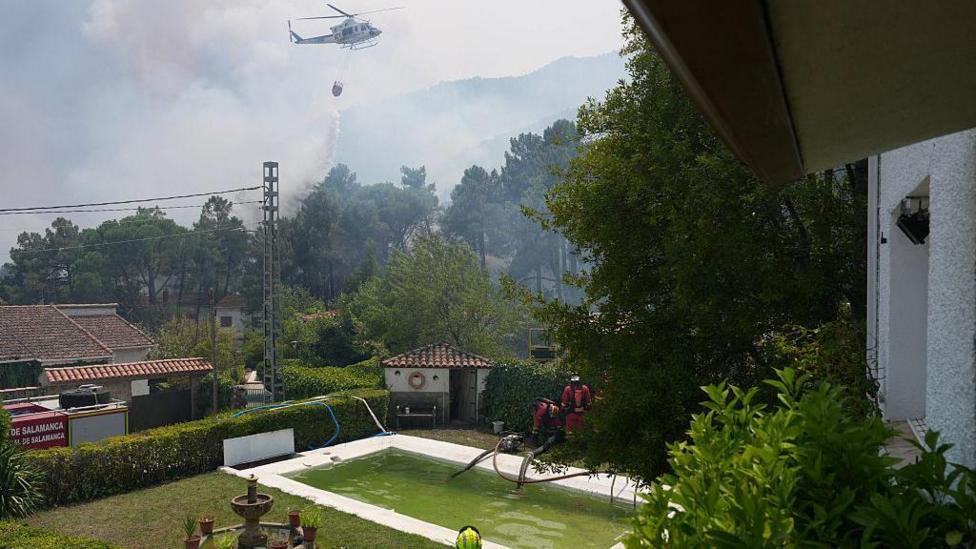
In Spain, fires continued near Madrid but the regional government said there had been some progress. The change in weather conditions - less wind, higher humidity and lower temperature - has greatly benefited the fight against the forest fires, which have advanced little and decreased in intensity, it wrote on X.
Speaking from Cenicientos, south-west of Madrid, Prime Minister Sánchez said:
"Right now, we have a window of opportunity in order to tackle against the wildfires, protect and save lives and effectively try and control the fire."
"It's true that temperatures have dropped a little bit, "
said Sánchez. "But still the wind is making it difficult and there may be thunderstorms as well."
Since the wildfires broke out in Spain, nearly 60,000 people have been evacuated from the Madrid and Ávila regions, while more than 28,000 remain confined to their homes, according to Spain's Interior Ministry.
Madrid's regional president Isabel Díaz Ayuso described the situation as the "worst fire in the history of the region".
Sánchez said 130,000 hectares of land had been burned in Spain so far this year, ahead of an annual average of 100,000 hectares for the country over the last decade.
How are other countries affected?
France's Interior Minister Laurent Nuñez said 98,000 hectares have burned across the country since the beginning of 2026.
Meanwhile in Italy, more than 350 fires - including 10 major blazes - broke out on the island of Sicily, the head of the Sicilian Civil Protection said on Wednesday, prompting evacuations.
A major incident was also declared by emergency services in Scotland on Friday evening as they continue to tackle a wildfire in the Cairngorms National Park that has been burning for 10 days.
Hadja Lahbib, the EU's commissioner for crisis management, said it is likely that the damage from wildfires in Europe will surpass previous records.
She said fires had started earlier in the year when, in April, the Netherlands activated the EU's civil protection mechanism which triggers support and reinforcements from other countries.
"Last year, one million hectares burned during the summer and so we are expecting to face another historical, sad record because the season has started earlier in the year."
She also warned that more outbreaks are likely as the summer goes on.
"Forecasters are predicting, unfortunately, another heatwave so we can expect other wildfires."
France has activated the civil protection mechanism and will receive water bombers, comprising three Canadairs planes from Croatia and two Air Tractors from Portugal as well as Black Hawk helicopters from the Czech Republic and Slovakia, and 40 members of a Romanian forest fire team.
EU Commission President Ursula von der Leyen said 11 planes and helicopters have also been sent to France and Spain from the EU's firefighting fleet.
Additional reporting by Mary Litchfield, BBC Your Voice and Srosh Khan, beat
Key Facts
- More than 250,000 people in France and Spain have fled wildfires.
- Around 200,000 people have been evacuated in France's Gironde and Landes regions.
- Nearly 60,000 people have been evacuated from Spain's Madrid and Ávila regions, and more than 28,000 remain confined to their homes.
- One man in his 70s was found dead in his car in Manises, near València.
- France, Spain and other European countries have received extra firefighting support through the EU civil protection mechanism.