

Temperatures across south-east England soared past 37C on Thursday, marking the hottest day of 2026 so far and prompting health warnings, wildfire call-outs and a scramble to keep both people and animals cool. The Met Office provisionally recorded 37.8C at Charlwood in Surrey by midday, with 37.2C measured at Wisley, while London's Kew Gardens later logged 38.1C, overtaking the 38C recorded at Lingwood in Norfolk in June as the year's new high. The reading also makes Thursday the UK's fifth hottest day since records began.
Maidstone in Kent and Crawley in West Sussex both reached 34C, with similar conditions forecast for Uckfield in East Sussex. Pershore in Worcestershire also recorded 37.8C, matching Charlwood, showing the heat's reach beyond the South East. Since UK weather records began, only four days have ever been hotter than Thursday's peak — all of them in the 21st century, including 10 August 2003, when Faversham in Kent hit 38.5C.
How hot did it get on Thursday?
By 11:00 BST, temperatures had already climbed to 30C at Charlwood and Kenley in Surrey and at Herstmonceux in East Sussex, according to weather presenter Darren Bett. That extended an unprecedented run to 38 consecutive days of 30C-plus heat somewhere in the UK this year, well past the previous record of 34 days set in 1995. Surrey was among several counties placed under an extreme heat warning running until 23:59 on Thursday, and much of the South East, including the whole region, has now been formally declared to be in drought. Later readings at Kew Gardens also showed a temperature of 37.0C alongside the provisional 38.1C peak, and the Met Office confirmed that 2026 is the first year on record in which the UK has seen three separate days reach the 37C threshold.
The scale of this week's heat follows a run of previous records this year. The UK's earlier June heat record of 35.7°C in Surrey and a subsequent reading of 36.1C in Hampshire had already surpassed marks dating back to 1957 and 1976, while a May record above 35C in London caused transport delays and water shortages earlier in the year. Days before this latest spike, forecasters had already warned that Kent, Sussex and Surrey were under mounting strain from drought and an amber health alert as temperatures pushed past 30C.
How does this compare with previous UK heat records?
The four days hotter than Thursday's peak all occurred within the past two decades. The highest temperature ever recorded in the UK was 40.3C at Coningsby, Lincolnshire, on 19 July 2022 — the only day on record when readings above 40C have been seen. Before that, the record stood at 38.7C at Cambridge Botanic Gardens on 25 July 2019, while a temperature of 38.2C was recorded at Pitsford, Northamptonshire, on 18 July 2022, and 38.5C at Faversham on 10 August 2003. Accounts of this year's earlier benchmark also differ slightly: this article's original reporting placed the previous 2026 high at 38C in Lingwood, Norfolk on 26 June, while separate live coverage of the heatwave put the earlier 2026 benchmark at 38.0C on 28 June. Kew Gardens was also the site of the UK's earlier May temperature milestones this year, with 34.8C recorded on 25 May and 35.1C on 26 May, according to a national broadcaster's report.
How are water supplies being affected?
More than 27 million people across England are now facing water use restrictions, including hosepipe bans, as almost three quarters of the country — around 45 million people — live under drought conditions. Thousands of homes in east London and Essex have also been left with a complete water outage or low water pressure for almost a week following a series of burst pipes in South Woodford, with the supplier repeatedly apologising and saying it expects supplies to be restored by 14 August 2026. Wales has also declared a drought across the entire country, with temperatures there forecast to reach 35C.
How is the heat affecting people and emergency services?
Vikki Lewis of the South East Coast Ambulance Service said crews were coming under growing pressure as more people struggled to cope with the conditions.
"We've seen an increase in people reporting the heat exhaustion signs, feeling faint," she said.
"We've seen collapses and this has created an increase in demand for our service."
In Charlwood, councillor Lisa Scott described the conditions as punishing for residents.
"It is absolutely roasting. When you open the back door you are just hit by the heat."
She said stepping outside felt "like stepping off a plane in a tropical country", adding that the local landscape was visibly suffering.
"It is oppressive. The verges are brown and crispy. The trees are dying."
"I am in bare feet and the floor is too hot to stand on."

Scott said the council was working to set up a cool hub for residents, describing efforts to keep working through the heat as "exhausting". In Pershore, Suzanne Badger, front of house manager at a local pub, said customers were "walking in off the street, melting".

"We usually say it's hotter in the kitchen than outside - but today it's hotter outside. The heat in the kitchen is unbearable, it is 36C in there," she said.
A&E departments in England recorded their busiest period ever in July, with 2.49 million attendances, and record-breaking heat cited as a key factor. Preliminary figures suggest there were more than 2,800 heat-related deaths in May and June, almost double the total for the same period last year. One ambulance technician described working in the heat as "vile", while other healthcare workers said they were "dripping with sweat from head to toe". Health Secretary Yvette Cooper said the figures show how much of an "additional burden is placed on the NHS during periods of extreme heat", and said the NHS must plan for summer pressures in a similar way to winter.
The UK Health Security Agency's amber heat-health alert, which initially covered the South East, has since been extended to cover the whole of England, running until 21:00 on 14 August 2026, according to the agency's regional dashboard. The Met Office separately confirmed an amber extreme heat warning was active across the Midlands and into the South East on Thursday, later expanded to cover a wider swathe of England stretching from London to Sheffield, parts of Cheshire and Greater Manchester, into Gloucestershire and Wiltshire in the South West, and Shropshire and Herefordshire in the west, as reported by a national broadcast weather update. Forecasters had earlier said temperatures in the warned area could reach 36C, 37C or even 38C, according to a national newspaper's report.
What is happening with wildfires in the region?
Just before 13:00 BST, East Sussex firefighters were called to a blaze that had taken hold of roughly 50 square metres of land near Ringmer. Within an hour the fire had spread across two fields and a hedge, though crews were damping down hotspots by 14:40. Separately, at around 13:20, firefighters were called to Little Horsted, where three fields and an area of woodland had caught fire.
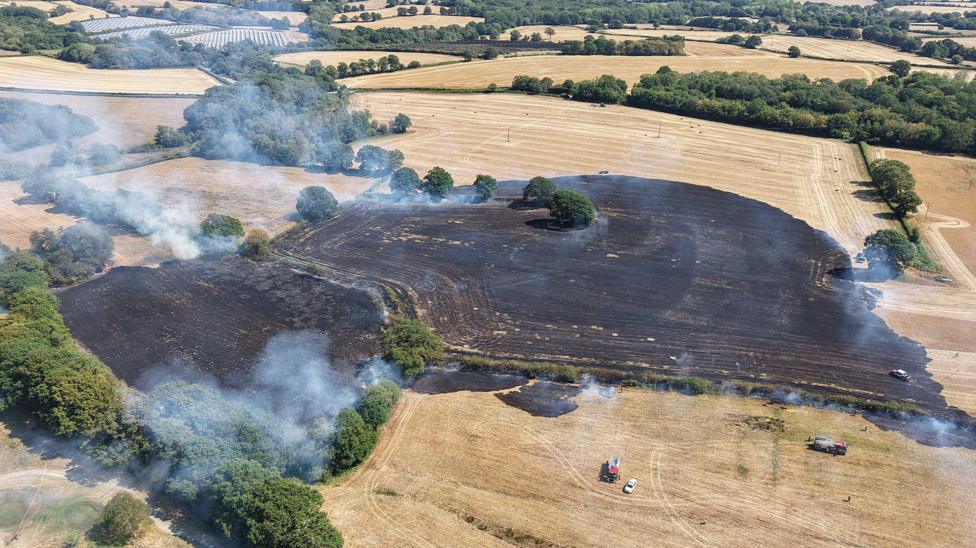
Matt Gamblen, wildfires tactical advisor for West Sussex Fire and Rescue Service, urged the public to take extra precautions, including not leaving vehicle engines running while parked on grass.
"Firefighters are really busy at the moment, we're getting multiple calls," he said.
"We've had over 1,000 calls in the UK now nationally that are for wildfires."
"That's on top of just our normal fires in the open [and] smaller fire activity as well, so it's been a really busy time for our firefighters across the UK."
According to the National Fire Chiefs Council, a total of 1,017 wildfires have been recorded in England and Wales so far this year, matching last year's record total. In the New Forest, Hampshire, a team of 130 firefighters battled a wildfire on Thursday that authorities said had affected an area roughly the size of 230 football pitches.
How are animals at wildlife parks coping?
At Howletts Wild Animal Park near Canterbury in Kent, keeper Adam Letts said the western lowland gorillas had been cooling off with dips in their splash pool and frozen fruit treats. Courtney Mansfield, the park's head of elephants, said the animals in her care were accustomed to such heat and could drink up to 200 litres of water a day.
Keeper April Hall said the park's European grey wolves found the conditions less comfortable, often seeking shade or paddling in their stream.
"They also enjoy the blood lollies we give them which are made up of the frozen blood of the meat we give them," she added.
Is this part of a broader climate trend?
The Met Office said 2026 is on course to become the UK's hottest summer on record, needing only average conditions for the rest of August to overtake the record set in 2025. This latest spell of heat forms the fifth heatwave of the summer, according to a weather news roundup, and the South East's amber alert sits alongside similar warnings issued for other parts of England and Wales during the same hot spell, as noted by a broadcaster's regional report. The heat forms part of a wider European heatwave, with gale-force winds fuelling a wildfire that forced evacuations on Greece's Chalkidiki peninsula around the same time. Elsewhere in the UK, a yellow thunderstorm warning was in place for Northern Ireland until 06:00 on Friday, while rain was forecast for much of Scotland.
Professor Liz Bentley, chief executive of the Royal Meteorological Society, said the famous heatwave of 1976 was once considered a "once in a generation" event, but such conditions were "now happening much more frequently".
She explained the country was "moving into a new norm with warmer, wetter winters, and hotter, drier summers".
Bentley urged people to stay in the shade, warning that surface temperatures in direct sunlight could reach as high as 60C.
What happens next?
The amber heat-health alert, now covering the whole of England, is due to remain in force until 21:00 on 14 August 2026, according to the UK Health Security Agency's dashboard. The Met Office's extreme heat warning for the Midlands and South East was set to expire at midnight on Thursday, according to the earlier newspaper report, after which conditions are expected to ease. The extreme heat in this spell is now believed to have peaked in England, with cooler temperatures of 30-34C expected across the Midlands, East Anglia and much of southern England by Friday, dropping further to around 26C by Sunday. Officials continue to monitor drought conditions, water restrictions and wildfire risk across the region.
Key Facts
- Charlwood, Surrey, and Pershore, Worcestershire, both provisionally recorded 37.8C, with Kew Gardens later reaching 38.1C — the UK's hottest and fifth hottest day of 2026 on record.
- Thursday marked 38 consecutive days of 30C-plus heat somewhere in the UK, beating the previous 1995 record of 34 days, and 2026 is the first year with three separate days at or above 37C.
- An amber heat-health alert now covers the whole of England until 21:00 on 14 August 2026, alongside a Met Office extreme heat warning that has expanded across much of the country.
- More than 27 million people face water restrictions and around 45 million are living under drought conditions, while A&E attendances hit a record 2.49 million in July.
- Firefighters tackled blazes near Ringmer and Little Horsted in East Sussex and in the New Forest, amid 1,017 wildfires recorded in England and Wales this year, matching last year's record.


