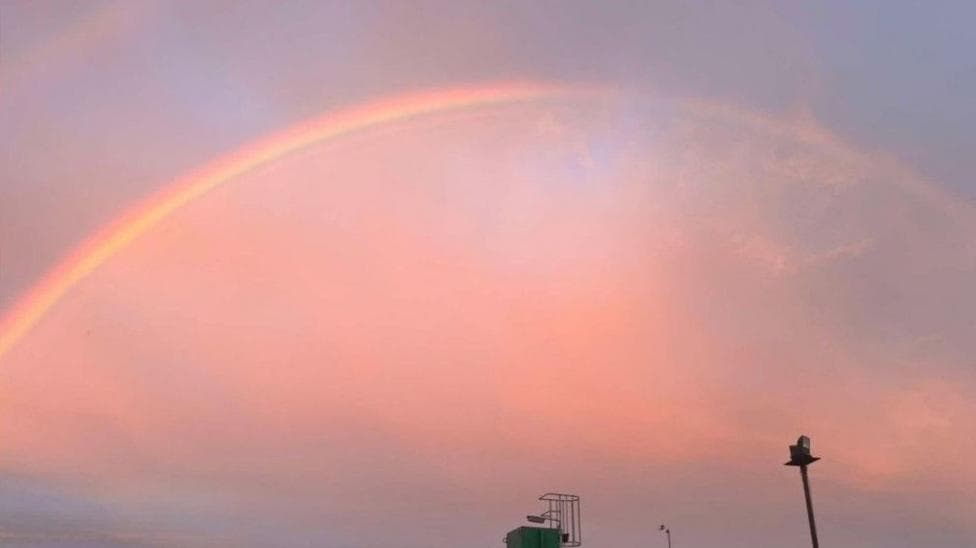
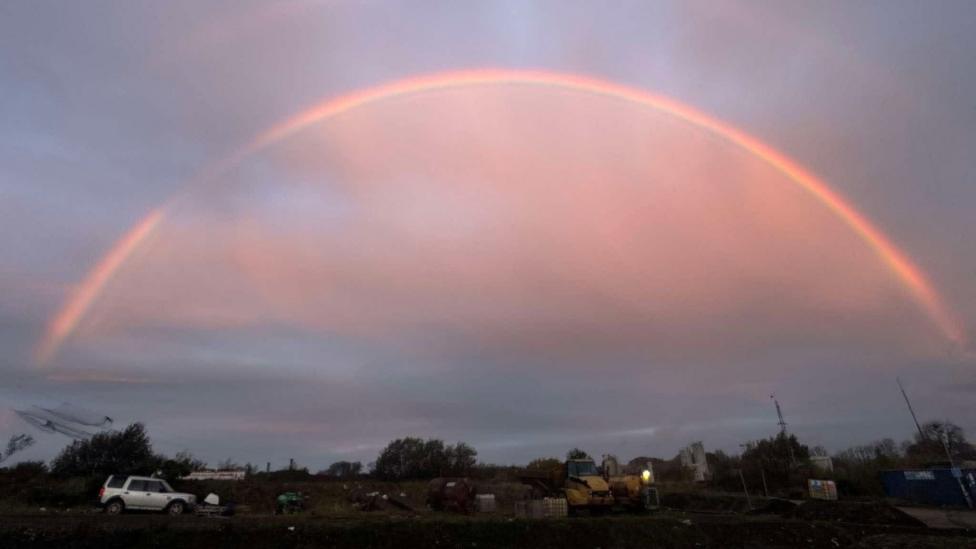
A strikingly uncommon red rainbow was photographed in County Antrim on Friday morning. Peter Kirk spotted the phenomenon in Mallusk and shared images with BBC News, which documented the sighting.
Rainbows emerge when sunlight bends and reflects through water droplets suspended in the air, dispersing the light across its component colours. Red rainbows follow the same optical principles but manifest exclusively during sunrise or sunset, when the sun sits low on the horizon.
Why do red rainbows appear at these times?
During sunrise and sunset, sunlight must travel through a substantially greater thickness of the atmosphere to reach an observer. As light passes through this extended atmospheric path, shorter wavelengths—particularly blue and green hues—scatter away into the surrounding sky. This selective scattering process leaves predominantly longer wavelengths visible: reds and yellows. The result is a rainbow suffused with a deep reddish glow, created by the same mechanism responsible for vivid red sunsets.
How rare is this phenomenon?
Red rainbows remain exceptionally scarce compared to ordinary rainbows. Sky watchers and meteorology enthusiasts may encounter one only once or twice throughout their entire lifetime. The combination of precise atmospheric conditions, solar angle, and water droplet distribution required to produce a visible red rainbow makes such sightings genuinely remarkable events.
Northern Ireland has experienced several notable atmospheric phenomena in recent months. Nearly 9,000 lightning strikes illuminated the skies above northwest Ireland on 26 June 2026, creating an extended thunderstorm display. Additionally, the Aurora Borealis painted UK skies from Scotland to the south coast on 10 October 2026, with exceptional solar activity enabling sightings as far south as Devon and Kent.