When temperatures reach 40C inside and French building regulations will not even allow shutters, residents say their listed homes in Firminy are simply unlivable. The social housing apartments inside Le Corbusier’s l’Unité d’Habitation, a landmark tower in south-east France, are now at the centre of a dispute over heat, heritage and habitability.
Firminy’s population has been shrinking for decades, shaped by factory closures in a region built on steel. Locals say many people leave for better opportunities in neighbouring Saint-Étienne or to live in the countryside of Haute-Loire.
On the top of a hill, however, stands Firminy’s pride: l’Unité d’Habitation, an imposing tower of concrete designed by Le Corbusier. The architect’s final project is an oddity – a building for people, where two-thirds of the apartments are dedicated to habitations à loyer modéré (or HLM – social housing); but also a piece of history, whose facade and roof were listed as historic monuments in 1993.
It was also designed for a 1960s climate, not the one France has experienced for much of the summer. For its residents, the tower feels increasingly like an unlivable furnace – and because of its protected status, that is unlikely to change soon.
We are on the brink of the fourth heatwave of the year when a group of residents meets at the bottom of l’Unité d’Habitation. They say they have had enough. Inside their flats, during a heatwave, the temperatures regularly reach 35C, and can rise to 40C.
“I slept on the floor because it was the only place I could stay cool,” says Aurélie Mohamed, who has lived in l’Unité d’Habitation for five years.
“I slept on the balcony,” says Nathalie Rouchouse, who moved in 15 years ago.
“My godmother was one of the original residents of , and I can remember coming here aged nine,” Chantal Hospital tells me. “We marvelled at the building; we were so proud of it in Firminy. It’s been 26 years since I moved in, and now I’m doing my best to move out. I never want to live in a historic monument again.”
L’Unité d’Habitation has no shutters, but adding them would not be a straightforward task. Any change to the facade of a historic monument is subject to a long list of rules, and cannot currently be done without the authorisation of the architectes des bâtiments de France (ABF). For now, residents resort to DIY methods, hanging blankets or panels made from tinfoil across the windows, but it is no substitute.
When a person owns a part of a historic monument, as is the case with the third of apartments in private ownership in l’Unité d’Habitation in Firminy, there are certain benefits to its listed status. They are entitled to a grant of 40% of the cost of the work when they carry out renovations, and they are able to claim some tax reductions.
But social renters are caught in the middle of the rules imposed on all historic monuments in the country, and the actions and investment of Habitat et Métropole, the social landlord that manages the HLM part of the building. Habitat et Métropole did not answer any questions regarding the Firminy site.
The relentless heatwaves have highlighted a class divide in France. The residents of l’Unité d’Habitation are far from the only ones living in HLMs to suffer inside their homes, and in some respects they are better off than those in poorly designed buildings elsewhere. Le Corbusier’s famous pilotis allow for better airflow underneath the tower.
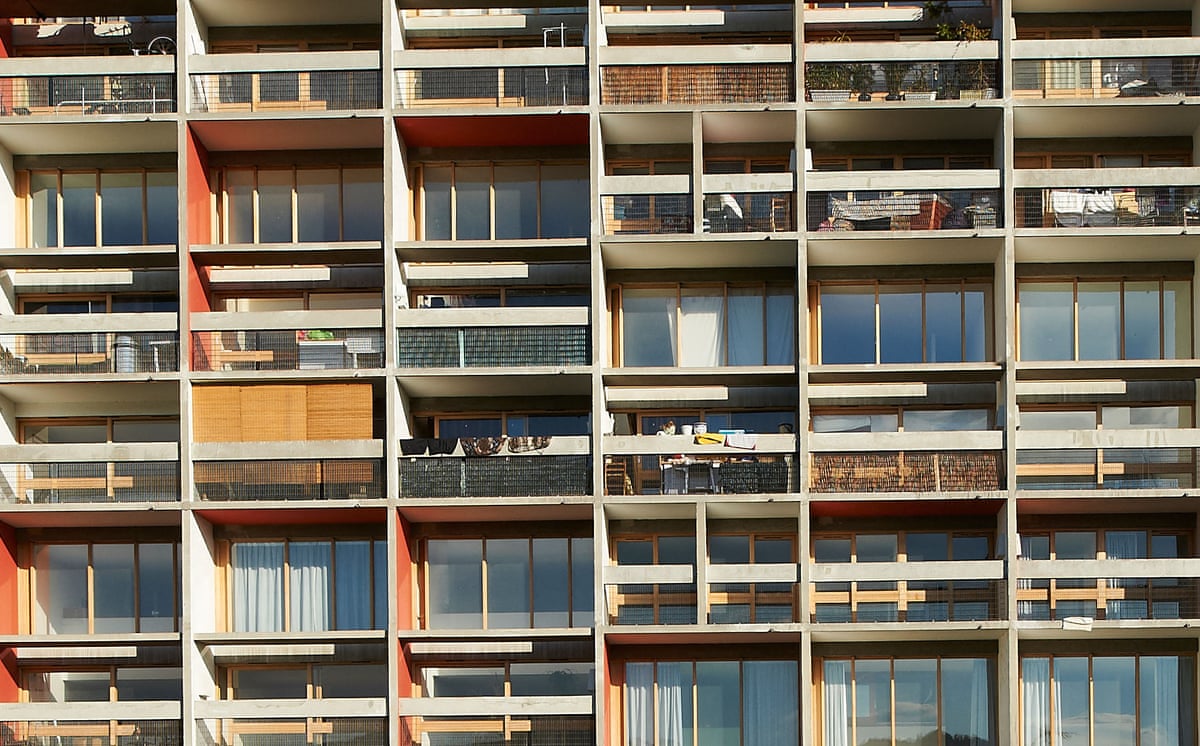
This class element is even more apparent in Firminy, where the Le Corbusier site, including parts of l’Unité d’Habitation, is also a tourist attraction. About 20,000 visitors a year come to see l’Unité d’Habitation, its showroom apartment and the kindergarten, which is no longer used as a nursery. Aurélie Mohamed, Nathalie Rouchouse and Chantal Hospital’s home is a living museum, but although tourists pay to visit their building, none of the money from ticket sales is injected back into the site. It is run as a separate operation and Géraldine Dabrigeon, the chief curator, says that the revenue from ticket sales only covers guides, advertising and insurance. Even though the part open to tourists is run separately, it strikes me as rather zoo-like to have people paying to visit somewhere while the residents swelter behind blankets hung to compensate for the lack of shutters.
Le Corbusier’s vertical towns were built at a time when social initiatives were booming, and they were designed to support those on lower incomes. Now, the very people these buildings are designed for are being penalised for living in a keepsake of France’s social history.
Under a law brought forward by the French government on 7 July in response to the heatwaves, local councils could gain greater power to modify historic buildings. Rather than the ABF having the definitive say on any modifications, its opinion would be regarded as merely advisory. Critics in the conservative newspaper Le Figaro say that such a move would lead to a “”. But the residents of l’Unité d’Habitation already live in a concrete block – one without shutters.

“At some point, a choice will need to be made,” says Chantal Hospital. “Does the building stay residential, as Corbusier intended, or does it become a museum?”
The problem is not necessarily that l’Unité d’Habitation is a historic monument, but rather that HLMs across France leave the poorest and most vulnerable suffering the worst of the heatwaves. To be both a historic monument and an HLM, however, means to have all the disadvantages of an underfunded HLM while also being subject to the list of strict rules imposed on historic monuments. It makes the prestige of their “monument historique” plaque rather hollow for the renters – especially when their makeshift provisions for the heat can be gawked at by visiting tourists. At what point do we respect architecture and history over people’s living conditions?
Speaking under the tower, residents said they had been raising these issues for years. But the Fondation Le Corbusier only discussed the increasing impact of heatwaves on the various Le Corbusier sites this year, one board member said. It plans to look through his old architectural plans to see if it would be possible to install shutters that fit with the listed facade. If the foundation fights sufficiently for its residents, particularly those in HLMs, perhaps the renters will finally reap the rewards of living in a listed building. The fact that this is only just being discussed, however, makes me feel this may be too little, too late.
There is also a significant risk that the HLM renters of l’Unité d’Habitation will fall foul of the famous complexities of French bureaucracy, in a case of too many cooks. In that instance, the whole complex affair could drag on for so long that these homes become uninhabitable.
The number of heatwaves is increasing in France by 2050. While the rich are largely responsible for the climate crisis, those living in social housing, without air conditioning or shutters, will be the first to suffer the consequences.
Anna Richards is a journalist and travel writer based in Lyon
Why are residents calling the building unlivable?
Residents say the temperature inside their apartments regularly reaches 35C during heatwaves and can rise to 40C. They describe sleeping on floors or balconies to escape the heat, and say the building’s lack of shutters makes conditions worse.
Why can’t shutters simply be installed?
Adding shutters is not straightforward because l’Unité d’Habitation is a listed historic monument. Any change to the facade must follow strict rules and currently requires authorisation from the architectes des bâtiments de France (ABF).
What do residents gain from the building’s protected status?
Private owners in the tower can receive a grant covering 40% of renovation costs and can claim some tax reductions. Social renters, however, do not get the same practical benefits and are dependent on the social landlord and the rules governing historic monuments.
How does tourism affect the site?
The building and wider Le Corbusier site attract about 20,000 visitors a year. Tourists pay to visit the showroom apartment and the kindergarten, but none of that money is reinvested into the residential part of the site; it only covers guides, advertising and insurance.
Could the rules change?
A French government law brought forward on 7 July in response to the heatwaves could give local councils more power to modify historic buildings. That would make the ABF’s view advisory rather than decisive, although critics say it could undermine heritage protection.
What happens next for the residents?
The Fondation Le Corbusier says it is looking through old architectural plans to see whether shutters could be installed in a way that preserves the listed facade. Residents fear that French bureaucracy could delay any solution long enough for the homes to become uninhabitable.
Key Facts
- L’Unité d’Habitation in Firminy was designed by Le Corbusier and listed as a historic monument in 1993.
- Two-thirds of the apartments are social housing, while around one-third are privately owned.
- Residents say indoor temperatures can reach 40C during heatwaves.
- About 20,000 visitors a year tour part of the site.
- A French government law brought forward on 7 July could give councils more power over changes to historic buildings.