

Officials are expected to declare drought conditions in additional parts of England on Monday, extending a status that already covers roughly half the country and all of Wales. The National Drought Group, which brings together regulators, government representatives, water companies and farming organisations, will convene on Monday afternoon to review the situation and decide which regions should be added to the list.
Southern England is almost entirely under official drought status following an unusually hot and dry summer, and forecasters expect a renewed spell of heatwave conditions across much of the country this week. According to a national broadcaster's report, the Environment Agency has now confirmed drought across more than half of England, describing the rapid onset as a "flash drought" affecting central, eastern and southern parts of the country.
Liz Bentley, chief executive of the Royal Meteorological Society, said the number of people living under hosepipe restrictions is likely to grow beyond the 23 million already affected. Speaking to Radio 4's Today programme, she described the season's weather as remarkable.
"exceptional, unprecedented summer"
Bentley added that this pattern was becoming the "new norm", and predicted that north-west England — currently classified under the milder "prolonged dry weather" designation — would likely be upgraded to full drought status when officials meet on Monday.
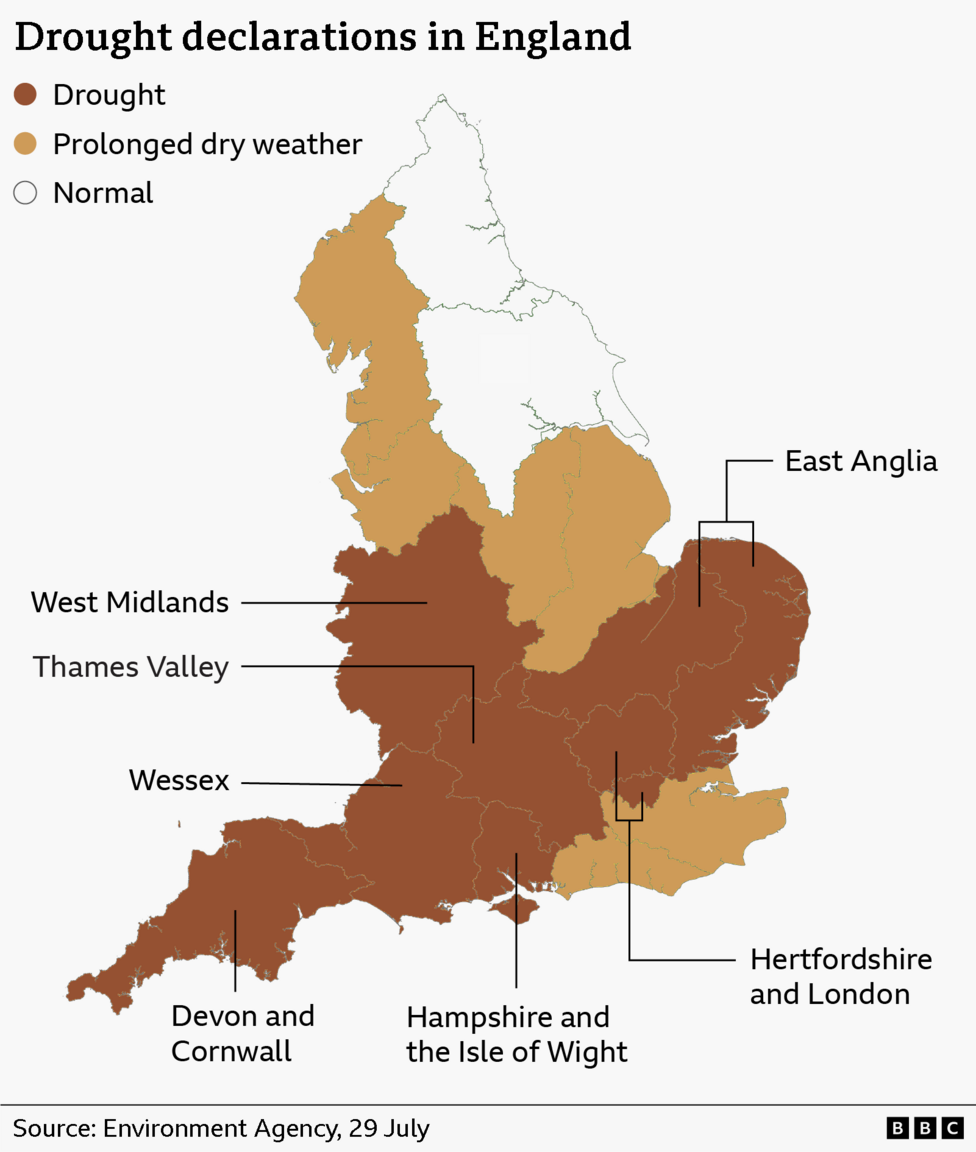
Regions already formally in drought include East Anglia, Hertfordshire, London, the Thames Valley, Hampshire, the Isle of Wight, Devon, Cornwall, the West Midlands and Wessex, which covers Dorset, Somerset, Wiltshire and south Gloucestershire. There is no single agreed definition of drought, though it generally describes an extended period of unusually dry weather with knock-on effects for people, wildlife and the wider environment.
How dry has it actually been?
July was the driest month on record for England and Wales since record-keeping began in 1836, and the driest month ever measured across southern England specifically. River levels have kept falling after seven consecutive weeks in which parts of England received under 10mm of rainfall, and government figures show that east and south-east England saw less than 1mm of rain in the week leading up to 6 August 2026, according to a Government drought summary report.

The same report notes that England's reservoir storage stood at 69% for the week ending 4 August 2026, a drop of 3% from the previous week and 11.6% below the long-term average for this time of year. The Environment Agency has also flagged navigation difficulties for boats on the Thames, Lark and Ouse rivers because of falling water levels, and separately reported that almost all reservoirs across England are running below normal, with five now rated as "exceptionally low".
This is not the first drought warning of the summer. Our earlier coverage detailed how half of England was officially placed in exceptional drought on 29 July 2026, when seven regions were affected after July recorded just 7% of expected rainfall nationally and only 1% across southern England, a milestone also covered in our report on seven areas of England entering drought. Before that, our coverage tracked how the UK's driest areas missed out on rain ahead of a fresh heatwave on 26 July 2026, and how rain returned briefly over one weekend even as parts of Wales entered drought on 23 July 2026, though officials warned at the time it would not be enough to reverse the trend.
Has this happened before?
According to the national broadcaster's report cited above, this marks the third time England has faced drought conditions in five years, following earlier droughts in 2022 and 2025. After the 2022 drought, scientists at the UK Centre for Ecology and Hydrology said it would take "exceptional" rainfall sustained over one to three months to restore river, reservoir and groundwater levels to normal — a benchmark that underscores how difficult recovery can be even after conditions ease.
What is the impact on farming?
The National Farmers Union has warned that the prolonged dry spell could contribute to food shortages if conditions persist. NFU president Tom Bradshaw said wheat and oat yields have been poor this year.
"very, very poor"
Bradshaw also said livestock farmers have already had to dip into winter feed reserves because pasture growth has been too weak to sustain grazing animals through the summer months.
What areas remain on watch?
Beyond the regions already in drought, the Environment Agency's current bulletin lists Cumbria and Lancashire, Greater Manchester, Merseyside and Cheshire, the East Midlands, and Lincolnshire and Northamptonshire as areas currently classified under the lesser "prolonged dry weather" status, according to the Government's drought summary. These are among the areas being watched closely ahead of Monday's review.
What happens next?
The National Drought Group is scheduled to meet on Monday afternoon to assess conditions across England and determine whether further regions should be moved into drought status. The Government's own drought summary states that no changes to area status occurred in the most recent week, but that several areas are expected to see status changes during the week commencing 10 August 2026. Forecasters expect the coming week to remain largely dry, with temperatures rising across much of England and Wales, peaking on Thursday before easing slightly over the weekend, and no significant rainfall currently expected for either country in the foreseeable future.
Key Facts
- Drought already covers roughly half of England and the whole of Wales, with more regions expected to be added on Monday.
- July 2026 was the driest month on record for England and Wales, and the driest ever for southern England specifically.
- England's reservoir storage was 69% as of 4 August 2026, down 3% week-on-week and 11.6% below the long-term average.
- Around 23 million people are already under hosepipe bans, a figure expected to rise.
- The National Drought Group meets on Monday afternoon to decide on further drought declarations.


