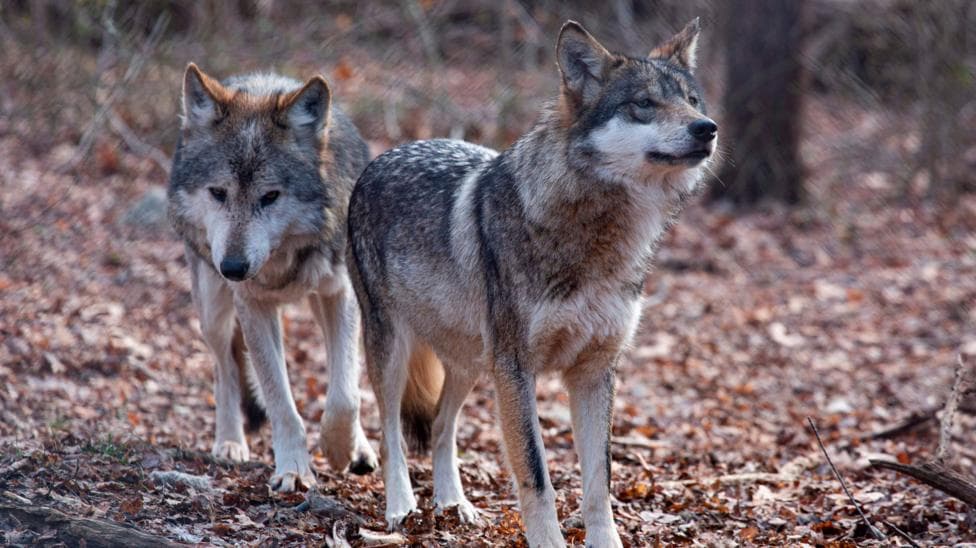
President Donald Trump has signed an executive order directing the removal of endangered species protections for grey wolves and Mexican wolves, a subspecies found primarily in the southwestern United States. The directive could enable ranchers to legally kill wolves threatening livestock, framing the action as support for pastoral farmers who the order describes as playing a "vital role" in the food supply chain and American cultural heritage.
Conservation advocates have strongly opposed the decision, warning that it threatens to undermine decades of recovery work for wolf populations that were nearly driven to extinction. The order does not immediately authorize ranchers to shoot wolves, but instead instructs Interior Secretary Doug Burgum to spend 90 days evaluating whether grey and Mexican wolf populations have recovered sufficiently to be removed from the endangered species list.
How many wolves currently exist in the wild?
Mexican wolf numbers have grown substantially since reintroduction efforts began. According to data from the US Fish and Wildlife Service, the wild Mexican wolf population in the United States reached 319 individuals in 2025, a dramatic increase from just four animals when the reintroduction programme started in 1998. Grey wolves are far more numerous, with approximately 18,000 individuals distributed across the country, though they remain classified as endangered because human activity has destroyed most of their historical habitat.
What is the administration's rationale for this action?
The executive order emphasizes economic pressures facing the livestock industry. It notes that US livestock herds have fallen to their lowest level in 75 years while beef demand has increased by 10 percent over the past decade, concluding that "more can and should be done to support this critical industry." The action aligns with the Trump administration's broader effort to reduce record-high beef prices for consumers, which have been driven upward by drought conditions and a parasite outbreak affecting US cattle stocks.
Ranchers have expressed frustration with other Trump administration policies, particularly the decision to relax restrictions on beef imports—a move intended to address consumer prices but that puts additional pressure on domestic producers' already narrow profit margins.

What do conservation groups say about wolf attacks on livestock?
Environmental organizations dispute the premise that wolves pose a significant economic threat to ranchers. Studies cited by conservation groups indicate that wolf attacks on livestock are uncommon and have minimal impact on ranchers' overall income. The Wolf Conservation Center points out that ranchers currently receive compensation for livestock losses caused by wolves, with individual states funding programmes designed to prevent attacks. Under the existing system, ranchers are entitled to up to 100 percent reimbursement for any livestock killed by wolves.
"This is a huge distraction to placate a handful of ranchers and make them believe that wolves are a greater threat than President Trump's own policies,"said Greta Anderson, deputy director of Western Watersheds Project, an organization focused on wildlife conservation in western US states.
What is the historical context for wolf management in the United States?
The relationship between humans and wolves in North America has been marked by systematic eradication efforts. Towards the end of the 19th century, the US government launched a campaign to exterminate wolves across the country. This government-led initiative, combined with private efforts by farmers and landowners to trap and kill wolves, brought the species to the brink of complete eradication. Despite legal protections established in recent decades, ranchers continue to view wolves as a nuisance, and killing them outside authorized circumstances remains a federal crime.
What happens next?
The outcome of Interior Secretary Burgum's 90-day review will determine whether the administration proceeds with formal delisting. An earlier attempt to remove grey wolves from the endangered species list at the federal level in 2022 became entangled in litigation, and conservation advocates have already signaled their intention to pursue similar legal challenges if the Interior Department acts on Trump's current order.
Claire Musser, executive director of the Grand Canyon Wolf Recovery Project, emphasized the stakes of weakening protections:
"The Mexican grey wolf is not recovered simply because the population has grown. Weakening federal protections now would put decades of recovery work at risk."
Key Facts:
- Mexican wolf population grew from 4 animals in 1998 to 319 in 2025, according to US Fish and Wildlife Service data
- Approximately 18,000 grey wolves currently inhabit the United States, though they remain endangered due to habitat loss
- Interior Secretary has 90 days to determine if wolf populations have recovered enough to warrant delisting
- Ranchers currently receive up to 100 percent compensation for livestock losses caused by wolves under existing state programmes
- A previous federal delisting attempt in 2022 became tied up in court proceedings