

Derrick Bowler and his wife arrived in the Norfolk coastal village of Trimingham in 2011 believing they had a century before their newly bought "dream home" would be claimed by the sea. Fifteen years on, that estimate has shrunk dramatically: North Norfolk District Council now tells them the property, built in 1780, has roughly 20 years left before erosion takes it.
The couple's experience mirrors a wider pattern along this stretch of coastline, where dozens of properties have become uninhabitable over the past two decades. The most recent casualty was a home demolished in May 2024, and Bowler says the changes to the landscape near his own house have been stark.
"We've had to revise our opinions and our thoughts because of the coastal erosion, but it's not something we think about every day - you would go mad otherwise."
Bowler's wife had hoped to recreate the daily beach visits she enjoyed while living in Cape Town, South Africa. When the couple first settled in Trimingham, a gentle 45-degree slope led down to the water's edge. Now, Bowler says, the cliff looks as though "a giant has taken two big bites" out of it.
"In comparison to the inhabitants of Hemsby and Happisburgh, we are so lucky. We don't think about it too much."
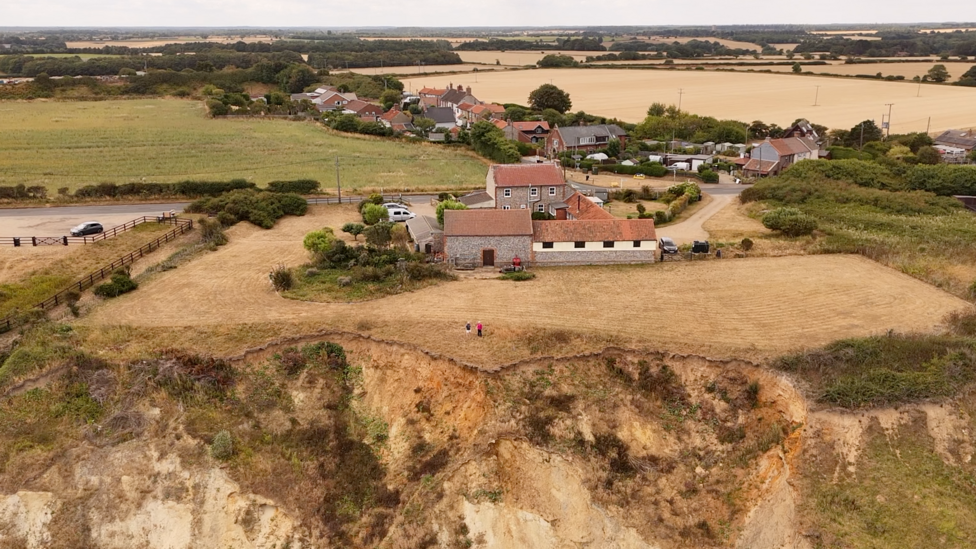
Rather than dwelling on the threat, the Bowlers have chosen to set it aside for the sake of their own wellbeing.
"If we worry about that, we will never get a night's sleep. Let's just enjoy it while we can and when the time comes we'll have to find something else."
Bowler accepts that no amount of money could reverse the process.
"Even if I was to win the Euro Lottery, you still can't stop what's happening from happening. Everything has a lifespan. We might be able to pass it on to Liz's children but we'll just have to see."
Faced with a battle they cannot win outright, villagers in Trimingham have instead focused on measures designed to protect what they can and cushion the eventual loss.
How severe is the erosion at Trimingham?
Official figures show the scale of the problem is considerable. According to a North Norfolk District Council document, cliff regression at Trimingham has been recorded at up to 15 metres a year, which the council says is better understood over the longer term as up to 25 metres of loss every 10 years, according to a council report on water and cliff failure. The same report links the erosion to episodic landslides driven by groundwater and surface water, alongside longer-term recession of the cliff line.
The council's coastal transition manager has said heavy winter rainfall and climate change are contributing to the pace of erosion along this section of coast, according to a national broadcaster's report. Environmental plans cited by the Telegraph suggest that as many as 105 buildings, the main village road and the Grade II-listed 13th-century parish church could ultimately be lost to the sea by 2100.
The demolished Cliff Farm farmhouse referenced earlier became a stark symbol of the danger after a cliff slip left it hanging precariously over the beach for more than a month. The council said it first identified the property as being at risk on 28 March, and pledged demolition would proceed "as soon as is practicably possible," according to a further broadcaster report. Despite the drama of that case, the authority has said "very few" other nearby properties are currently considered at immediate risk, even though the broader coastline remains vulnerable, per the same coverage.
To track the danger more precisely, the council is monitoring the coastline between Sidestrand and Trimingham using fibre optic ground-sensing technology, described as "state-of-the-art" equipment capable of detecting shifts in the earth, according to the broadcaster's report.
What are villagers doing to prepare?
Terry Brown, who moved to Trimingham 17 years ago, bought his property fully aware of where it might eventually end up. At the time, the village hall itself was expected to survive only another 20 years, prompting residents to build a replacement.


Although the cliff behind the hall has "barely receded" since then, Brown believes early action was essential.
"We've got to make sure this village has a future and is able to roll back and continue to be."
Even though Trimingham sits within the Norfolk Coast Area of Outstanding Natural Beauty, Brown argues that building social housing for residents displaced by erosion would help secure the village's long-term survival.
"Nobody knows how quickly it's going to go. You come here because you like what you've got. You like the surroundings, you like being able to get on the beach, you like the people that live around you."
"You've got to be on your toes. We've had little movement through this part of the village but you could wake up tomorrow morning and suddenly you're faced with something quite dramatic."
Alex Ponting, operations manager for the MacKenzie Hotel Group, has taken a similarly cautious approach, describing new construction in the village as unwise. Two years ago, five mobile sea-view lodges were installed at the Sea Marge Hotel in nearby Overstrand, close to Cromer, specifically designed to be relocated if necessary.
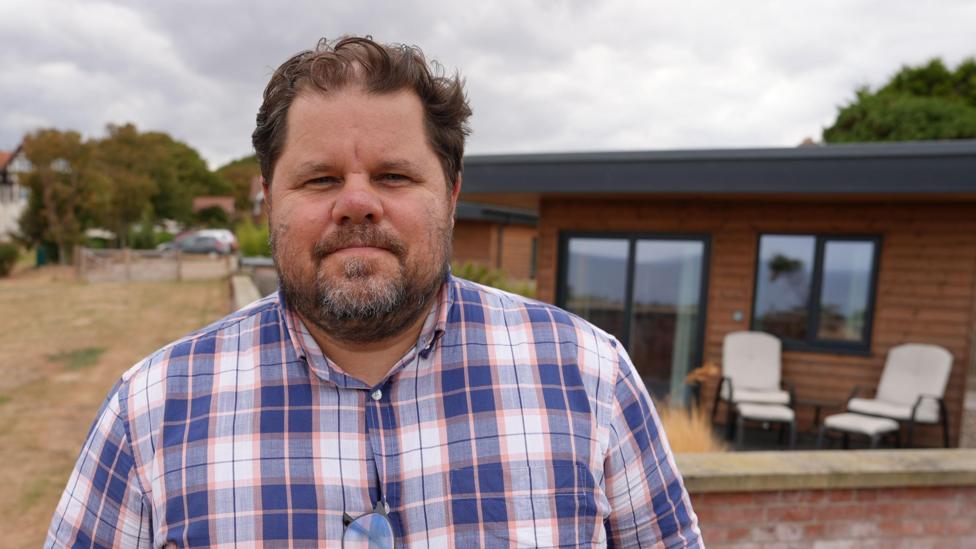
"We have done this purposefully as we are concerned about coastal erosion. These five lodges were built off site and transported… if you take down the wooden cladding you can unbolt them and they are reusable somewhere else."
Ponting said the threat has remained constant throughout the three decades the hotel has operated.
"We are very lucky here that there has been very little degradation of our coastal point but to the right and to the left of us there has been some erosion so we had no choice."
Is money being spent to slow the erosion?
Along the coast at Overstrand, £1 million is being invested in reinforcing the sea wall, an effort officials hope will buy the village's properties another 30 to 40 years. Harry Blathwayt, portfolio holder for coast at North Norfolk District Council, said the investment reflects the strength of the local community.

"Overstrand is a remarkably vibrant and economically viable community so we can actually say, 'we need to expend this money' because this is what we are protecting."
Blathwayt acknowledged that sea levels have risen faster than experts predicted 50 years ago, but said the council's strategy is to put infrastructure in place now so homeowners are prepared for whatever eventually happens.
"I would say there should be a level of concern. Everyone should know the risks they face, but there isn't anything to stay awake about at night."
"[Residents] can thrive. It's not a survival issue, it's how we best thrive and how North Norfolk District Council can support people thriving in this community."
The current shoreline management approach for the Overstrand-to-Mundesley stretch, which includes Trimingham, is classified as "managed realignment," though the next planning period is set to shift to "no active intervention," according to the North Norfolk News. Trimingham Parish Council has separately warned that existing sea defences are approaching the end of their useful life, and that erosion risk at the base of the cliffs is being worsened by groundwater and surface water, according to the parish council's own assessment.
What happens next?
Trimingham and the neighbouring village of Happisburgh are set to become the first communities to receive Coastal Transition Plans developed jointly with residents through the council's Coastwise initiative, following drop-in events held on 12 December 2025, according to the Coastwise project blog. Trimingham Parish Council confirmed that an in-person session with Coastwise and consultancy Jacobs to shape a local Coastal Erosion Transition Plan was scheduled to take place at Trimingham Village Hall on the same date, according to the parish council's website.
Separately, North Norfolk District Council has said it is working toward the demolition of one further erosion-affected property, and hopes that process will move forward within the next 12 months, according to a regional radio station's report. The council's wider Coastwise project is intended to help communities across the north Norfolk coast plan for ongoing coastal change, according to a national broadcaster's earlier coverage.
Key Facts
- North Norfolk District Council now estimates the Bowlers' 1780-built home has around 20 years left before erosion claims it, down from an original 100-year estimate.
- Cliff regression at Trimingham has reached up to 15 metres a year, or as much as 25 metres per decade over the longer term, according to council data.
- A £1 million sea wall reinforcement project at Overstrand aims to protect properties for another 30 to 40 years.
- Environmental plans suggest up to 105 buildings, the main road and the village's Grade II-listed parish church could be lost to the sea by 2100.
- Trimingham and Happisburgh are set to receive the first jointly developed Coastal Transition Plans following a 12 December 2025 planning event.


