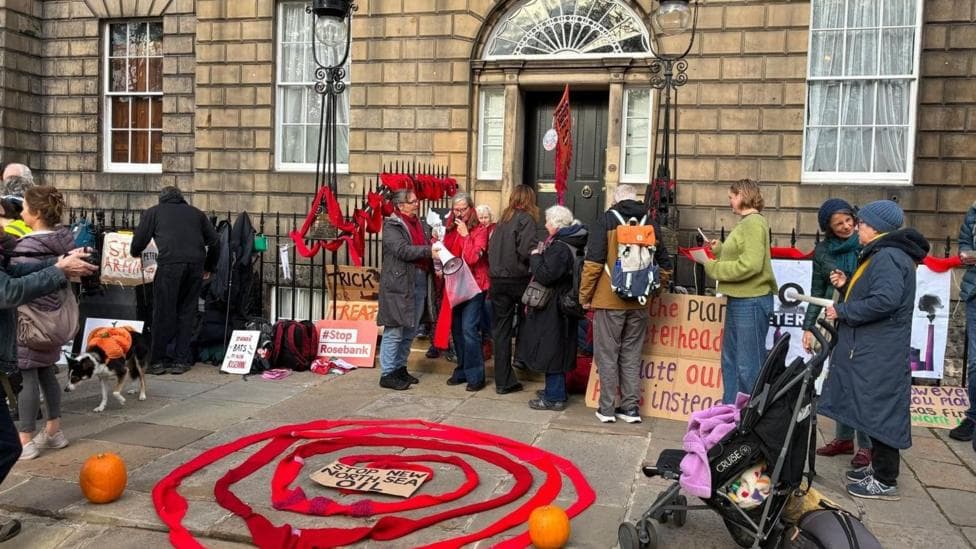
Environmental campaigners have staged a Halloween-themed demonstration outside the first minister's official residence in Edinburgh, protesting against the Scottish government's approval of a new gas-fired power station and the UK government's decision to allow the Jackdaw gas field to proceed. According to BBC News, climate groups gathered outside Bute House to voice their opposition to what they describe as decisions that prioritise fossil fuels over climate action.
This story was first reported by BBC News.
The Scottish government has given the go-ahead for a new 910-megawatt gas-fired power station at Peterhead in Aberdeenshire, a joint venture between SSE and Equinor. The plant is designed to generate about 900 MW and use carbon capture technology intended to remove more than 90% of emissions. Environmental campaigners have branded this decision a "catastrophic failure", arguing that burning fossil fuels remains a key driver of extreme weather including recent storms, record heat and flooding.
The protest also follows the UK government's approval of the Jackdaw gas field near Aberdeen. The North Sea Transition Authority granted development and production consent to Jackdaw's owners, Adura, on 21 October 2026, allowing the project to move forward after earlier court challenges had delayed its progress.
Demonstrators wearing Halloween-themed masks and carrying placards with messages such as "fossil fuel ghouls" and "this decision will haunt you" gathered on Charlotte Square outside the first minister's residence. The timing and messaging of the protest underscored campaigners' view that the government's energy decisions pose an existential threat to Scotland's climate commitments.
What are campaigners' main concerns?
Environmental groups argue that approving new fossil fuel infrastructure contradicts Scotland's stated commitment to achieving net zero emissions by 2045. Kate Whitaker of Friends of the Earth Scotland said fossil fuels are "scary" because of the harm they are causing "millions of people".
"When politicians make disastrous decisions to approve new oil or gas, people get even more terrified about our collective future," she said. "Giving the go ahead for a new fossil-fuelled power plant at Peterhead is a catastrophic failure from the Scottish government to protect people from both climate breakdown and the increasing burden of household energy bills."
Whitaker called on politicians to pursue alternative solutions that would improve living standards without relying on fossil fuels.
"Politicians could instead help allay our fears by focusing on climate solutions that improve people's lives such as warmer homes, reliable bus services and creating green jobs."
The Peterhead decision is particularly contentious because the existing power station at that location has operated since 1982, and its expected closure date has shifted from 2030 to at least the mid-2030s, meaning the new facility would extend fossil fuel generation at the site for decades longer than previously anticipated.
What is the Scottish government's position?
The Scottish government maintains that it remains committed to tackling climate change and delivering climate action to achieve net zero by 2045. A Scottish government spokesperson said the decision-making process took into account potential impacts on communities, nature and cultural heritage, including the cumulative effects of developments.
"We remain unwavering in our commitment to tackle climate change, delivering positive climate action to achieve net zero by 2045. The full grounds for the ministers' decision are set out in the decision letter. Potential impacts on communities, nature and cultural heritage, including the cumulative effects of developments, were important considerations in the decision-making process."
What is the broader context?
These approvals come amid ongoing tensions between the UK and Scottish governments over North Sea energy policy. Earlier in 2026, a Scottish court ruling had overturned previous approvals for both Jackdaw and the Rosebank oil field because the government had not considered emissions from burning the extracted fuels in its environmental assessments. The new approvals represent a reversal of that position.
The Jackdaw project was expected to begin supplying gas to the UK from the end of October 2026, after development work is completed. The decision to allow the project to proceed has drawn criticism from climate campaigners who argue that new fossil fuel infrastructure undermines Britain's international climate credibility and will not meaningfully reduce energy bills for households.