

A builder from near Stowmarket, Suffolk, who built his own observatory in his back garden livestreamed the partial solar eclipse on 12 August 2026 to an online audience of around 1,500 viewers, describing the experience as "fantastic".
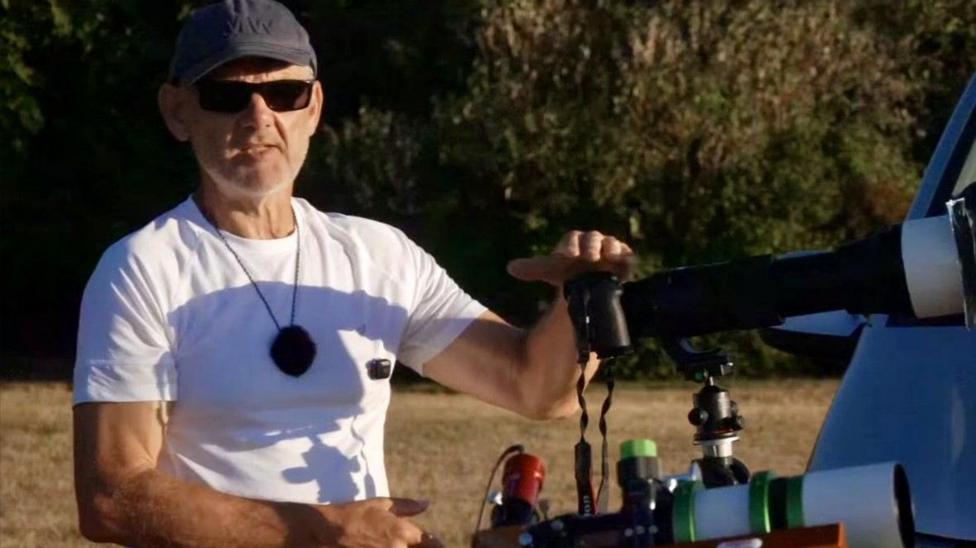
Simon Wallace, who became interested in astrophotography while off work during the Covid pandemic, now operates a fully automated imaging setup at his home. For Wednesday's eclipse, he instead packed up mobile equipment and travelled to a rural spot with an unobstructed view of the horizon so he could broadcast the event live on YouTube while narrating for viewers.
"I've not seen one like that before - I saw one in March last year, but it wasn't as much of an eclipse as this, so for me it was really quite special," he told Radio Suffolk.
"It's just an incredible thing to see - it doesn't happen very often and it's something everyone can enjoy."
"Even the weather played ball, we didn't have any clouds, it was fantastic."
How did Wallace get into astrophotography?
Wallace said photography had long been a hobby of his, and he had spent recent years teaching himself the specialist techniques needed to capture distant objects such as galaxies and nebulae.
"Before I knew it I built observatory and every clear night I have to take images, it's the unwritten astrophotographers' law."
"I tend to spend several nights on one object, and get as much data as a I can - it's quite a truncated process."
He had also livestreamed a previous partial eclipse from his back garden in March 2025, when the moon obscured roughly 30 to 40% of the sun - a much smaller event than Wednesday's.

How significant was this eclipse compared with past events?
Wednesday's eclipse has been widely described as the most substantial seen from the UK since 1999, with more than 90% of the sun obscured by the moon at its peak shortly after 19:00 BST. According to NASA, this was in fact a total solar eclipse rather than only a partial one, with the path of totality sweeping across northern Russia, Greenland, Iceland, the North Atlantic, Spain and a small part of Portugal, while much of the rest of Europe and North America experienced varying degrees of partial coverage. NASA recorded London's coverage at maximum eclipse at 91%, with Madrid reaching 99% and Milan 92%.
reported that the eclipse darkened skies as it tracked from the Arctic toward Spain, marking the first total solar eclipse visible from mainland Europe since 1999 - a milestone also noted separately by NASA. CBS News said the path of totality crossed the northern Atlantic for around 45 minutes, with the shadow reaching northern Spain at approximately 2:30 p.m. ET.
When exactly did the eclipse occur in different locations?
Timing details published by NASA show London's partial eclipse beginning at 6:17 p.m. and reaching its maximum at 7:13 p.m., while Madrid's partial phase started later, at 7:36 p.m., peaking at 8:32 p.m. Separately, Timeanddate recorded the first location worldwide to witness totality at 16:58:09 UTC, with the overall global maximum of the eclipse occurring at 17:46:06 UTC.
Elsewhere in the UK, enthusiasm for the rare event was widespread. One cyclist reportedly rode three and a half hours to Brough Observatory to view the deepest such eclipse since 1999, while crowds in the south of England and Hertfordshire used eclipse glasses and improvised colanders to watch safely. Some UK-based astronomers chose to travel abroad instead, with a group of Cambridge astronomers heading to Spain and the Faroe Islands to witness totality directly.
What is known about the wider impact of the eclipse?
Broadcast coverage indicated that millions of people across the UK and Europe witnessed what was widely regarded as their most significant solar eclipse since 1999, according to an earlier television report from a national broadcaster. For Wallace, the appeal lay in sharing the spectacle with as many people as possible through his livestream, rather than simply observing it privately.
Key Facts
- Simon Wallace livestreamed Wednesday's eclipse from a rural location near Stowmarket, Suffolk, to about 1,500 YouTube viewers.
- The eclipse peaked shortly after 19:00 BST, with over 90% of the sun obscured as seen from the UK.
- NASA confirmed the event was a total solar eclipse, the first visible from mainland Europe since 1999, with totality crossing Greenland, Iceland, Spain and part of Portugal.
- London saw 91% coverage at maximum, Madrid 99% and Milan 92%, according to NASA.
- Wallace previously livestreamed a smaller partial eclipse from his home in March 2025, when 30-40% of the sun was covered.


