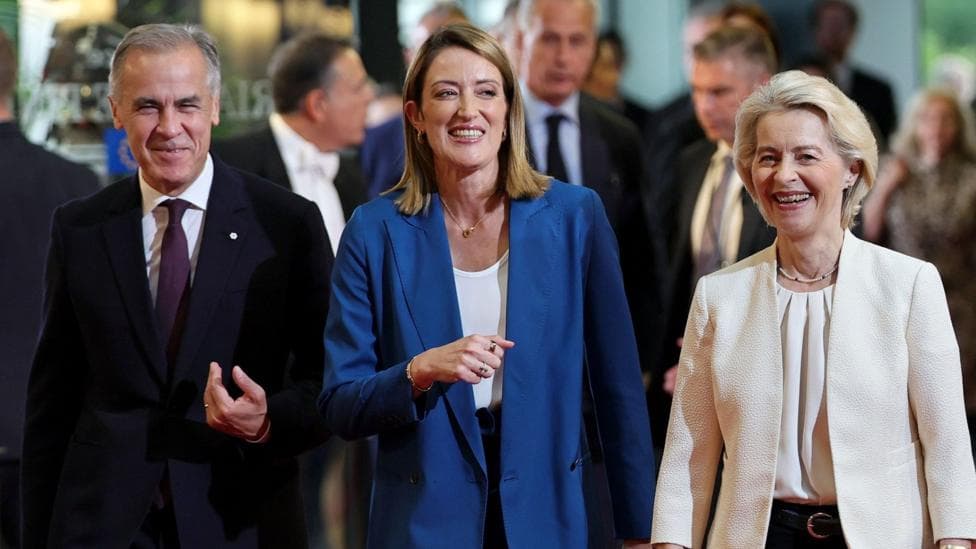
The president of the European Commission has endorsed proposals for Canada to become the EU's inaugural "associate member", a status that does not currently exist within the bloc's framework.
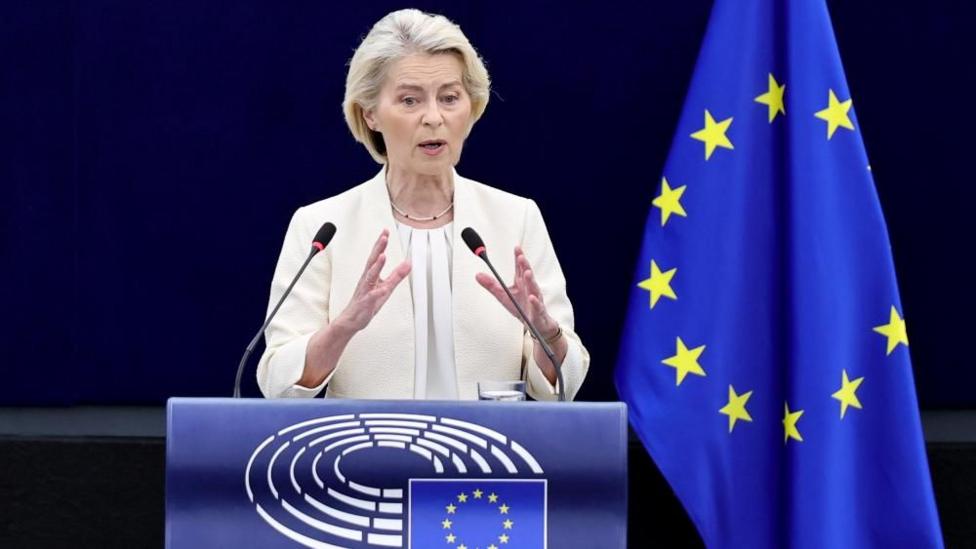
During her address to the European Parliament on Wednesday, Ursula von der Leyen expressed her intention to work on "opening the door" for Canada, which would entail strengthened cooperation across multiple critical sectors including defence, technology, energy and raw materials.
Canadian Prime Minister Mark Carney, who was present at the annual keynote speech in Strasbourg, has previously articulated his country's interest in forging a "unique alliance" with the EU. According to reporting, Carney publicly clarified that Canada is not seeking full EU membership, but rather a distinctive partnership arrangement. Canada currently navigates strained relations with the United States, compounded by an escalating trade dispute that has intensified in recent weeks.
Without explicitly naming US President Donald Trump, von der Leyen characterised the proposed arrangement as
"not a partnership against anyone else, but for our common strength". She further emphasised that
"Partnerships are a strategic choice for Europe. But they also respond to the fracture in the international rules-based system".
Trade negotiations between Canada and the United States collapsed last month, triggering a cascade of new tariff measures. Trump's repeated references to incorporating Canada as a "51st state" have further strained relations between the North American neighbours and appear to have accelerated Ottawa's pivot toward European engagement.
What areas would the partnership cover?
Von der Leyen outlined manufacturing, technology, artificial intelligence, defence, energy, critical minerals and economic security as priority domains for deepened Canada-EU cooperation. She told parliament that the EU and Canada
"see the world with the same eyes", citing shared positions on artificial intelligence, climate action and geopolitical challenges.
The Commission President highlighted areas of existing alignment, stating:
"And we have stood together: on Ukraine, on defence, on raw materials and on supply chains. But above all... Europe and Canada believe in democracy."Von der Leyen said it was time to bring the EU's relationship with Canada to
"the highest level possible".
According to Wall Street Journal reporting, Canadian and EU officials have been discussing a more integrated strategic relationship spanning trade, defence and technology. The same source indicated that Carney instructed his special envoy to Europe to explore the most ambitious options available short of full EU or single-market membership.
How would this new status actually work?
Associate membership of the EU does not currently exist as a formal category, and establishing such a framework would require significant negotiation and agreement among member states. The process, if approved, could require years to complete. Von der Leyen did not provide specific operational details regarding how Canadian associate membership would function within existing EU structures.

Earlier this year, Germany's Chancellor Friedrich Merz suggested—to mixed reactions—that Ukraine could be granted this new status. Several countries in the western Balkans, including Albania, Bosnia and Herzegovina, Montenegro, North Macedonia and Serbia, are already pursuing full EU membership through the established accession process. In Eastern Europe, Georgia and Moldova are also formal applicants.
A significant obstacle to deepened Canada-EU integration involves outstanding trade arrangements. Ten of the bloc's 27 member states have yet to ratify a comprehensive free-trade agreement negotiated with Ottawa nearly a decade ago. Some European capitals prefer to build upon existing defence and trade agreements rather than create an entirely new membership category for Canada.
Why is this happening now?
Both von der Leyen and other European leaders have identified Carney as a dependable partner as they confront comparable challenges. In particular, they have faced Trump's aggressive deployment of tariffs and his stated ambition to annex Greenland, which remains a sovereign territory of EU member Denmark. According to , the idea surfaced amid renewed Canada-U.S. trade friction following the collapse of bilateral talks and escalating tariff measures, prompting Ottawa to examine European alternatives more seriously.
Canada already maintains a comprehensive trade agreement with the EU, which provides a foundation for discussions regarding deeper integration. Commentators have noted that formal EU membership is legally restricted to European states, making any associate-member concept a bespoke arrangement rather than an existing treaty category.
What else did von der Leyen announce?
Beyond the Canada proposal, von der Leyen outlined the EU's political and policy priorities for the year ahead. She proposed establishing a European Security Council that would incorporate the United Kingdom and Ukraine, reflecting mounting security concerns on the continent stemming from Russia.
She stated:
"For a long time, we have discussed a leaders' format focused on the security of our continent, with partners like Canada, Norway, Ukraine, the United Kingdom and others involved. This is even more urgent now, given the nature and scale of the risks at play. This is why we will set out our ideas to make a European Security Council a reality."
Addressing domestic concerns, von der Leyen acknowledged that numerous European families remain preoccupied with living costs and the "dizzying speed of change" in technology and its consequences for employment and society. Additional proposals included inviting the world's leading artificial intelligence laboratories to participate in discussions on supporting industry efforts to advance frontier research.
The Commission also announced plans to reduce regulatory burden on businesses throughout the EU. A new emergency mechanism to assist member states in managing mass migration movements—prompted by the deadly influx of migrants to the Spanish enclave of Ceuta in July—would be introduced. Measures to restrict social media use among children were also proposed, including a ban on platform access for those under 13 years old, with supervised accounts permitted for ages 13 to 15.
What happens next?
Carney is scheduled to deliver a formal address to the European Parliament on 17 September 2026, following his meetings in Strasbourg on 16 September. The Canadian government confirmed that Carney's visit to Strasbourg and Liverpool runs from 15 to 17 September 2026, creating an immediate window for potential new announcements regarding Canada-EU relations. However, reports suggest that no formal deal is likely to be finalised during this week's Strasbourg meetings, indicating that substantive negotiations will continue beyond the current visit.
Key Facts:
- The EU currently has no "associate member" category; creating one for Canada would require negotiation and agreement among all 27 member states
- Canada-U.S. trade talks collapsed last month, with new tariff measures now in effect, accelerating Ottawa's European engagement
- Ten EU member states have not yet ratified the existing Canada-EU comprehensive trade agreement from nearly a decade ago
- Carney will address the European Parliament on 17 September 2026, with no major deal expected to be announced during this visit
- The proposal reflects broader European efforts to strengthen partnerships outside traditional transatlantic frameworks amid geopolitical tensions