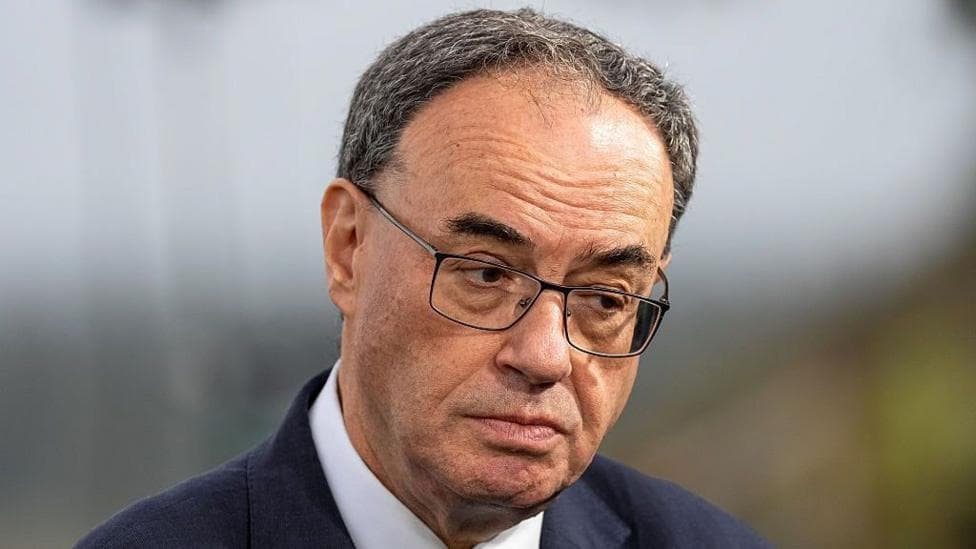
Artificial intelligence investment could trigger significant financial market disruptions, and the UK must prepare for potential shocks, according to Andrew Bailey, governor of the Bank of England.
Bailey stated that the central bank is monitoring the substantial capital flowing into AI firms with close attention and emphasised that success in the sector is far from guaranteed. The billions invested in and lent to artificial intelligence companies in recent years, driven by expectations of substantial returns, have resulted in some firms being valued at multi-trillion dollar levels.
When asked whether he anticipated an AI bubble could deflate, Bailey responded:
"You could see some correction of asset prices at some point."He made these remarks during an exclusive interview about the potential risks and opportunities artificial intelligence presents for the British economy.
Bailey acknowledged that the technology possesses
"great potential to strengthen growth in our economies"and that this capability was needed by the country. However, he stressed that alongside these opportunities came
"substantial risks and so we have to be on top of both of those."
What happens if AI investments fail to deliver?
One significant concern is the possibility that the major bets placed on artificial intelligence may not generate the anticipated profits. Nvidia, an AI chipmaker, currently holds the position of the world's most valuable publicly traded company with a market capitalisation of $5.5tn (£4.14tn), largely due to investor confidence in the substantial profits AI could generate.
In parallel, technology corporations including Alphabet, Meta, Microsoft, and Amazon are committing hundreds of billions of dollars toward the sector. Additionally, two of the world's leading AI enterprises – Anthropic and OpenAI – are preparing to conduct initial public offerings on the US stock market, moves widely expected to channel hundreds of billions of dollars more into the industry.
Bailey noted:
"There is a large, very large, amount of investment going into this sector now, and of course that's natural because it's a major area of growth."He continued:
"And of course you see that the asset prices of the companies that are developing it have gone up a lot and that reflects the fact that there are high expectations of what it can deliver."
He cautioned that
"Everybody is currently priced to be a winner,"but warned that historical precedent suggests otherwise.
"You look back at the past, not everybody is a winner. Google was not the first market leader in internet search. It was Netscape. Nobody can remember Netscape today. It doesn't exist. So not everybody always wins."
According to analysis from the Bank's Financial Policy Committee released on 30 September 2026, rising AI-related debt issuance and other interconnected vulnerabilities have increased the risk of a sharp market adjustment, though markets have remained resilient so far. Morgan Stanley estimated in early September that global AI-related debt issuance stood at around $450bn, double the 2025 level, with some projections suggesting 2026 issuance could reach as high as $570bn.
Bailey stated:
"We are prepared for the fact that there will be, I think, some shocks come along to markets and we have to deal with that. We have to make sure the system is resilient."
This warning builds on earlier concerns raised by the Bank. Bailey previously warned G20 finance ministers that artificial intelligence could trigger a global economic downturn and pose severe cybersecurity risks to financial systems worldwide. In December 2025, the Bank noted that US equity valuations had reached levels not seen since the dot-com bubble, while UK valuations stood at their highest point since the global financial crisis, heightening the risk of a sharp correction.
What cyber and security risks does AI present?
Bailey highlighted additional threats stemming from artificial intelligence, including its potential use in cyber attacks. He explained that AI has created
"a much more powerful way of uncovering vulnerabilities."He added:
"It's revealing things that have been in bits of operating software that we've had, and all of us have had. In the wrong hands... it's a very powerful, potentially very powerful, weapon."
The Bank's July 2026 Financial Stability Report stated that rapid advances in frontier AI had significantly increased cyber and operational risks to financial stability, while also highlighting growing borrowing by AI companies and uncertainty surrounding future profits and productivity improvements.
Another emerging threat is the proliferation of deepfakes – artificially generated images and videos of individuals that appear authentic – which can be deployed to deceive the public. Bailey has experienced this firsthand. In June, fabricated images showing him and Nigel Farage engaged in a physical altercation were distributed across social media platform X.
He told the BBC that the counterfeit images were created in a manner that made it difficult for the Bank to trace their origin.
"We've got to be able to trace these things back. And we need a lot of help from the tech sector to do that,"he said.
How could AI benefit the financial system?
Despite the risks, Bailey identified a significant potential advantage of artificial intelligence: its capacity to
"speed up the work that supports the Monetary Policy Committee [MPC]"which determines interest rates.
"It's not taking a decision, but it's a tool in the hands of the policy maker and that's good,"he explained.
The Bank's April 2025 analysis had previously warned that AI-driven trading strategies could lead firms to adopt increasingly similar positions, potentially magnifying market disruptions during periods of financial stress. This concern underscores the interconnected nature of AI-related financial risks.
What is the Bank doing to manage these risks?
The Bank stated it would maintain close observation of AI-related investment, development and adoption for financial-stability implications. The July 2026 report also urged firms and authorities to reassess their resilience against cyber and operational threats posed by advancing artificial intelligence capabilities.
Key Facts:
- Nvidia, valued at $5.5tn, is the world's most valuable listed company, primarily due to AI investment expectations
- Tech giants Alphabet, Meta, Microsoft, and Amazon are collectively spending hundreds of billions on AI development
- Global AI-related debt issuance reached approximately $450bn in 2026, double the previous year's level
- The Bank of England's Financial Policy Committee warned on 30 September 2026 that rising AI debt and interconnected vulnerabilities increased the risk of sharp market adjustment
- Bailey cautioned that historical precedent shows not all major technology investments succeed, citing Netscape's failure despite early dominance in internet search