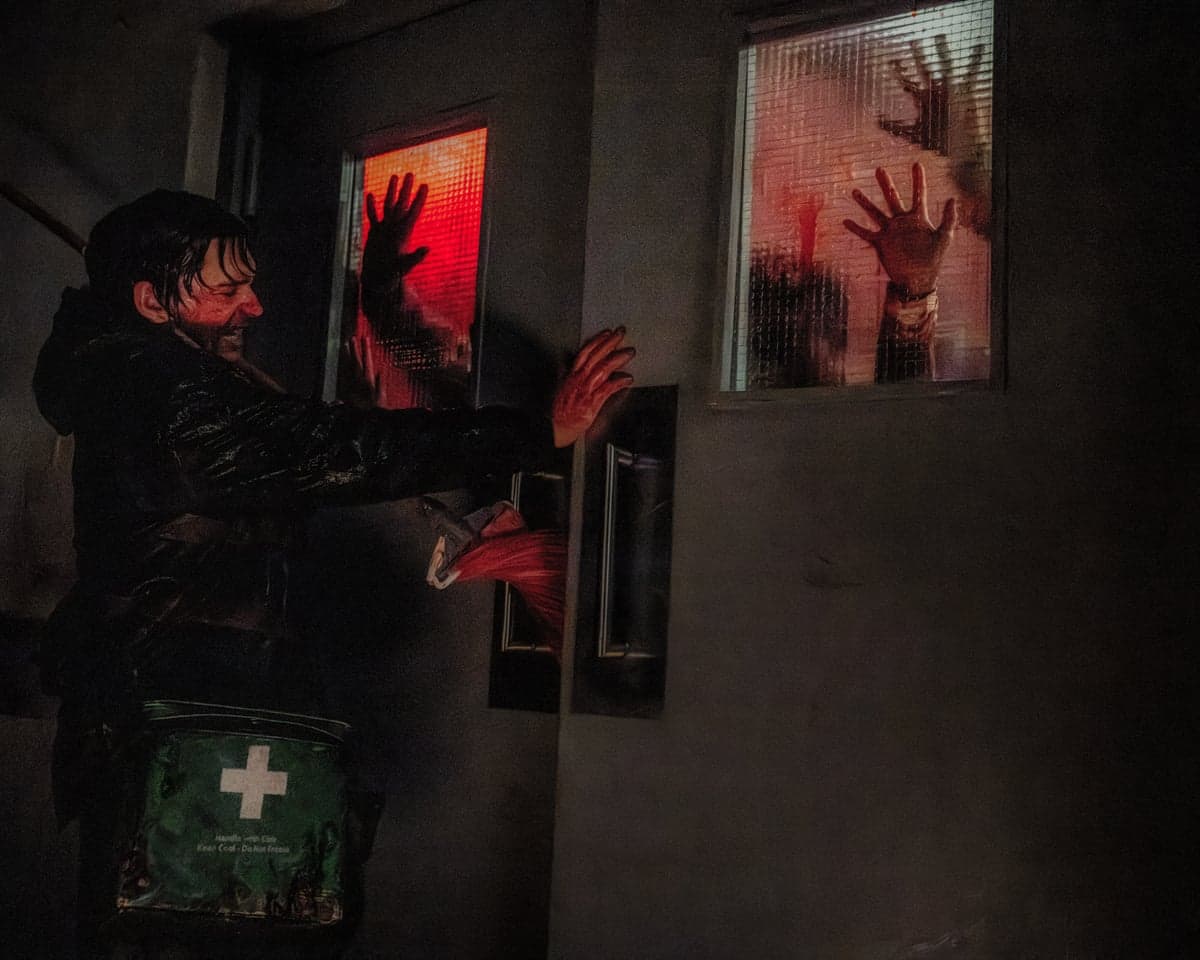
Director Zach Cregger delivers a kinetic horror-action thriller that treats its video-game source material as a template for pure cinematic mayhem rather than a narrative to adapt. The film, which opened in wide release on 18 September 2026, stars Austin Abrams as Bryan, an ordinary courier whose decision to take one final delivery during a snowstorm spirals into a nightmare of monsters and survival. According to industry reporting, the reboot generated $8.8 million in preview screenings—the largest preview total in franchise history—and is projected to earn between $40 million and $60 million domestically in its opening weekend.
Abrams anchors the film with a performance that recalls Bruce Campbell's later Evil Dead work: charming, self-aware, and deeply human even as the character stumbles through catastrophe. What distinguishes Bryan from typical horror protagonists is his refusal to become a caricature. When he strikes a mysterious woman on an icy road, he attempts to help her reach the hospital. When a police officer pulls him over, he prioritizes his medical mission over self-preservation. His failures—whether supporting an unseen girlfriend through a personal crisis or fumbling with a firearm against undead creatures—feel earned rather than contrived. Abrams captures the oscillation between overconfidence and panic with a symphony of profane muttering that occasionally reaches comedy gold; at one point, after multiple near-death experiences, Bryan complains about his wet socks.
This everyman quality serves Cregger's stated ambition: to replicate the experience of playing a video game before mastering its controls, rather than adapting the games' existing storylines. The film, which is rated R and runs 1 hour and 30 minutes, functions as an original story set alongside the events of Resident Evil 2, according to promotional materials. Abrams humanizes what could have been an arch, self-conscious gimmick, transforming the avatar-learning-the-rules conceit into genuine character development. His scenes without other human characters often play like silent comedy—except he's audible enough to deliver a masterclass in frustrated ad-libbing.
How does Cregger's direction shape the experience?
Cregger, who established himself as a horror auteur through the inventive Barbarian and Weapons, orchestrates the mayhem with expert command of pacing, comic-horrific timing, and the jumpscare—including at least one genuinely masterful example. His sketch-comedy roots remain visible in the film's tonal balance, though the comedy lands with less Sam Raimi-style boldness. The director maintains relentless momentum throughout the film's gamified plot structure, never allowing tension or entertainment value to flag as Bryan navigates increasingly surreal encounters.

Where Cregger's vision diverges most sharply from the earlier Milla Jovovich franchise is in its monster-mashier sensibility. Rather than cycling back to zombie action, the reboot embraces a broader creature-feature approach—a shift presumably closer in spirit to the games themselves. This tonal choice feels welcome and fresh, yet Cregger falters slightly in the film's final stretch. The director flirts with exploring the line between monstrousness and underlying humanity but ultimately pulls back, leaving Bryan's character arc incomplete. After spending more than 90 minutes earning audience investment in his journey, Cregger seems to abandon him just short of genuine transformation. Whether this represents a deliberate choice—suggesting that surviving the chaos is journey enough—or a missed opportunity remains ambiguous.
What is the film's place in the broader franchise?
This reboot marks the eighth major theatrical film in the Resident Evil franchise and represents Sony's deliberate restart of the property, separate from the earlier Jovovich series. According to reporting from the film's release, Sony is positioning it as a complete "reinvention" with an all-new story, with the theatrical rollout including IMAX presentations. Cregger co-wrote the screenplay alongside Shay Hatten, bringing a fresh creative voice to material that had previously been mined for action spectacle.
The film's streamlined single-mindedness—its refusal to overcomplicate its premise—distinguishes it from its predecessors. Rather than layering mythology or expanding a complex universe, Cregger keeps the focus tight on Bryan's moment-to-moment survival and the escalating absurdity of his predicament. This approach mirrors the video-game sensibility the director sought to capture: forward momentum, escalating stakes, and the constant threat of failure.
What happens next for the franchise?
The film's opening weekend performance will prove consequential for the franchise's future. According to coverage from early September, Cregger has already begun developing sequel concepts, making the reboot's commercial and critical reception especially significant. The film is scheduled to expand internationally, with a Japan release set for 9 October 2026. If the domestic opening approaches the higher end of industry projections, sequel discussions will likely accelerate, potentially establishing Cregger's vision as the franchise's new foundation.
Key Facts:
- Austin Abrams delivers a Campbell-esque performance as Bryan, a courier drawn into a monster outbreak during a snowstorm delivery run
- Director Zach Cregger (Barbarian, Weapons) treats the video-game source material as a template for cinematic experience rather than narrative adaptation
- The film generated $8.8 million in preview screenings—the franchise's largest preview total—and projects to earn $40–60 million domestically in its opening weekend
- Rated R, 1 hour 30 minutes; an original story set alongside Resident Evil 2 events, separate from the earlier Milla Jovovich franchise
- International expansion begins with a Japan release on 9 October 2026, with sequel development already underway pending opening-weekend performance