The Bayeux Tapestry, one of history's most extraordinary artistic achievements, has opened to the public at the British Museum on 10 September 2026 after arriving in London in July under a historic France-UK loan deal. The 11th-century embroidered narrative of the Norman Conquest unfolds with such visual power and emotional depth that it transcends the limitations of its medieval medium, depicting not merely a battle but the human cost of war itself.
The tapestry's arrival in Britain marks the first time in nearly 1,000 years that this masterpiece has been displayed outside France. According to , the exhibition is proving immediately overd, with tickets sold out for months and the museum expecting around 1 million visitors before the exhibition closes in July 2027. The loan was arranged as part of a reciprocal cultural exchange, with British treasures including the Sutton Hoo artefacts and the Lewis chessmen sent to France in return.
The tapestry should not work as art. By conventional medieval standards, its creators lacked the technical sophistication expected of timeless masterpieces: they could not render proper portraits, pictorial depth, or realistic landscapes. When depicting a church, they resorted to labelling it with the word Ecclesia. Yet from these apparent limitations emerged something stupefying—a work of such visual abundance, humour, and horror that it surpasses almost everything else ever created in paint, carving, or embroidery.
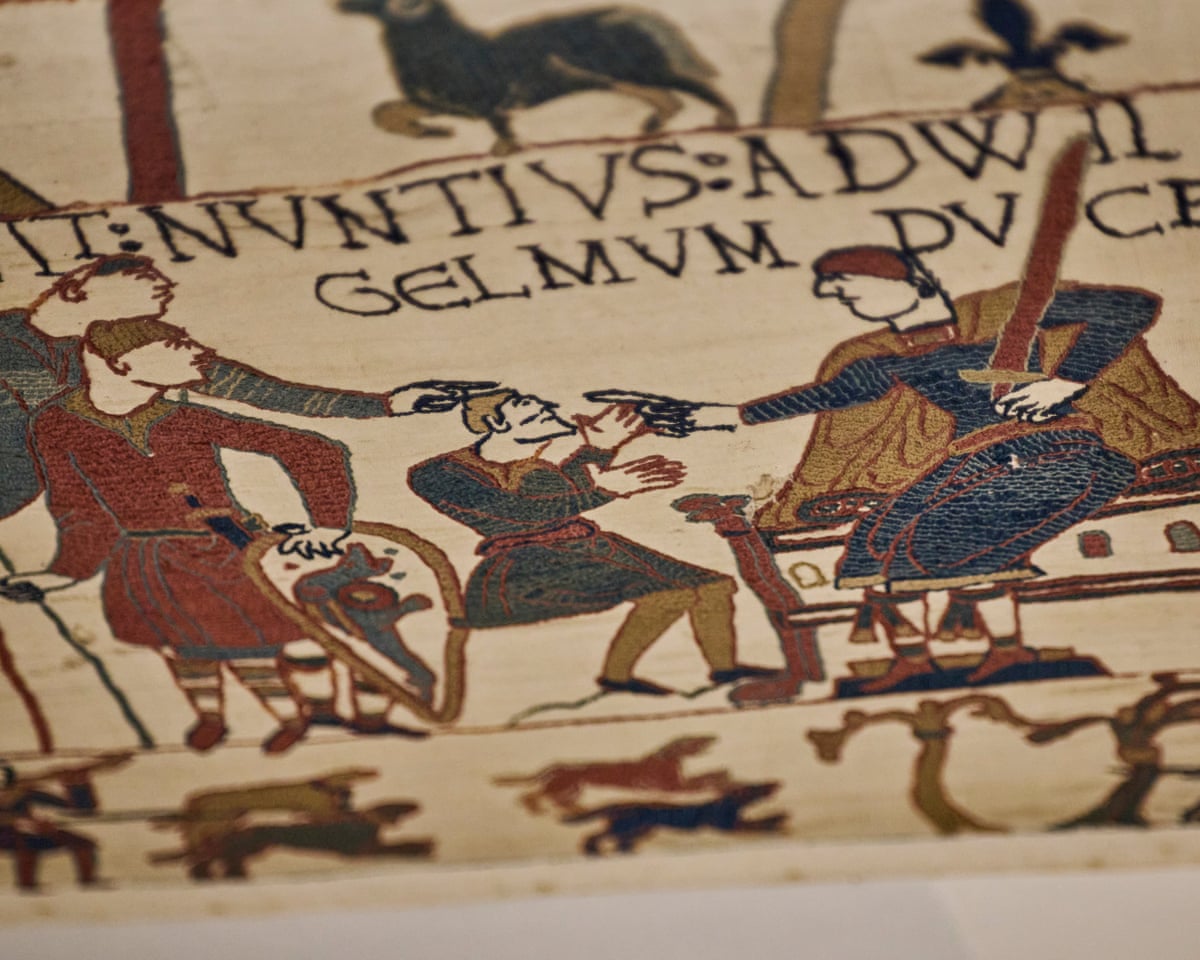
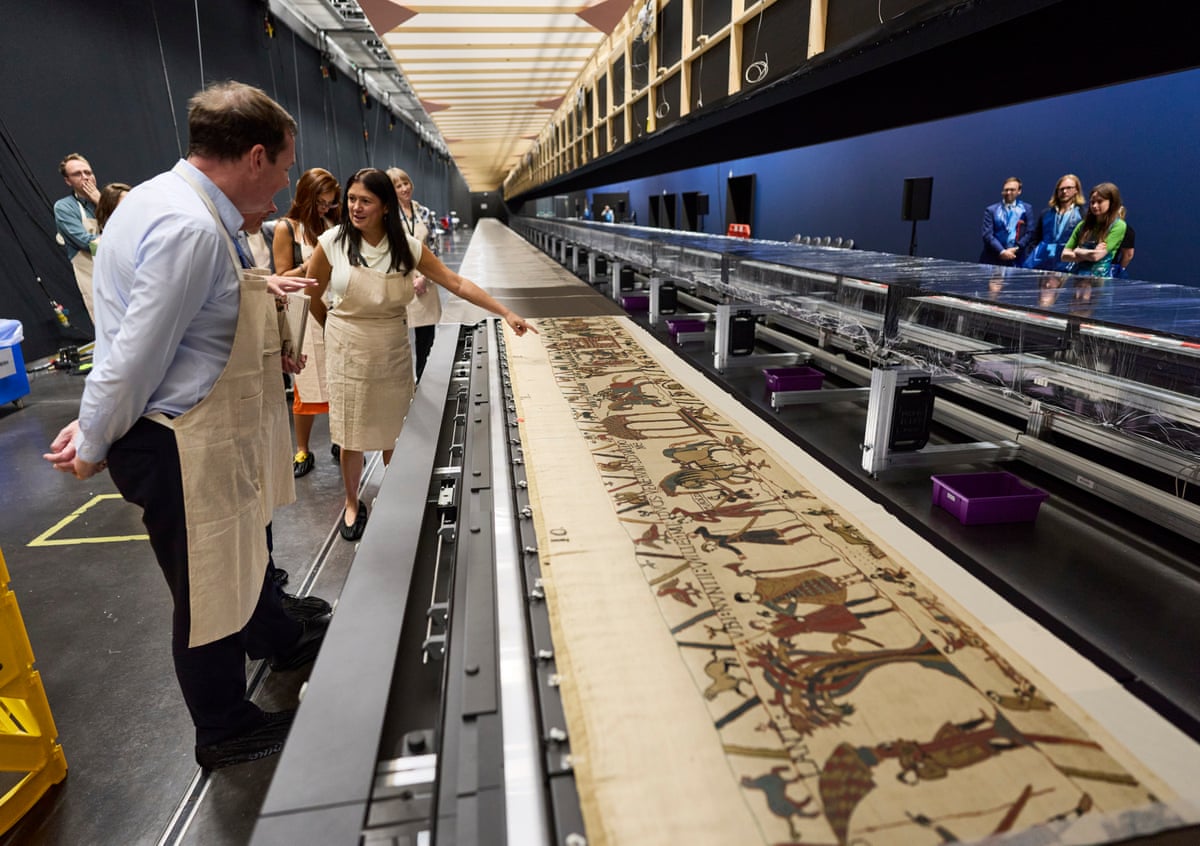
The British Museum's presentation of the tapestry is exemplary. Visitors approach through galleries displaying medieval armour, historical chronicles, and contextual information before reaching the exhibition space. From a viewing parapet, the tapestry's colours—russets, greens, yellows—become visible below. The embroidery is then followed from beginning to end, laid out along the length of a gallery, surrounded by darkness and illuminated with precision lighting that makes the ancient threads shimmer. The only jarring element is the ethereal soundtrack; the narrative demands the sound of drums, war horns, and the clash of battle.
What makes this battle unique in art?
Battles and warfare have captivated artists for millennia, from Trajan's Column to Picasso's Guernica, typically rendered as scenes of hopeless chaos. The Bayeux Tapestry stands apart because of the clarity and definitiveness of its subject: on 14 October 1066, Harold, the recently crowned king of Anglo-Saxon England, and his army faced the newly landed forces of William, Duke of Normandy, near Hastings. By day's end, Harold lay dead alongside devastating numbers of his soldiers and nobles. The Normans had conquered England—and they never left. This single battle transformed a nation in ways that later would-be cross-Channel invaders, including Philip II of Spain, Napoleon, and Hitler, would all fail to achieve.
As viewers move along the display, savouring intimate details—a servant eavesdropping on conversation, one of Harold's attendants carrying his hunting dog aboard a ship to keep its paws dry—the tapestry builds mounting excitement toward the confrontation. The narrative arc is relentless and purposeful.
How does the tapestry convey the violence of battle?
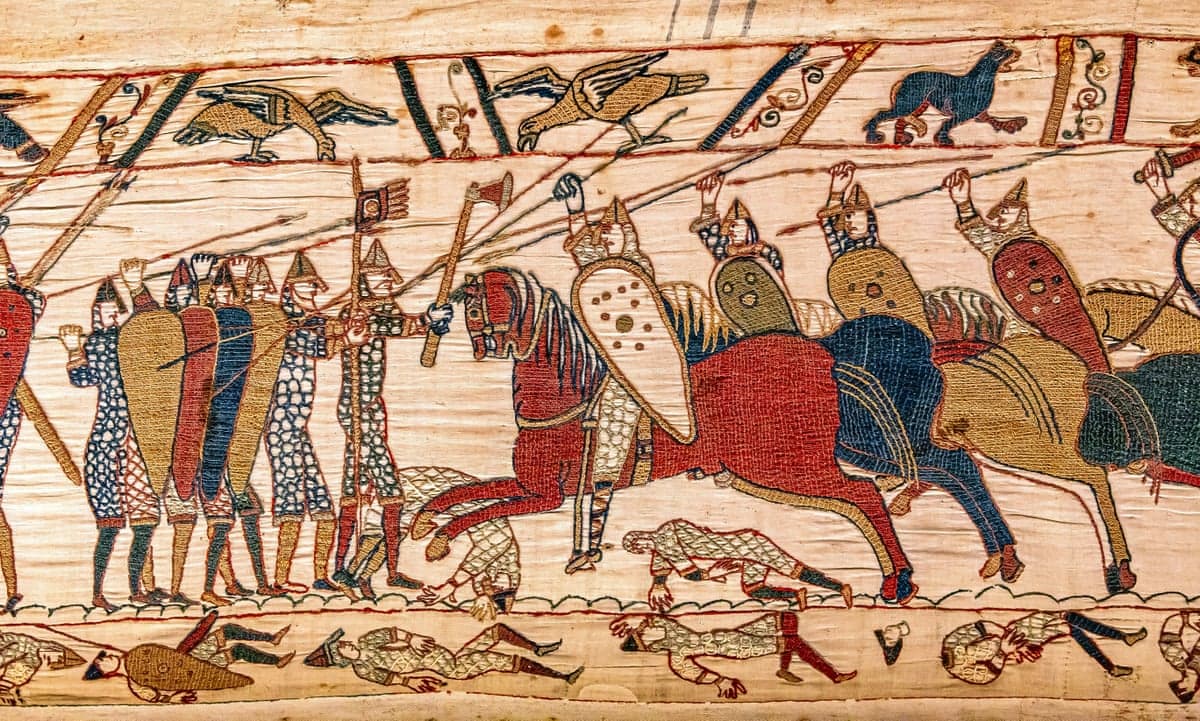
When the conflict erupts, the Norman cavalry pound forward with such force that the earth seems to shake beneath their hooves. Norman archers unleash continuous volleys, sending arrow shafts directly into Saxon bodies. The Saxons, clad in hauberks and armed with axes, stand their ground with grim determination, both absorbing and delivering blows. For a moment, William appears to be losing the day—horses topple, knights fall, the outcome uncertain.
It is in these images that the Bayeux Tapestry transcends every reasonable expectation of medieval craftsmanship. The scene depicting the Norman cavalry's apparent faltering is simultaneously realistic and nightmarish. One horse is completely inverted, its face pressed to earth, rear legs thrust skyward. Another tips as its rider slides forward, his armoured body suddenly transformed into a helpless, vulnerable form.

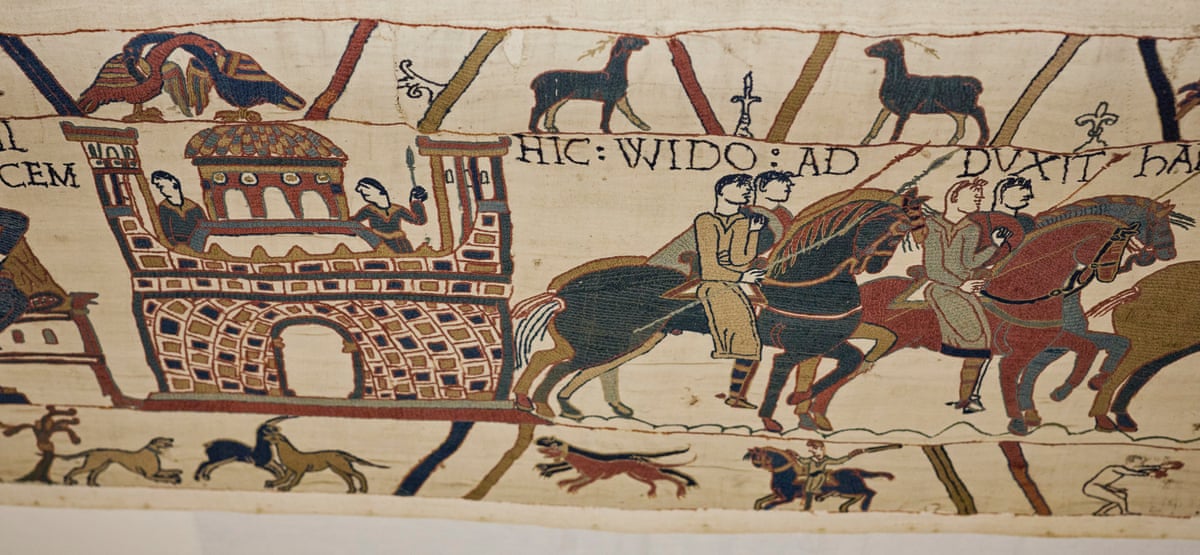
The tapestry's greatest achievement lies in its brilliant sense of momentum. Early scenes show two messengers racing across the French countryside, their hair streaming behind them in straight black threads—a thrilling visual shorthand for speed. This bone-shaking velocity appears repeatedly in superbly economical ways. At Hastings, Norman knights gradually gather pace. Their horses prance calmly, riders sit upright with lances raised, then one rider tilts forward as his horse lowers its head and bends its front legs into a run. Soon all the horses' legs fly in rhythm as the knights hold their lances ready to throw, intensifying the sense of forward thrust.
This is the 11th-century equivalent of Eadweard Muybridge's motion photography sequences. The viewer follows a change in speed as if watching a single figure transform. The Normans appear so disciplined, so perfectly coordinated, that they seem to function as one lethal horseman—and that unity of purpose is why they will prevail.
What role do the borders play in the narrative?
While the central action propels the viewer forward, the margins invite wandering through a world of monsters and myths. Bizarre creatures constantly interrupt the story's momentum: gryphons, dragons, and square-winged, hieratic birds of prey appear far more vivid and commanding in person than in reproduction. Initially, a pattern seems discernible—the upper margin more ordered and sublime, suggesting the heavenly sphere (Halley's Comet speeds through it like a rocket), while creatures below appear earthy and sinful. Yet two bare-chested female centaurs at the top spread their arms as if proclaiming: "Lo and behold!" Such logic dissolves.
The border's great advantage is that it can be broken. When William's ships speed across the Channel, their bulging, wind-filled, multicoloured sails fill the upper space. As the Battle of Hastings grows bloodier, bodies and body parts accumulate in the lower margins.
How does the tapestry show the wider consequences of war?
Both the borders and central strip situate action within a broader world, even a larger cosmos. As the armoured elite march to war, peasants plough and sow fields, rendered in distracting, vibrant detail. This workaday scene approaching the battle is pointed and poignant: whoever wins, whoever rules England, the country people will continue working the soil. A similar sudden shift in perspective occurs when a woman and her child watch Normans set their house ablaze. Yet in the exceptional light and close proximity to the stitches, one of the men torching the building appears sad and conflicted—a moment of profound humanity amid violence.
This honesty transforms the tapestry from a fascinating medieval relic into a universal depiction of war's madness. The violence is stunningly realistic, and so are its consequences. Dead bodies pile in mounds as Saxon after Saxon falls. While historical accounts dispute whether King Harold actually died from an arrow through his eye, the tapestry's depiction is unmistakable. His royal body simply joins the rest of the slain.
In the final scenes, the peasants—the churls—achieve a form of revenge. Small, shabby figures strip the mailed hauberks from dead knights, leaving them naked. This closing flourish reveals the precocious artistic brilliance of these 11th-century artists and craftspeople. Naked bodies emerge from their armour, pale and oddly beautiful—at least the intact ones—as these medieval geniuses demonstrate their ability to depict, through embroidery alone, incredibly gentle, intimate nudes whose dead flesh fills the battlefield with pathos.
What happens next for the exhibition?
The exhibition runs until 11 July 2027 at the British Museum's Sainsbury Exhibitions Gallery. According to the BBC, the tapestry will return to France after the London run concludes. Additional ticket releases are scheduled, with the next wave of bookings reported to open on 21 October 2026. Adult admission is £33, with discounted pricing available for students, 16–18s, jobseekers, and disabled visitors. The loan is temporary, arranged while the Bayeux museum in Normandy undergoes renovation.
Key Facts
- The Bayeux Tapestry is on display at the British Museum from 10 September 2026 to 11 July 2027, marking its first exhibition outside France in nearly 1,000 years.
- The museum expects approximately 1 million visitors during the exhibition, with tickets already sold out for months.
- The loan is part of a reciprocal cultural exchange; British treasures including Sutton Hoo artefacts and the Lewis chessmen have been sent to France in return.
- The 11th-century embroidery depicts the Norman Conquest of 1066, culminating in the death of King Harold and the transformation of England under Norman rule.
- The tapestry will return to France in July 2027 while the Bayeux museum completes its renovation.