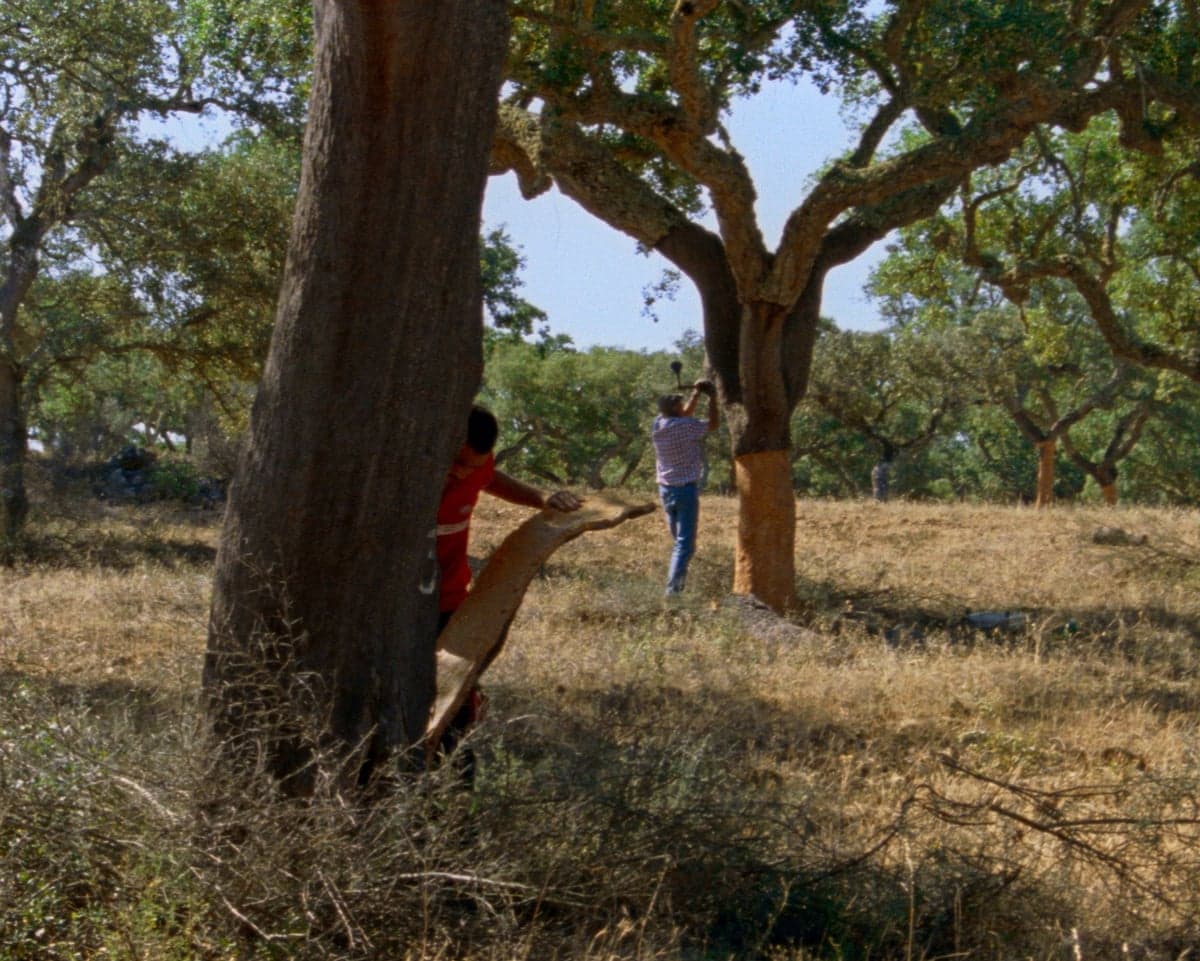
Maureen Fazendeiro's debut feature film stands apart in an era dominated by apocalyptic environmental narratives. Rather than catastrophe, this hybrid work by the Lisbon-based French director offers a meditative study of Alentejo, a rural expanse in southern Portugal, weaving together historical records, geographical observation, and cultural memory into a singular cinematic vision. The opening sequence establishes the film's sensory richness: energetic percussion and organ notes accompany sweeping views of rugged terrain and verdant hillsides, while an archaeological expedition unearths ancient artefacts from beneath layers of dust. Through this layering of past and present, Fazendeiro constructs her film as a cinematic excavation, merging contemporary observation with archival documents, oral folklore with written history.
The film employs extensive tracking shots to navigate both the ecological diversity of Alentejo and the temporal distances between different historical moments. Scenes of rolling green hills, expansive skies, and grazing animals are interwoven with narrated passages from wartime correspondence between German archaeologists Georg and Vera Leisner. The couple, credited with producing the first systematic inventory of megalithic monuments in the region, infuse their letters with both the exhilaration of discovery and the melancholy of displacement during the Second World War.
Oral tradition provides another layer of historical preservation within the film's structure. One sequence captures a gathering of elders in which a woman voices her sorrow over the rise of fascism and the decline of socialism through song, evoking the decades under António de Oliveira Salazar's authoritarian regime. A particularly imaginative moment stages a 17th-century legend, breathing theatrical life into myth. By interweaving these narrative strands—archaeological investigation, personal correspondence, communal memory, and reimagined folklore—Fazendeiro constructs an alternative mode of geographical interpretation, treating the landscape itself as a text or poem to be read, preserved, and transmitted across generations.

How does the film's structure reflect its thematic concerns?
The film's hybrid form mirrors its subject matter: just as archaeologists excavate layers of earth to uncover the past, Fazendeiro excavates layers of history, geography, and culture to reveal the depth contained within a single region. The movement between observational tableaux and archival materials, between contemporary voices and historical documents, creates a temporal fluidity that suggests how the past remains embedded in the present landscape. This structural approach transforms Alentejo from a mere geographical location into a palimpsest where multiple histories coexist and inform one another.
What is the significance of the Leisner correspondence?
The letters of Georg and Vera Leisner serve as a crucial historical anchor for the film. Their work documented dolmens and menhirs in Alentejo, many dating to the 4th millennium BCE, establishing the region as a major centre of megalithic studies. By incorporating their wartime correspondence, Fazendeiro connects personal experience—the joy of discovery tempered by the trauma of exile—to the broader historical forces that shaped European life during the 1940s. The Leisners' scientific endeavour becomes inseparable from their human vulnerability.
What happens next for the film?
The film is scheduled to screen at the ICA in London from 25 September 2026 as part of its Off-Circuit strand. The work, which received its French release on 11 February 2026 under the title Les Saisons, represents an international collaboration involving Portugal, France, Spain, and Austria. Fazendeiro's debut feature has already circulated through festival circuits, including a screening at the Open City Documentary Festival in 2026, establishing her as a distinctive voice in contemporary documentary cinema.
Key Facts
- The film interweaves archaeological investigation, wartime letters, oral histories, regional legends, and poetic reimagining of 17th-century myth
- Georg and Vera Leisner's correspondence provides historical documentation of Alentejo's megalithic heritage, a region rich in dolmens and menhirs from the 4th millennium BCE
- Fazendeiro's debut feature is a four-country co-production and will screen in London from 25 September 2026
- The film treats landscape as a readable text, suggesting how geography preserves and transmits cultural memory across generations