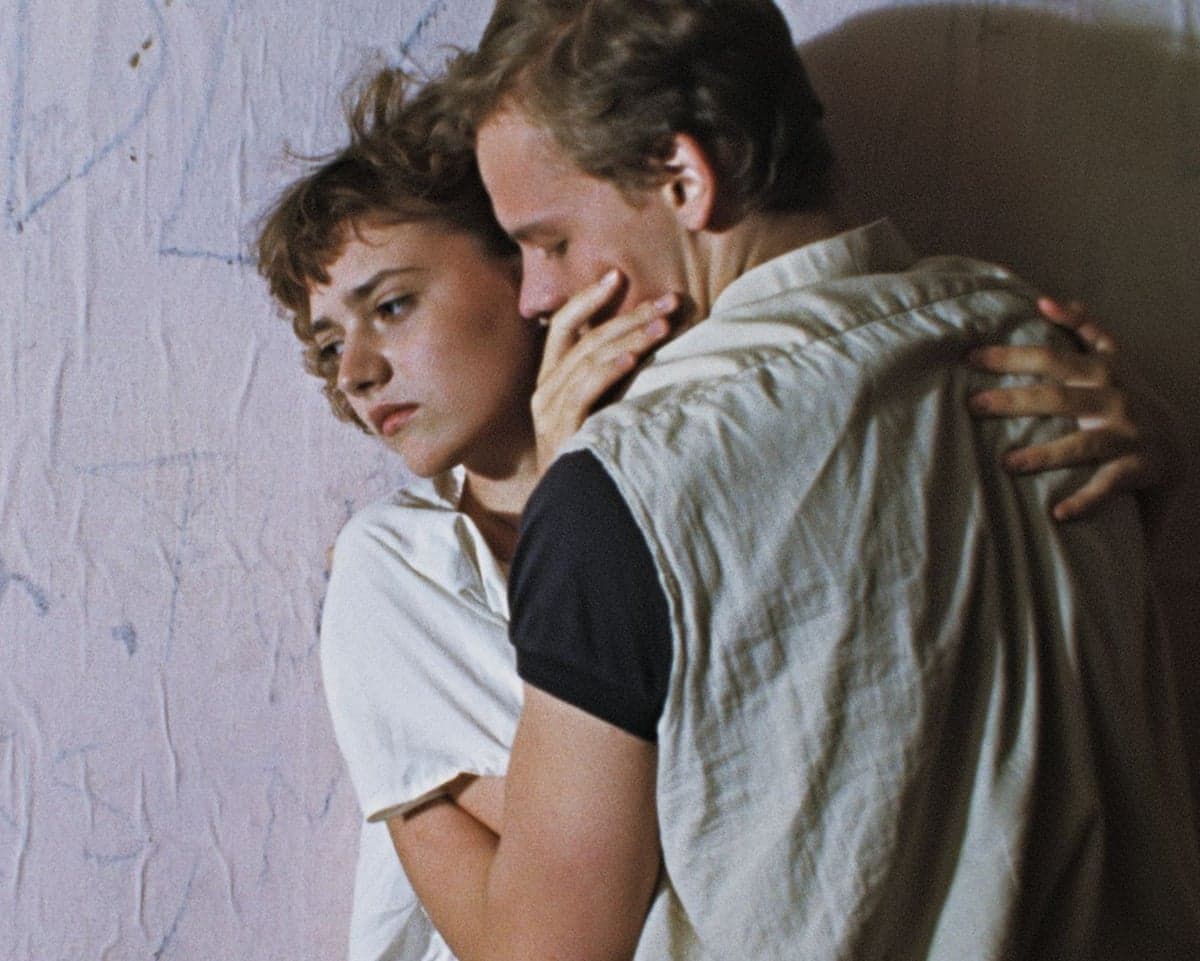
Leida Laius and Arvo Iho's 1985 film Smile at Last presents a bleak portrait of institutional life in Soviet Estonia through the eyes of a teenager abandoned to a state residential facility. Shot with handheld camerawork and nonprofessional actors, the film eschews the sentimental conventions of coming-of-age cinema to offer instead a mysterious parable about state indifference and the survival strategies of the young. The work has recently gained renewed attention following its digital restoration and expanded availability on streaming platforms.
Based on Estonian author Silvia Rannamaa's novel Kasuema, the film follows Mari (Monika Raide), a girl whose mother has died and whose father has abandoned her to a new partner. Packed into a residential youth care facility that blurs the line between orphanage and state boarding school, Mari navigates a harsh social hierarchy and attempts escape, only to find herself returned by police to the same institutional walls. The handheld camera work brings faces looming toward the viewer, intensifying the claustrophobic atmosphere of confinement.
The Estonian title Naerata Ometi translates as Smile at Last, though the phrase carries darker weight in context. It is what a bullying figure named Robi (Hendrik Toompere Jr)—the swaggering top dog of the facility—demands of the unhappy Mari. Robi commands a retinue of submissive peers and enforces his will through intimidation. Yet the film complicates this dynamic through Tauri (Tauri Tallermaa), a more sensitive young man with musical talent and an ambiguous connection to Robi. As Mari observes the intrigues and cruelties of institutional life—including the brutal treatment of single mothers and their children—she begins to perceive that Robi's dominance masks something more complicated beneath.
How does the film portray Soviet state institutions?
The facility functions as a microcosm of late Soviet society itself, reflecting the alienation and warped logic that characterised the system. A photograph of Lenin frowns from the walls of the police station where Mari spends a night after her escape attempt, a visual reminder of state surveillance and authority. The institution presents itself as caring and nurturing, yet the reality is one of neglect, bullying, and the casual cruelty inflicted by those with power over those without. The film refuses to sentimentalise this world or suggest that Mari gains anything redemptive from her ordeal. Instead, it asks whether she has simply become institutionalised, accepting her confinement as inevitable.

What is the film's visual and narrative style?
Despite its ostensible kitchen-sink realism, the film possesses a dreamlike quality. The young people in the institution appear to have no formal schooling; they drift through days of games, crushes, quarrels, and intrigues until the atmosphere turns sour. The handheld camerawork and use of nonprofessional actors create an immediacy and authenticity that contrasts with the film's almost pastoral sense of timelessness. This tension between documentary-like observation and parable-like abstraction gives the work its distinctive unsettling power. The narrative unfolds with a strange, bittersweet acceptance, neither condemning nor celebrating the world it depicts.
What is the film's recent restoration and release history?
The film was originally released in 1985 and runs 87 minutes. The National Archives of Estonia digitised the film in 6K and Locomotive Classics restored it in 4K in 2024, bringing new clarity to Laius and Iho's visual language. This was the penultimate film directed by Laius, a figure of Estonian cinema, and marked Iho's directorial debut. The restored version has a significant festival history: it won the UNICEF Award at Berlinale in 1987 and the Prix Graine de Cinéphage at the Créteil International Women's Film Festival in 1990.
The restored version is currently available on ARTE until 31 December 2026, and was added to the Klassiki streaming platform on 17 September 2026, making it accessible to international audiences for the first time in decades. The film's rediscovery comes as part of a broader reassessment of Soviet-era cinema and its unflinching documentation of social dysfunction.
What screenings are scheduled?
Cinémathèque @Cercle Cité will present the digitally restored version on 24 October 2026 as part of CinEast 2026, offering audiences the opportunity to experience the film in its newly restored form on the big screen. This screening represents a significant moment for the film's continued circulation and critical reassessment.
Key Facts
- Directed by Leida Laius and Arvo Iho, based on Silvia Rannamaa's novel Kasuema
- Shot in 1985 with handheld camerawork and nonprofessional actors; restored in 4K in 2024
- Won the UNICEF Award at Berlinale (1987) and Prix Graine de Cinéphage at Créteil Women's Film Festival (1990)
- Currently streaming on ARTE until 31 December 2026 and available on Klassiki from September 2026
- Screened at CinEast 2026 on 24 October 2026 in its restored version