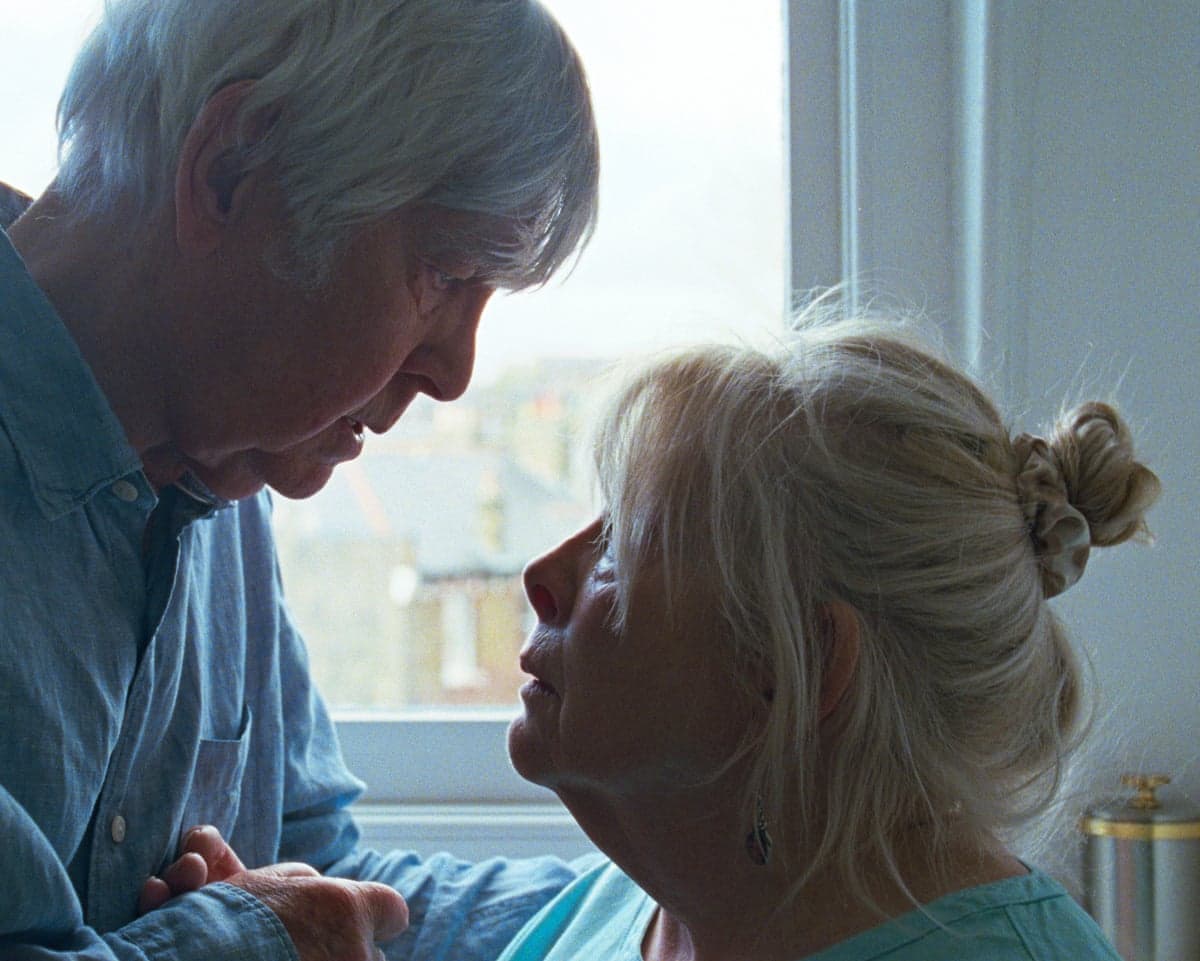
Driven by extraordinary late-career performances from Tom Courtenay and Anna Calder-Marshall, Lance Hammer's long-awaited return to filmmaking is an unbearable meditation on dementia, spousal care, and the moral complexities that arise when a carer becomes as fragile as the patient they tend. The film, which premiered in competition at the 76th Berlin International Film Festival on 17 February 2026, has already garnered significant recognition: both Courtenay and Calder-Marshall won the Silver Bear for Best Supporting Performance, while the film itself claimed the Silver Bear Jury Prize.
This profoundly painful narrative explores dementia, the endgame of care, and the agonising decisions that must be made when the line between protection and violation becomes impossible to discern. At its heart lies a question about the nature of intimacy between partners and how adult children navigate their own sense of responsibility when that intimacy becomes contested.
The Setup: A Troubling Discovery
The story unfolds in a wintry, grey London. Juliette Binoche plays Amanda, a recently divorced academic who has taken a sabbatical with her teenage daughter, Sara (Florence Hunt), to be nearer to her elderly mother, Leslie (Calder-Marshall), who is living with dementia, and her stepfather, Martin (Courtenay).
One unremarkable weekday morning, Amanda discovers Martin and Leslie engaged in sexual activity, her mother's face a blank mask of incomprehension. Furious, Amanda accuses Martin of rape. Her revulsion stems partly from the fact that he is her stepfather rather than her biological father, but more fundamentally from the fact that their GP has already advised that Leslie can no longer provide meaningful consent to sexual activity.
The Moral Argument: Who Decides?
Martin, however, has conducted his own research and presents a counterargument that complicates the narrative considerably. He contends that marital intimacy provides comfort to dementia patients in the same way that other care activities do—food, shelter, medical treatment—all administered without explicit consent. Crucially, he argues, it also sustains the carer. He loves his wife, and this remains a vital expression of that love.
Amanda's response is to call the police, a decision she almost immediately regrets. Martin is barred from seeing Leslie, who becomes terrified by the rape examination and bewildered by her husband's absence. The only way to halt the legal proceedings is for Leslie to enter a care home—something Amanda has long demanded. Martin fiercely resists, viewing this as a malicious manipulation, a false choice between institutional care and criminal prosecution, and a permanent stain on his character regardless of the outcome. Meanwhile, Sara begins a relationship with a boy at her new school, a secret her mother remains unaware of.

A Cascade of Impossible Choices
The narrative progresses through a series of agonisingly ambiguous situations, each representing a point of no return, each marked by words and actions that cannot be unsaid or unseen. The film refuses easy moral judgement: Is Amanda right to intervene as she has, or has she fundamentally mishandled the situation? Is Martin a sinister abuser or a misunderstood man trying to preserve his marriage? Is the care home itself necessarily harmful? The crisis that unfolds, rooted in uncomfortable truths about older people's sexuality and the potential for abuse, does not resolve these questions. Every development is merely a consequence of the overall situation, which can only be managed, never solved.
The Crux: A Four-Way Conversation
The film's emotional and moral centre is a four-way conversation between a social worker, Amanda, Martin, and Leslie. Martin delivers a tearful, passionate declaration of love for his wife and closest companion—a virtual renewal of their marriage vows, which Leslie poignantly reciprocates. The film poses its most devastating question here: Has dementia rendered her affirmation meaningless?
The film concludes with a heartbreakingly ironic and enigmatic final sequence that refuses conventional narrative resolution. It functions as a diptych exploring love across generations, contrasting the pleasures and expectations of intimacy in youth with those in age.
Director's Return and Critical Reception
This represents the return of American independent filmmaker Lance Hammer, who has been absent from feature filmmaking since his 2008 debut, Ballast. Queen at Sea is a lacerating work that invites comparison with films that grapple with similar moral weight and emotional intensity. The 121-minute Anglo-American production carries the tragic, wintry candour of a work unafraid to sit with ambiguity and refuse easy answers.
The film's performances are extraordinary. Courtenay and Calder-Marshall inhabit their roles with a depth and vulnerability that makes every scene almost unbearable to witness. Their work has already been recognised internationally, with recent critical coverage describing the film as a brutal masterpiece about the end of life.
What Happens Next
The film is now in cinemas in the UK following its theatrical release through Curzon. Greenwich Entertainment has scheduled a US theatrical release for 30 October 2026, with further international releases planned, including a Dutch release on 12 November 2026.
Key Facts
- Won the Silver Bear Jury Prize at the 2026 Berlin International Film Festival, with both lead actors receiving the Silver Bear for Best Supporting Performance
- Marks Lance Hammer's first feature film since his 2008 debut, Ballast
- Stars Juliette Binoche, Tom Courtenay, Anna Calder-Marshall, and Florence Hunt in a 121-minute Anglo-American production
- Explores dementia, spousal care, consent, and the moral complexities faced by adult children when their parents' autonomy is in question
- Now playing in UK cinemas, with US theatrical release scheduled for 30 October 2026