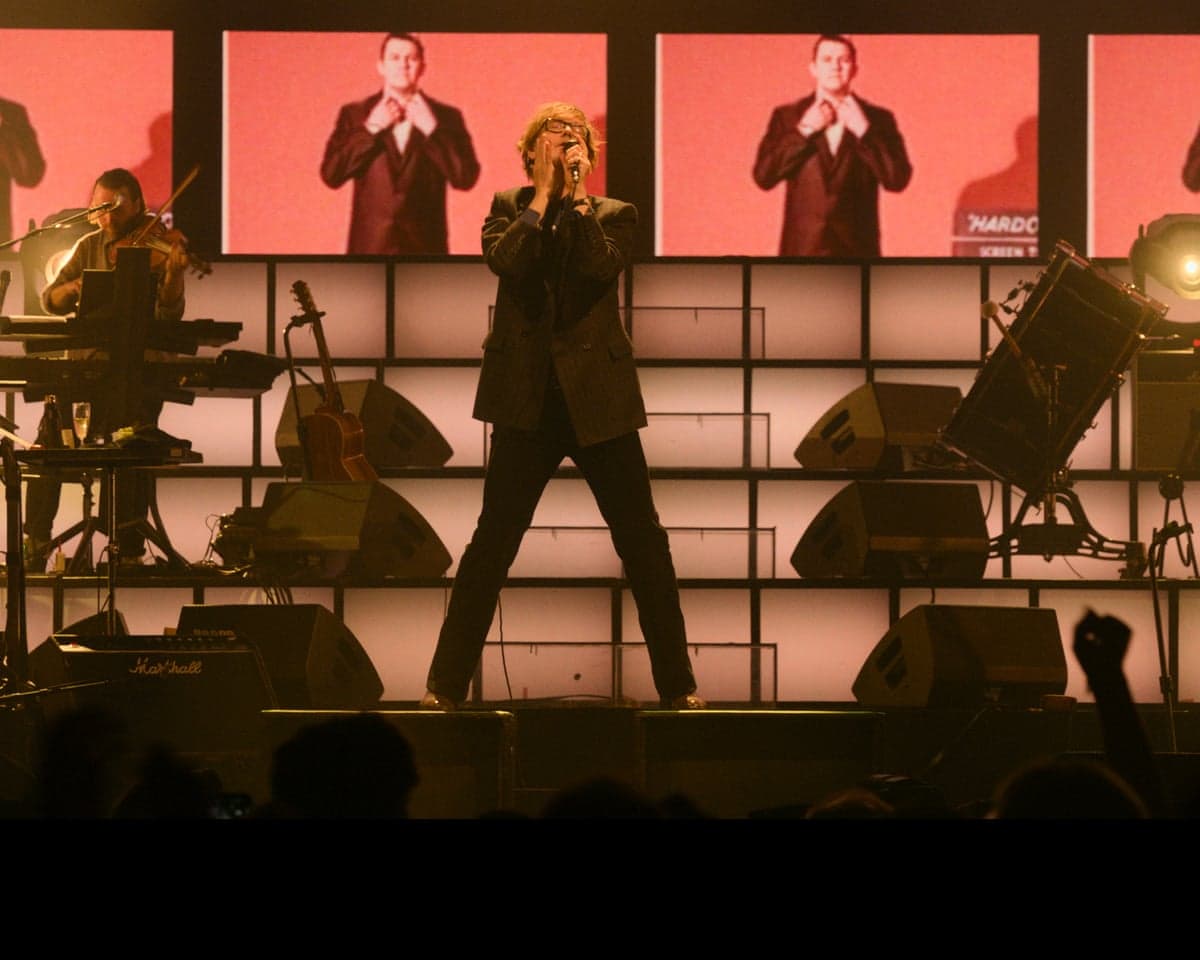
In 1978, a 15-year-old student at a Sheffield comprehensive school penned an ambitious vision in the back of an exercise book—a blueprint for stardom with a band formed by classmates equally unlikely to be picked first for sports. Nearly half a century later, that same musician, now in his sixties and still commanding the stage, led his group Pulp through two sold-out nights at London's O2 arena in front of 20,000 people each evening, marking a triumphant return after a decade away from touring.
The new documentary What Do You Do for an Encore?, directed by Garth Jennings and running approximately 99 minutes, weaves together concert footage from those landmark O2 performances with four decades of previously unseen archive material and personal reflection. Jarvis Cocker performs his art-pop anthems alongside most of the classic band lineup and a 10-piece string section, while the film layers in autobiographical narration, interviews with family members, and the story of how an outsider from Sheffield became a national institution. According to music industry reporting, the project is built around Pulp's "More" tour, which supported the band's first album in 24 years.
The documentary balances celebration with introspection in characteristically Cocker fashion. In voiceover, he reflects that songs
contain pockets of energy from your past life that's released again when you perform them. Listening to these performances now, the lyrics reveal a preoccupation with youth and uncertainty about the future—lines such as
Let's all meet up in the year 2000 / Won't it be strange when we're all fully grown?capture young people wrestling with present decisions while imagining adulthood. The archive material demonstrates how Cocker achieved an unlikely transformation: the patron saint of outsiders, celebrated for championing
misshapes, mistakes, misfits / Raised on a diet of broken biscuits, seemed bemused by his own ascent to national treasure status. Yet he grasped early the power of performance—that even the most awkward teenager could strike a pose and become a symbol of desire.

Even at the height of the Britpop era, Pulp remained distinct from their contemporaries. A 1996 clip shows Cocker participating in a charity football tournament alongside Liam Gallagher, Damon Albarn and Robbie Williams; while he briefly made the starting XI, his presence on the sidelines seemed more natural. Much of the 1990s footage suggests that achieving the dreams of his youth proved anticlimactic—a trauma from which he has only recently recovered.
The reunion carries symbolic weight. Pulp's first album in 24 years reached number one, and the O2 concerts opened with a track from it, Spike Island, featuring the defiant declaration
I was born to perform … I exist to do this. These performances marked the band's 566th and 567th live shows, with no indication that further dates will not follow.
Why the arena setting undermines the film's power
The documentary's weakness lies in its reliance on the O2 as the sole filming location. Even by the standards of corporate megavenues, the O2 functions as what might be called an enjoyment-vortex—a space designed to contain rather than amplify energy. While audience members sing along and appear engaged, the screen transmits little of the vitality that must have filled the room. Pulp's appeal rested on their directness, their sense of speaking to and for their audience intimately. Yet the camera placement, the vast stage, and the distance between musicians all conspire against capturing that connection. The biographical and archival sections shine with wit, warmth and unmistakable Cocker sensibility; the concert footage, by contrast, demands to have been experienced in person.
What comes next for Pulp
According to recent announcements, the film will premiere theatrically across the UK, Ireland, Canada, the US and Mexico before becoming available exclusively on MUBI from 25 September 2026. Canadian theatrical screenings are scheduled for 23 September 2026, with US screenings following on 24 September 2026. A companion live album, Live!, was released on 28 August 2026 alongside the documentary rollout. Looking further ahead, Jarvis Cocker has hinted that another Pulp album could arrive within the next couple of years, contingent on circumstances aligning favourably.