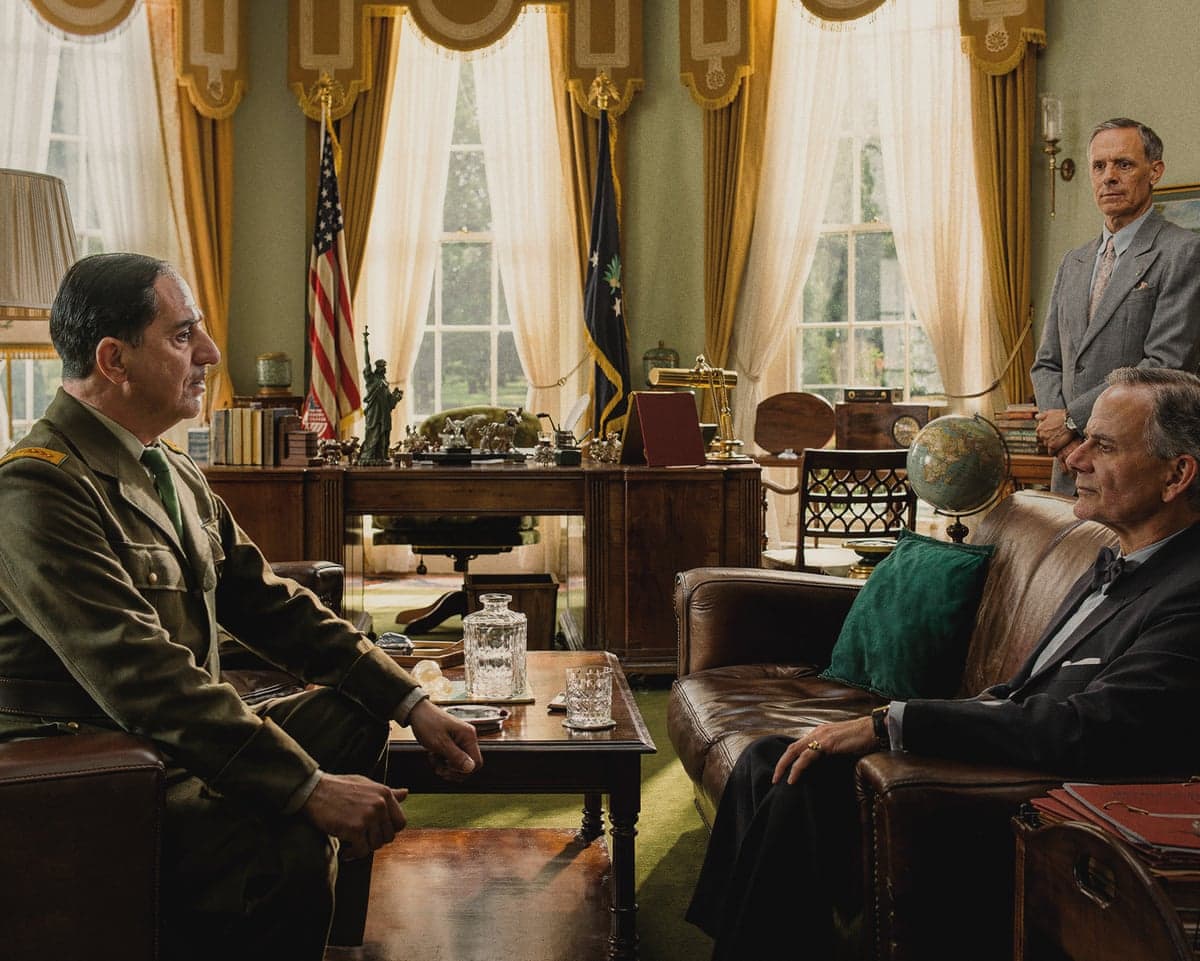
Simon Abkarian delivers a commanding performance in this commercially successful two-part film about General De Gaulle, which concludes with the second instalment tracking his rise to political dominance during and after the Second World War. The film, a France, Belgium and US co-production with a runtime of two hours and 39 minutes, focuses on De Gaulle's transformation from exiled figurehead to architect of French postwar authority.
Liberté charts De Gaulle's journey from his position as the contested leader of the Free French forces in exile—the figurehead maintaining French sovereignty while his authority remained challenged by rivals and allies alike—through to the triumph of the D-Day landings and France's liberation. The narrative centres on De Gaulle's diplomatic masterclass in persuading President Franklin D. Roosevelt, portrayed by Campbell Scott, to recognise French interests when American planners had envisioned treating postwar France as little more than a dependent territory comparable to occupied Japan.
How does the film portray De Gaulle's relationship with Churchill?
De Gaulle's turbulent partnership with British Prime Minister Winston Churchill, played with particular warmth by Simon Russell Beale, continues from the first instalment, and the film offers fresh insight into Churchill's deep affection for France and French culture. The screenplay captures De Gaulle's strategic intelligence as he manoeuvres through the provisional French government, appearing to share power with rival General Henri Giraud, played by Thierry Lhermitte, before systematically outmanoeuvring him to consolidate his own authority.

What role do military figures play in the narrative?
The African theatre of operations introduces General Leclerc, portrayed by Niels Schneider, whose unconventional tactics and improvisational military genius draw inspiration from De Gaulle's own leadership philosophy. Field Marshal Bernard Montgomery, shrewdly cast as Pip Torrens, appears in supporting scenes, though the film notably excludes German military figures from its mythic retelling of events.
Abkarian excels in scenes depicting De Gaulle's arrival at various locations, where he meticulously assesses the reception and status accorded to him, remaining acutely conscious of any perceived slight to his person and to France itself. The actor mines considerable dark comedy from De Gaulle's compulsive need to evaluate every room he enters, calculating potential insults and threats to national dignity. While Liberté may lack some of the intimate political intrigue present in the first half, it remains an engaging historical drama executed in the style of classic war epics by directors such as J Lee Thompson and John Sturges.
When will audiences be able to see the film?
The film arrived in UK and Ireland cinemas on Friday 18 September 2026, with screenings continuing through late September at venues including Filmhouse Edinburgh on 22–24 September.
Key Facts
- The second instalment concludes the two-part historical epic but does not explore De Gaulle's complex postwar handling of the Algerian question, leaving scope for potential future dramatisation
- Simon Abkarian's performance anchors the film through scenes emphasising De Gaulle's acute sensitivity to matters of French prestige and international standing
- The film demonstrates how De Gaulle secured American backing for French sovereignty at a moment when US policymakers intended to treat France as a subordinate postwar dependency
- General Leclerc emerges as a secondary protagonist whose military innovations reflect De Gaulle's own strategic vision
- The production represents a France, Belgium and US collaboration spanning two hours and 39 minutes