

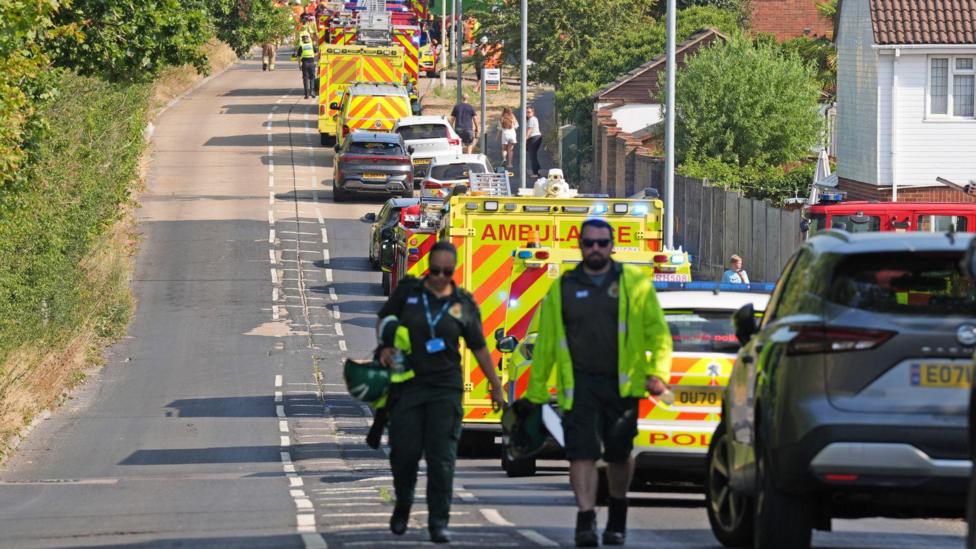
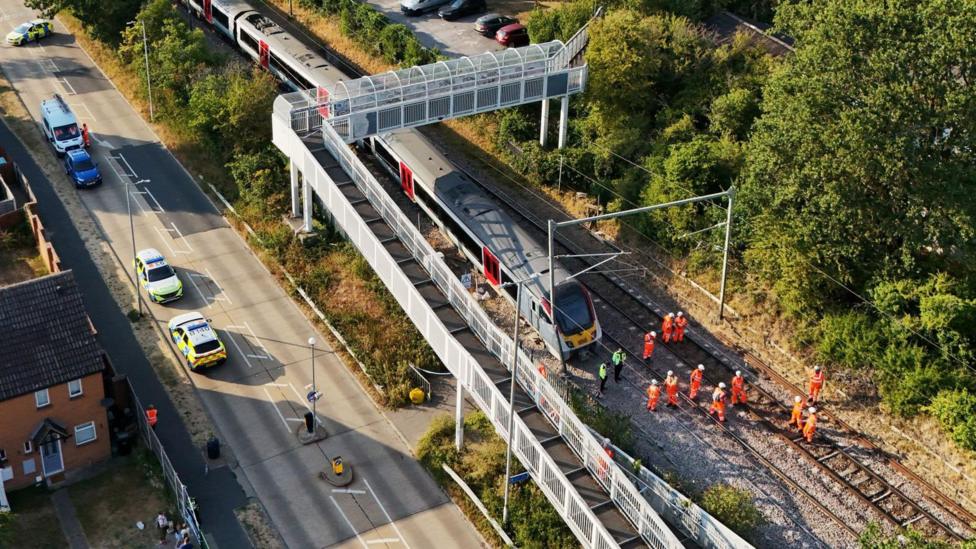
A Greater Anglia commuter train derailed just south of Wickford railway station in Essex on Friday, 14 August 2026, triggering the cancellation of all services on the line and widespread travel disruption. The train, which had been travelling from Southend Victoria to London Liverpool Street, came off the tracks at 14:12 BST with around 45 passengers on board. No injuries were reported, and the carriages remained upright, according to investigators.
British Transport Police confirmed the timing of the incident and said the rear carriages were left in an upright position, with no injuries reported at that stage, according to a report citing local officials and police. The same report put the number of passengers on board at between 40 and 45.
What caused the derailment?
The train had left Rayleigh at 14:06 and was due to arrive in Wickford five minutes later, but two of its rear carriages left the tracks before it could complete the journey. The Rail Accident Investigation Branch (RAIB) sent a team to the scene to gather evidence, and separately confirmed it had dispatched inspectors to begin a preliminary examination of the site, according to New Civil Engineer.
What did passengers experience?
Jon Young, 37, from Brentwood, was among those on board and described the frightening moments as the train came off the rails.
"The train swung wildly for around 10 seconds, like it was about to tilt over," Jon Young told reporters.
"It then carried on going for a couple of minutes but there was a horrible vibrating sound."
Young said smoke filled the rear carriage, causing passengers to panic and run in fear. He was seen leaving the train alongside a member of Greater Anglia staff who had also been on board.

Nearby, the noise of the derailment was felt well beyond the tracks. Danielle Belton, who runs a business close to the site and serves as a Conservative councillor in neighbouring Rochford, said the impact was startling.

"All the girls in my office, we all kind of went, 'blimey, what was that?'" said Belton.
"You felt the office rattle and you heard the loud noise."
Local residents responded by bringing bottled water and ice lollies to emergency crews, who were working in temperatures reaching 33C (91.4F).
How badly are rail services affected?
National Rail confirmed that the line between Wickford and Southend Victoria was closed, with major disruption expected to continue until further notice, according to a report on the incident. Network Rail said the Southminster branch line was also affected, with no services able to run between Wickford and Southminster, according to the same report citing local officials.
Greater Anglia advised passengers against travelling between Shenfield and Southend Victoria and said tickets dated 14 August would remain valid for travel on 15 August, according to RailAdvent. Passengers travelling to Southminster and Braintree were also warned to expect knock-on disruption.
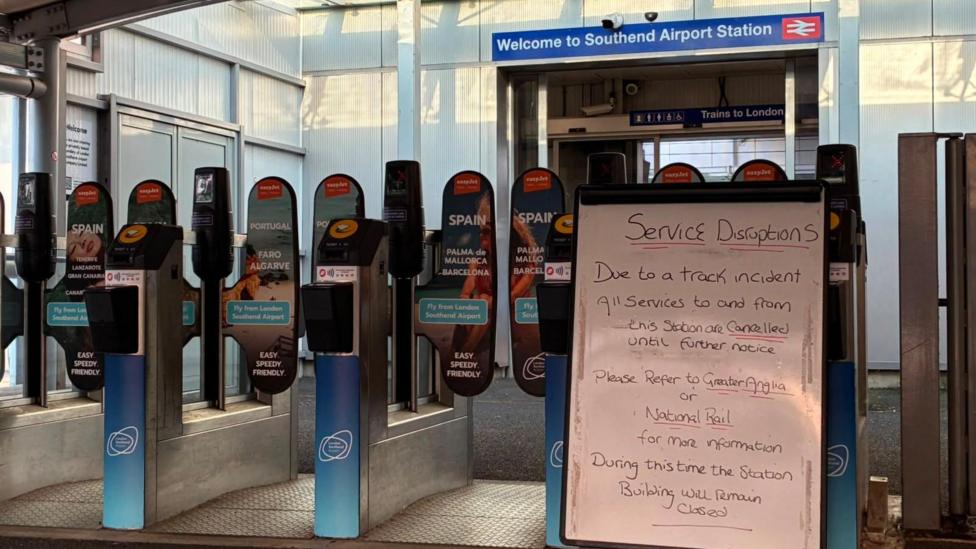
At Southend Airport, on the affected line, travellers found themselves stuck with no clear way to continue their journeys. A local reporter covering the area, who had just landed from holiday, noted that many passengers were unable to reach their onward destinations from the station.
Is this part of a wider pattern?
The Wickford derailment came less than 24 hours after a separate incident in East Sussex, where two passengers were seriously injured when a train derailed near Lewes. Network Rail issued a statement addressing both derailments together, and our earlier coverage detailed how the back-to-back incidents prompted warnings about the toll this summer's heatwave may be taking on the rail network. Further background on the East Sussex incident itself, including the route closures it triggered, is available in our report on the Lewes derailment.
Martin Frobisher of Network Rail acknowledged that the summer's extreme heat had placed unusual strain on rail infrastructure, describing the conditions as presenting exceptional challenges to the railway. Mark Francois, the Conservative MP for Rayleigh and Wickford, said investigators would specifically look at whether heat played a role in the Wickford derailment.
"However, the bottom line is that, thankfully, the passengers appear to be safe," Francois added.
The Department for Transport responded to the incident by emphasising that Britain's railways remain among the safest in the world, and stressed that derailments of this kind are extremely rare occurrences.
What happens next?
Network Rail said it expected major disruption to continue at least into Saturday as engineers worked to clear the site and restore services. RAIB inspectors were expected to complete their preliminary examination of the evidence before deciding whether to launch a full formal investigation into the cause of the derailment, according to New Civil Engineer. Greater Anglia's arrangement allowing 14 August tickets to be used the following day remains in place for affected passengers.
Key Facts
- The derailment occurred at 14:12 BST on 14 August 2026, south of Wickford station in Essex.
- Around 40 to 45 passengers were on board; no injuries were reported and the carriages stayed upright.
- The incident followed a separate East Sussex derailment near Lewes the previous day that left two passengers seriously hurt.
- Services between Wickford and Southend Victoria, and on the Southminster branch line, were suspended amid major disruption expected into Saturday.
- RAIB investigators were examining the site, with officials considering whether recent extreme heat contributed to the incident.


