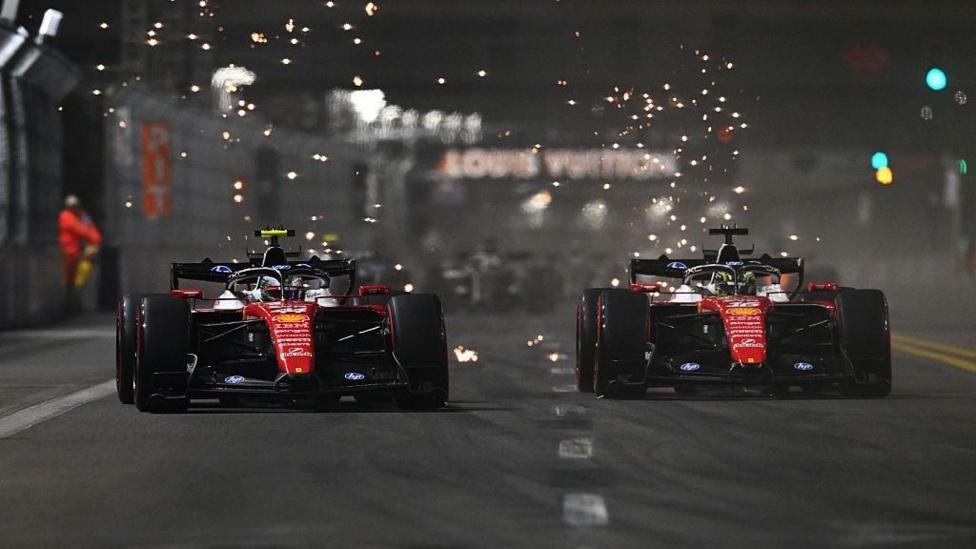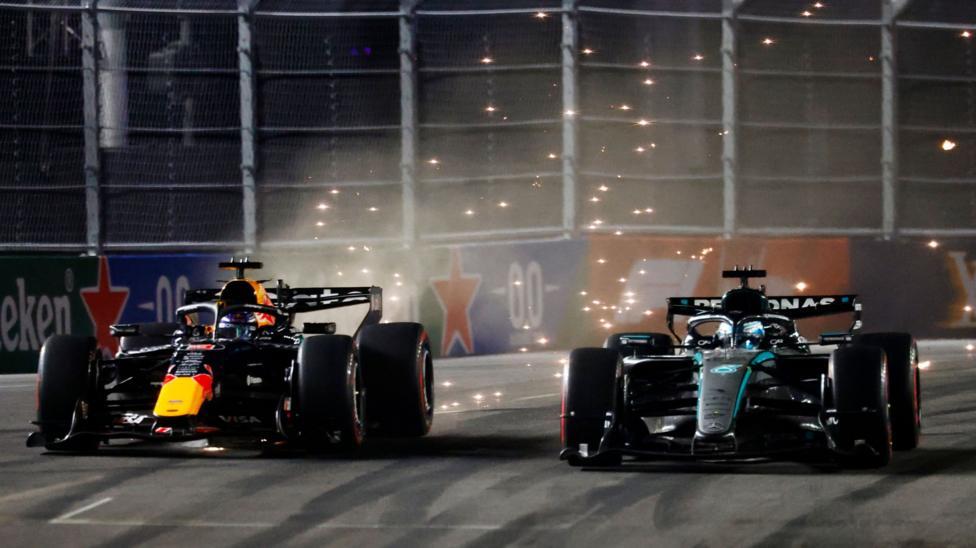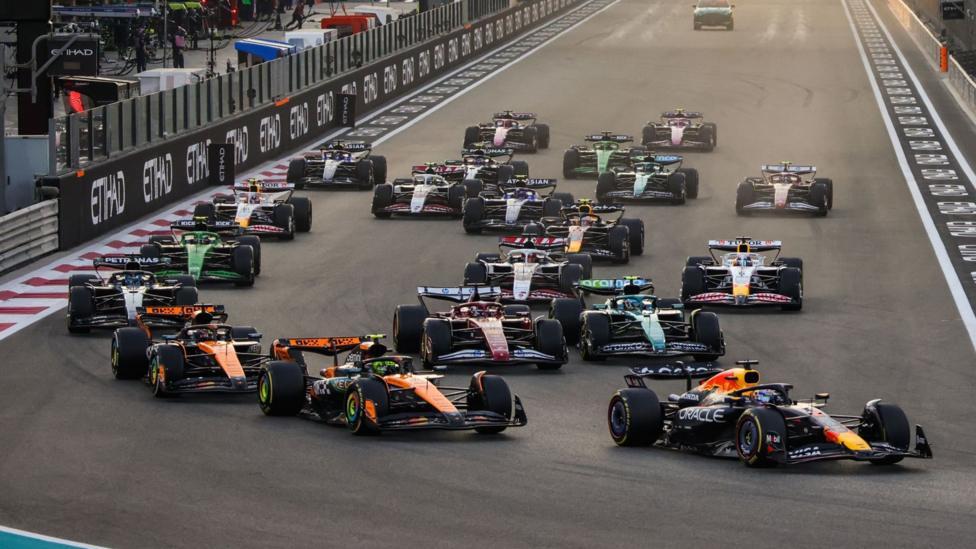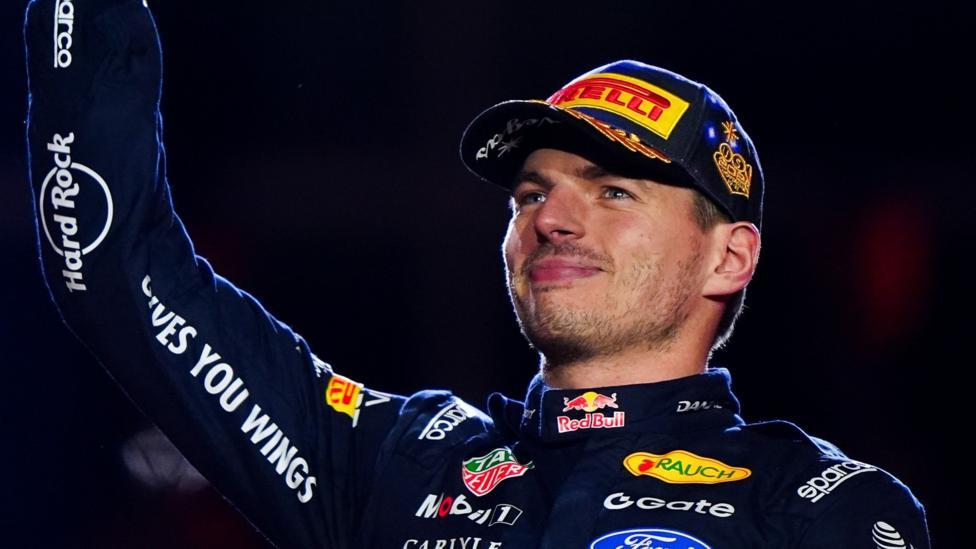
Max Verstappen emerged victorious from a remarkable Las Vegas Grand Prix that featured 34 overtaking moves for the lead across 50 laps and 352 overall, establishing himself as the dominant force amid unprecedented chaos. The race saw five cars battling nose to tail for the lead on the final lap, with the leader never holding an advantage greater than 1.5 seconds, according to BBC Sport. George Russell, who had been Verstappen's primary challenger from the start, locked up his brakes while attempting to pass Mercedes teammate Kimi Antonelli for second place with two laps remaining, sending his car into the barrier and transforming a certain podium finish into ninth place.
The timing of Russell's error proved particularly satisfying for Verstappen, coming just 24 hours after the Briton had reignited their long-standing rivalry. After an on-track altercation during practice, Russell had confronted Verstappen in the stewards' room and later declared his intention to challenge the Dutchman's dominance. According to the Telegraph, Verstappen and Russell exchanged the lead 12 times during their duel, with Verstappen repeatedly reclaiming position through audacious moves on the outside of fast corners that few other drivers even attempted.
Verstappen responded to Russell's pre-race comments with characteristic bluntness.
He speaks a lot next to the track, and it doesn't really bother me because he's so far below my level that it doesn't really make any sense for me anyway to try and challenge that, you know?He continued, describing the moment he witnessed Russell's crash:
And today, karma is a bitch. It was honestly fantastic when I looked in my mirror and I saw what was happening. I was, like, "Fantastic, my day is only getting better." And of course, when I then crossed the line in first, my day was complete.
Russell's pre-race challenge had stemmed from frustration over Verstappen's pole position, which came after Antonelli's five-place penalty was applied.
I am not just going to accept somebody to screw me over like this and walk around like they are bigger and better than everyone else,Russell had said.
Somebody has got to stand up to that guy.However, paddock observers noted that Russell had chosen a formidable opponent for such a confrontation. According to the New York Times, this rivalry has deep roots: after the 2024 Qatar Grand Prix, Verstappen called Russell a "backstabber" and a "loser," while Russell accused Verstappen of threatening to crash into him.
The championship implications proved significant. Lewis Hamilton finished seventh and moved ahead of Russell into third in the drivers' championship, while Verstappen extended his lead to 40 points over Russell. Lando Norris claimed second place, finishing 0.639 seconds ahead of Oscar Piastri, with Antonelli fourth, 2.574 seconds behind Verstappen.
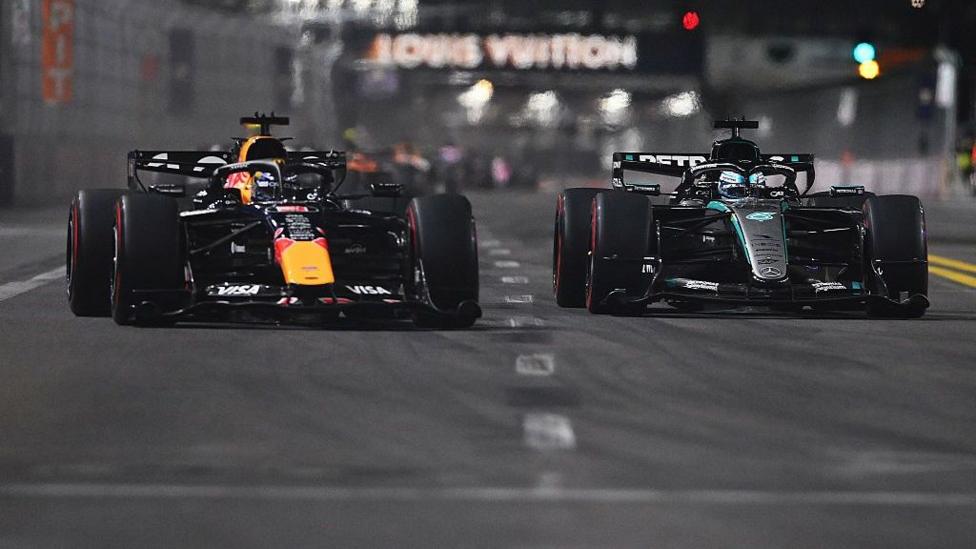
What made this race so extraordinary?
The Las Vegas Grand Prix bore little resemblance to conventional Formula 1 racing. The fabled slipstreaming battles of pre-chicane Monza in the 1960s and early 1970s—which produced the closest finish in F1 history at the 1971 Italian Grand Prix when the first five cars crossed the line 0.6 seconds apart—provided the closest historical comparison. In modern terms, the race more closely resembled American oval racing, where high-speed tracks create long chains of slipstreaming cars and frequent overtaking with little lasting consequence until the final stages.
Mercedes team principal Toto Wolff captured the essence of the spectacle when he observed:
It was Indy 500 and Nascar and Formula 1 mixed - I enjoyed it.The race encapsulated a broader debate within Formula 1 regarding the sport's current technical regulations and their unintended consequences.
How did the 2026 engine regulations create this chaos?
The near 50-50 split between internal combustion and electrical power in the current engine formula has produced energy-starved cars where batteries deplete before the end of long straights. This dynamic, known as "yo-yo" racing, causes cars to constantly pass and re-pass each other depending on their respective battery charge levels. After chaotic early-season races, teams developed better energy management strategies that reduced the effect. However, Las Vegas's combination of long straights and powerful slipstreaming effects brought this phenomenon to its extreme.
Verstappen offered a candid assessment of the racing experience. When asked whether he enjoyed this form of competition, he distinguished between spectacle and pure racing:
When I look at it from my racer heart, not. When you look at it as a show spectacle, yes. I enjoyed my repassing and everything, but I prefer to look at it with my racing heart. Even my heart rate, I was not nervous at all because it's just felt kind of cruising out there, just trying to press the battery whenever it was correct or defend.
He drew an unexpected comparison to video gaming:
I probably shouldn't say it. I probably should not. I remember winning one like this when I was playing Mario Kart. Yeah, you know, sometimes you drop back and you get drafts, and there's like a catch-up, you know? Always when you're dropping back, you go faster. So that's the last time that I felt something like this.
What did other drivers think of the spectacle?
Opinions among competitors varied considerably. Lando Norris, who finished second, acknowledged the entertainment value while recognizing its departure from traditional racing:
From a racing point of view, from the outside, I'm sure it probably was the best race ever in Formula 1. You never know what's going to happen. There was overtakes out of nowhere, and some of the overtakes weren't overtakes, you press boost and you go past someone. But the racing was still good. You're still fighting for position, and there are a lot of good things in there.
Russell, despite his disappointing finish, offered a more measured perspective:
It was interesting. I think it was quite fun for maybe half the race, but then it started to get a bit tiring at one point because it was just absolutely impossible to get away.
The divide essentially reflects a tension between racing purists and casual fans, particularly those new to the sport. Wolff recounted feedback from corporate guests during the race, noting that his wife Susie observed spectators in the Paddock Club screaming with excitement during the overtaking sequences.
The instant feedback I got from the friends watching, our sponsors, was that was awesome. Stefano [Domenicali, the F1 chairman] liked it very much. That's not going to happen everywhere.
Will Formula 1 change course on its regulations?
Verstappen's Mario Kart comparison echoed his earlier criticisms of the 2026 regulations, when he stated he considered retiring from the sport due to his dissatisfaction. Since those initial races, the rules have undergone tweaks, with further modifications planned for 2027 and 2028 to reduce energy starvation effects. Ironically, new regulations announced this weekend for 2030 will retain turbo hybrid engines but reduce the electrical element, explicitly designed to eliminate energy starvation and restore what officials describe as "pure" racing. The consequence will likely be that races of this character become impossible after that point.
Wolff defended the current regulatory direction despite the Las Vegas spectacle:
We're still doing the right thing. It's what we all wanted. But I have no doubt people will complain there is not great overtaking. We go back to the 'glorious years' in the 2000s. But we're gonna get those regs right. We see what we can do. It just needs a kilometre and a half straight.
McLaren team principal Andrea Stella urged caution against hasty conclusions, emphasizing the complexity of the decision:
It's very difficult to have a position as simple as saying, 'Oh, that's the race we want.' Because as soon as you say that, you will see some other perspectives which are important to consider. Like, I still have to talk to Lando and Oscar and understand, like, did you enjoy it or that was kind of too much and at times it felt like this is going to go very wrong from a safety point of view?
Stella continued with a broader reflection on the sport's decision-making process:
This race gave us a lot of information that we cannot ignore. In terms of the attention, the spectacle, in terms of, you know, like, wow, that's incredible racing, is this what we want? My main recommendation is that we remain kind of analytical. And we remain caring for the interest of the sport. Because we live in a world where everything is polarised, a world in which you need to have an opinion in one second. Otherwise you are a nobody. You need to have an opinion that is polarised. Well, I would like to have people that actually still value complexity of analysis. And caring for a common interest. That's my main message. When you have examples like today which offer so much information it would be a shame to process it in the space of a hot review. And say, 'Oh, let's abandon the new regulations.' That's not the case. But definitely there's some interesting information that we should consider from a technical point of view, from a sport regulation point of view.
What happens next?
The Formula 1 calendar moves rapidly toward its conclusion. The Qatar Grand Prix is scheduled for November 27–29, followed by the Abu Dhabi Grand Prix on December 4–6, providing the final opportunities for drivers to adjust their championship positions before the season concludes.
Key Facts
- Verstappen won the Las Vegas Grand Prix with 34 lead changes across 50 laps and 352 total overtaking moves, the highest number in modern F1 history
- Russell's attempt to pass Antonelli for second place resulted in a crash that dropped him from a podium position to ninth place
- Verstappen and Russell exchanged the lead 12 times during their duel, with Verstappen executing overtakes on the outside of corners that few other drivers attempted
- The race sparked debate about whether the 2026 engine regulations, which create energy-starved cars, produce entertaining spectacle or compromise pure racing quality
- New regulations for 2030 will reduce the electrical element of hybrid engines to eliminate energy starvation and prevent similar races from occurring