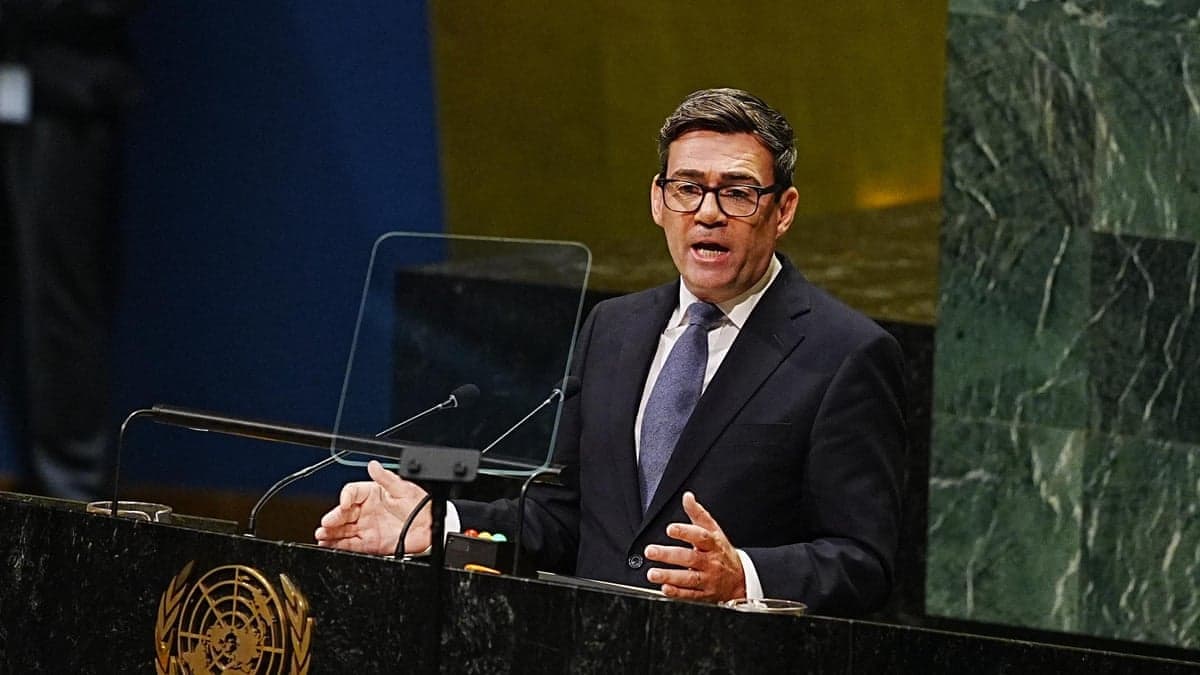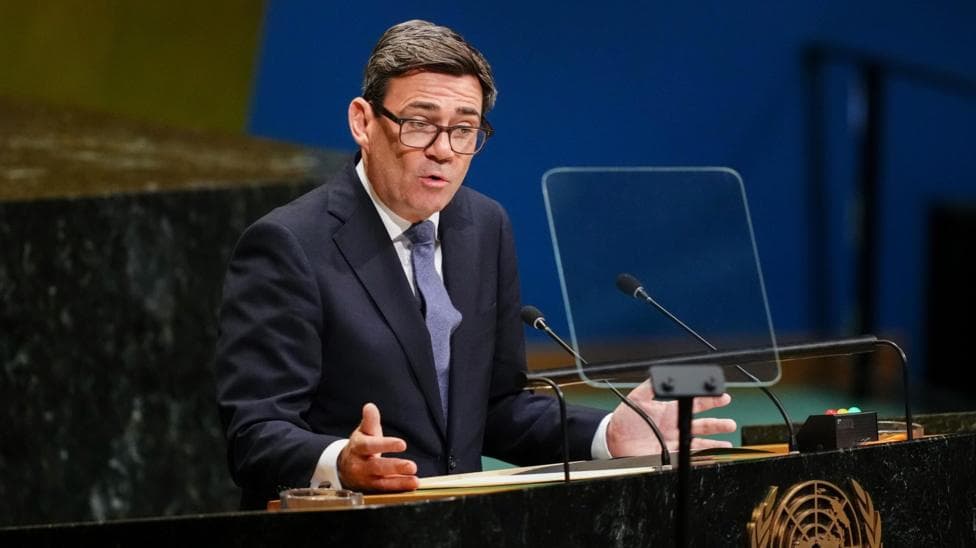
Prime Minister Andy Burnham has announced plans for a new National Centre for Information Defence to counter Russian disinformation campaigns and pledged to lead international efforts to establish global safety standards for artificial intelligence, in his first major address to the United Nations General Assembly in New York City.
Burnham warned that Russian state agencies deploy sophisticated tactics—including automated bots, fabricated websites, forged news articles and impersonation of British institutions—to spread false narratives designed to undermine public confidence in the UK. He told world leaders that the Kremlin's annual spending on information manipulation reaches approximately £1.3 billion, and that these campaigns extend beyond simple falsehoods to amplify divisive narratives that damage social cohesion.
"The Kremlin spends around £1.3bn each year on manipulating information," Burnham told the UN General Assembly. "They've used bots and fake websites, falsified newspaper articles, forged the branding of 28 British organisations, including universities and the BBC. We're talking about an insidious campaign that reaches into people's homes and twists what they feel about their own country and community – creating a narrative of decline, stoking division and sowing despair."
The prime minister highlighted that hostile state actors have also conducted cyber-attacks on British companies and institutions. He emphasised that artificial intelligence will intensify these existing threats, as the technology can be weaponised to generate deepfakes and automate disinformation at scale. According to reporting on the speech, the new centre will focus on detecting, attributing and disrupting hostile-state information attacks, including identifying deepfakes that could damage British interests.
Burnham referenced the 2019 general election, in which the UK government previously concluded that Russia almost certainly attempted to interfere. He also noted that when the government published a detailed report in 2020 documenting Russian hostile activity in the UK, including election-related operations, Moscow dismissed the findings as "Russophobia".
How will the new centre operate?
The National Centre for Information Defence will coordinate expertise across intelligence agencies, government departments, law enforcement and social media platforms to detect and disrupt AI-enabled disinformation campaigns by hostile states. The centre represents a structured response to what Burnham characterised as "information warfare"—a coordinated effort to manipulate public perception and sow discord within British society.
Security chiefs are to begin work on the new centre following its announcement at the UN. The initiative builds on earlier government action: the UK previously announced plans to establish a dedicated defence centre to combat Russian disinformation and deepfakes, and the government has signalled that officials expect "full and total visibility of model developments" from AI companies operating in the UK.
Burnham acknowledged that while AI developers have made voluntary commitments to transparency, the government has not ruled out legislation to protect the public. The prime minister noted that nothing is off the table if additional safeguards prove necessary.
What is the UK's position on global AI standards?
Burnham positioned the UK as an "honest broker" on artificial intelligence, citing the country's close relationships with both the United States and the European Union. He described frontier AI—the most advanced systems currently in development—as "one of the most significant challenges and opportunities of our age", capable of driving economic growth but also multiplying existing risks to national security and public safety.
"We've all heard the warnings – which we must heed. I know how worried people are. So we have to rise to this moment."

The prime minister committed to placing AI "at the heart of the UK's G20 Presidency next year", when leaders of the world's largest economies will convene in Manchester. According to reporting from the speech, the UK will seek to develop a single set of global principles and standards governing frontier AI development, with transparency and mandatory access to AI models as core components.
Burnham highlighted the UK's AI Security Institute, established under former Prime Minister Rishi Sunak, which conducts safety testing on major AI models before public release. He stated that the UK would work towards international agreement on principles ensuring transparency, model access, and safe development practices. He indicated this effort would incorporate existing initiatives from other nations, such as a proposal advanced by Norway this week.
The Norwegian-backed declaration, which has secured support from more than 20 countries including Germany, Canada and Ireland, calls for AI systems to remain under human control and mandates pre-release safety testing of frontier models. However, the declaration remains unsigned by the United States and China—the two nations that dominate global AI development—as well as by the UK itself.
What obstacles exist to international AI regulation?
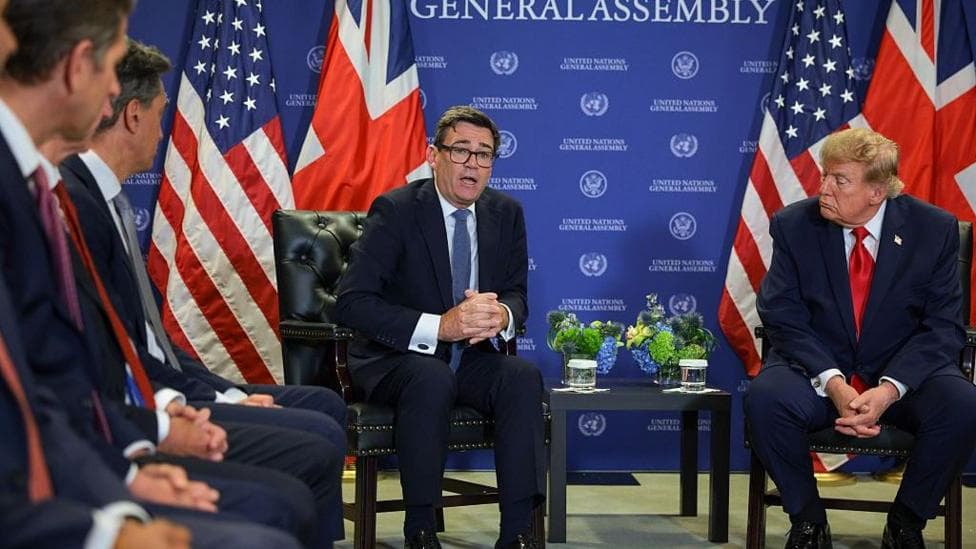
The UK's ambitions for coordinated global AI standards face significant headwinds. US President Donald Trump, speaking at the UN General Assembly earlier in the day, rejected
"any attempt to construct a globalist scheme"to control AI development. Trump has previously dismissed warnings that advanced AI could pose existential risks to humanity as "a hoax" and stated that his administration will encourage rather than restrict AI innovation.
The UK's own AI Security Institute currently operates on a voluntary testing basis, and at least one major AI company—Anthropic—has reportedly declined to submit its latest model for assessment. This voluntary approach contrasts with the mandatory pre-release testing that the Norwegian declaration and some UK lawmakers have advocated for.
Former cabinet minister Darren Jones, who previously served as chief secretary under Prime Minister Sir Keir Starmer, has called on Burnham to sign the Norwegian declaration and broker a bilateral agreement with the US on implementation. Jones argued that
"there should be a landing zone to agree mandatory testing"without compromising competitive advantage between companies and nations.
The Liberal Democrats and the Green Party have intensified pressure on the government to strengthen AI safety measures. However, any meaningful international regulatory framework would require cooperation from both the US and China—a prospect that appears unlikely given Trump's stated opposition to global AI governance schemes.
What happens next?
Britain is expected to advance the AI standards agenda through its upcoming G20 presidency in 2027. The government will pursue negotiations with other major economies to establish consensus on frontier AI governance, though success will depend partly on whether the incoming US administration shifts its position on international cooperation.
The National Centre for Information Defence will begin operations following the UN announcement, working to identify and counter Russian disinformation campaigns in real time. The centre's establishment reflects growing recognition within UK government that information warfare—particularly when amplified by AI-generated content—poses a direct threat to democratic institutions and public trust.

Burnham's speech marked a significant pivot in how the UK government frames both Russian interference and AI governance. Since taking office in July, his administration has emphasised the need for international cooperation to manage AI risks while harnessing its economic potential, signalling that further regulation and legislation may be necessary if voluntary measures prove insufficient.