The driver of a London-bound train where a knifeman attempted to kill 10 passengers has described the moment he made a critical decision to divert the service and make an emergency stop, potentially saving the lives of 155 people on board. Andrew Johnson was operating the Doncaster to London King's Cross LNER service on 1 November 2025 when Anthony Williams launched his attack. According to BBC News, Johnson diverted the train from the fast track to a slow track to enable an unscheduled stop at Huntingdon in Cambridgeshire.
Speaking publicly for the first time since Williams's conviction, Johnson told BBC Breakfast that the window for action was extraordinarily narrow.
We only had a few seconds to instigate the move or it'd be too late.On 26 November 2026, Williams was found guilty of all 14 counts of attempted murder, with 10 of those charges relating to the attacks aboard the train. The jury deliberated for 16 hours and 52 minutes before returning its verdicts.
Johnson recounted that the day had begun as routine, with fewer passengers on board due to engineering works. The situation changed abruptly when someone pulled an emergency passenger door at 122mph (196km/h).
Suddenly out of nowhere, someone pulled an egress, which is the emergency passenger door, to try to get off the train, which is very unusual at 122mph (196km/h).Johnson initially assumed it was a prank, but his assessment shifted immediately when he heard a shout about a knifeman stabbing people.
It was the way it was said, it was kind of horrifying. I knew right then it was really bad.
How did the driver manage the emergency?
Johnson had approximately five seconds to override the emergency door or the train would stop automatically. Once he understood the severity of the situation, he contacted the signaller to request an immediate route change.
I kind of looked at the phone [to the egress] going 'blimey' and I said I'll get us into Huntingdon, because I knew exactly where we were, even though it's pitch black, half the job is knowing the route you're on.The signaller, Johnson said,
reacted instantly, though the process of changing the track points required two minutes. During that interval, Johnson needed to reduce the train's speed while ensuring it remained above 6mph (9.7km/h), as passengers attempting to open the doors at lower speeds could have triggered the brakes and stranded the train in an isolated location.
Johnson described his emotional state during the crisis, noting that while he attempted to project calm, he was acutely aware of the danger.
I'm trying to stay calm, I'm trying to get the point across, but underneath I was fully aware of how serious it was.He recalled hearing
banging and screaming on my doorbut remained at his post to keep the train moving toward Huntingdon. At the moment the track points changed, the train was
five seconds from it not happening, meaning any further delay would have made the diversion impossible.
What happened during the attack itself?
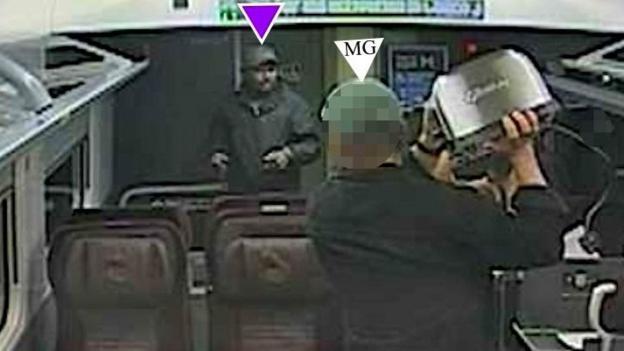
Passengers and staff fought back against Williams using improvised weapons, including frying pans and a toaster. Some passengers hid in bike racks and toilets to escape the attacker. The trial heard that Williams appeared at trial by video link from Rampton Hospital, a high-security psychiatric hospital in Nottinghamshire, and did not give evidence.
The 14 convictions cover not only the 10 attempted murders on the LNER train but also attacks on three people in Peterborough on 31 October 2025 and a teenager on a DLR train in east London hours later. Jurors heard that Williams operated under
the delusional premise that his life was at risk by a wide-ranging conspiracy by the devil. According to BBC News reporting on the conviction, the trial heard that Williams had contacted his GP twice in the month before the attacks to say his anti-psychosis medication was not working.
What has happened since the attack?
Johnson returned to work in April 2026 and has received substantial support from LNER, his family, partner and friends. He described the completion of the trial as
a big milestonethat would allow him and others affected to
get back to a normal life. Since the attack, Johnson has met the Fulham football team, which he supports, and has also met King Charles, with whom he discussed the Navy and rum.
Following the conviction, Cambridgeshire and Peterborough NHS Foundation Trust announced it would conduct an independent investigation into the care provided to Williams.
When will Williams be sentenced?
Williams is due to be sentenced at Cambridge Crown Court on 4 and 5 February 2027. The sentencing hearing will determine the length of his custodial sentence for the 14 attempted-murder convictions.