Nearly all Department for Work and Pensions (DWP) services have been taken offline following a "cyber incident" that prompted a precautionary shutdown. According to BBC News, the department has confirmed that benefit and pension payments will continue as scheduled, though the cause of the incident remains under investigation by the National Cyber Security Centre and Government Cyber Coordination Centre.
Officials identified suspicious activity that led to the decision to take systems offline, though they have not yet established which systems, if any, were directly compromised, according to further reporting. The Independent reported on Friday morning that there was no evidence that claimant personal data had been stolen while the investigation continued.
Which services have been affected?
Nearly all of the DWP's online systems have been taken down, including those for pensions, universal credit and Personal Independence Payment (PIP) applications, as well as the "Tell Us Once" system used to notify the government when someone has died. Reports of access problems on Downdetector began the previous evening, though officials could not confirm whether these were connected to the incident. According to the Liverpool Echo, reports of government-service problems on Downdetector peaked at 8am, with more than 600 people reporting issues.
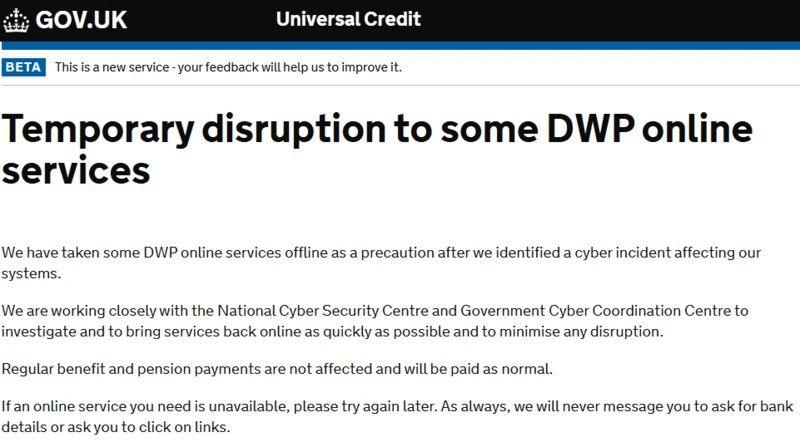
A DWP spokesperson stated:
We are working closely with the National Cyber Security Centre and Government Cyber Coordination Centre to investigate and to bring services back online as quickly as possible and to minimise any disruption. As always, we will never message you to ask for bank details or ask you to click on links.
The DWP did not provide a timeframe for when services may be restored. As of Friday morning, other government departments appeared unaffected by the incident.
Will I still get my pension or benefit payments on time?
The DWP has assured users that pension and benefit payments will not be affected by the incident and will be paid as normal. However, users attempting to log into the universal credit or pensions systems encounter error messages, which could affect their ability to check or make changes to their accounts.
Work and Pensions Committee Chair Debbie Abrahams commended the department's response, stating:
That today's ongoing cyber-incident is not affecting benefit and pension payments is a great relief. The DWP has taken swift action to contain any potential further damage from the cyber-incident and so that service is restored as soon as possible.
Abrahams added that it is "critical" the impact of the outage is investigated so advice can be given to pension and benefit claimants.
What caused the DWP cyber incident?
The cause of the incident remains unclear, and authorities have not yet determined whether the disruption resulted from a deliberate attack or, if so, who was responsible or what their motivation might be. Currently, there is no indication the DWP has been hacked, but taking services offline is a recognised response to cyber incidents, as it prevents attackers from gaining further access to systems. Cutting internet connectivity also helps investigators preserve evidence that could prove valuable if malicious activity is confirmed.
The BBC's cyber correspondent Joe Tidy noted that the department's actions and language mirror the Co-op incident from the previous year. In that case, Co-op initially described taking services offline as a "precaution," but it later emerged that hackers had already breached the firm and stolen the data of 6.5 million customers.
The incident occurs in a broader context of heightened cyber threats. In August, technology firms including Google, Microsoft, Anthropic and OpenAI signed an open letter urging countries and organisations worldwide to strengthen their cyber defences. Earlier in November, the National Cyber Security Centre similarly urged organisations to strengthen their defences as technology becomes more complex and capable.
The timing is notable given that the government recently carried out inspections on several websites after a critical flaw was identified in PHP, a global programming language. The PHP security vulnerability prompted a worldwide effort for organisations to determine whether they were affected and apply fixes before exploitation. So far, there is no indication that those checks and today's incident are related.
This incident follows a pattern of cyber-attacks affecting UK public services. In July, hackers obtained approximately 607,000 records in a cyber-attack on the Department for Education in England, affecting contact details though not bank or sensitive data. More recently, Dyfed-Powys Police in Wales suffered a cyber-attack on 14 September affecting non-emergency systems, with staff information potentially compromised, though emergency services remained fully operational.
What happens next?
The DWP said it was working with the NCSC and Government Cyber Coordination Centre to investigate and restore services, but has not given a restoration timetable. The department will continue investigating the cause of the incident and determining the full scope of any potential data compromise.