Staff at Glasgow Caledonian University are staging coordinated strike action, with all three campus unions walking out on the same day for the first time in opposition to planned job cuts. Lecturers and support staff members of the UCU, the EIS and Unison are taking action on Thursday, with union representatives warning the walkout could effectively halt university operations. Management at the institution plans to eliminate approximately 50 posts and has not ruled out implementing compulsory redundancies.
The university leadership says the reductions are essential to stabilise the institution's finances, citing a £33m decline in income over two years, partly driven by falling numbers of international student enrolments.
How did the dispute begin?
The conflict originated in March when management unveiled proposals to cut up to 100 positions, attributing the decision to a significant drop in revenue from overseas students. Voluntary redundancy schemes have since reduced that figure to around 50 roles, though according to a local news report, more than 100 roles remain at risk while the university maintains it has lowered the number at risk to 40, with no compulsory redundancies implemented to date.
The central point of contention remains compulsory redundancies. The unions are demanding assurances that no employee will be forced to leave their position, but management has declined to provide such a guarantee. Conciliation talks through Acas broke down earlier this month, and lecturers conducted a strike action the previous week. Three days of planned action in early September were called off after agreement to hold Acas talks, though those discussions on 15 September did not resolve the underlying disagreement.
What are the unions' arguments?
Union representatives contend that the cuts represent a strategic choice rather than an unavoidable necessity. They highlight what they describe as £95m in cash reserves held by the university, alongside its acquisition of city centre land for approximately £4.5m, which they characterise as ill-timed given current circumstances. The university counters that purchasing and selling land forms part of a longstanding strategic plan.
The institution has previously stated it faces a £10m financial deficit in the forthcoming financial year and maintains that the cuts are required to restore it to a
sound financial footing.
A university spokesperson expressed disappointment at the unions' decision to strike, stating that
the measures the unions had suggested as alternatives to compulsory redundancies had largely already been taken and that was why the number of job cuts had been reduced. The spokesperson added:
While voluntary measures remain our preferred approach, we cannot rule out compulsory redundancies if the required savings are not achieved.
Unison branch secretary Davena Rankin rejected compulsory redundancies as a solution, saying:
Staff want to support students and help the university succeed, but they need confidence that their jobs are secure.
UCU branch president Karen Lorimer stated that staff wanted to welcome new and returning students but that
the refusal to rule out using compulsory redundancies left them with no alternative but to strike.
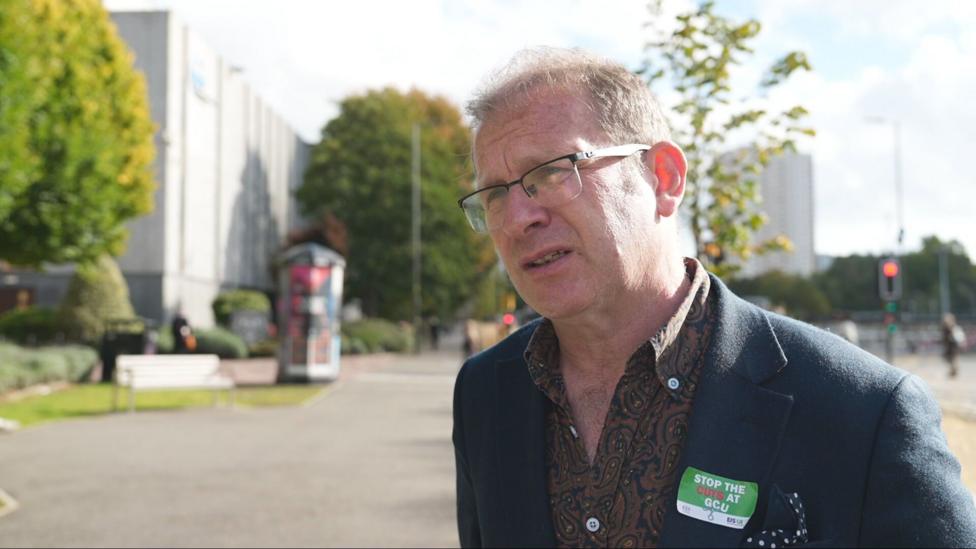
Dr Nick McKerrell, a law lecturer and branch secretary of the EIS, argued that while challenges exist across higher education, Glasgow Caledonian occupies a financially robust position and compulsory redundancies are not warranted.
What makes Thursday's action significant?
This represents the most substantial escalation to date in the ongoing dispute at the university. For the first time, all three unions are conducting strike action simultaneously. Union officials have noted that it is highly unusual for both lecturers' unions to walk out at the same institution on the same day. The addition of support staff—who manage IT systems, security, catering, cleaning, library services and student welfare—is expected to bring campus operations and the university to an effective standstill.
The planned action includes security staff, cleaners, couriers, accommodation and registry workers, according to union announcements. The university has stated throughout the dispute that it aims to minimise disruption for students, though with so many services affected, achieving this will prove extremely challenging. The institution says most classes and activities are scheduled to proceed during the industrial action, and it will contact students directly if they are affected.
Student Diannon Andrews, 20, reported that lectures and seminars had been cancelled during the earlier UCU action, highlighting the real impact on learning.
What happens next?
Further strike dates are scheduled extending into mid-October. The lecturers' unions are planning action again the following week, while Unison is expected to stagger action among its membership. According to union sources, Unison members will strike on 1 October, with further selective action planned during the following two weeks, and coordinated action is also scheduled for 15 October. The EIS has listed additional strike dates on 5–8 October and 13–16 October, with pickets at the Cowcaddens Road entrance from 8am to 11am.
Is Glasgow Caledonian alone in facing these pressures?
Glasgow Caledonian is far from an isolated case within Scotland's higher education sector. At the University of Edinburgh, approximately 3,000 staff have commenced five weeks of strikes running until 30 October, protesting £140m of cuts. Dundee University staff are also undertaking a five-week walkout. This represents the latest chapter in a difficult period for Scottish universities. Back in March, staff at Dundee, Aberdeen, Strathclyde and Heriot-Watt all conducted separate strike actions.
The underlying issue affecting all these institutions is funding. Scottish universities receive a fixed amount from government for each Scottish student they teach and are prohibited from charging tuition fees to domestic students. For years, they have compensated for this constraint by collecting fees from international students. However, the number of overseas students has declined while the costs of staffing, pensions and energy have continued to rise.
An expert group working on the Scottish government's review of university funding recently estimated that the sector faces a shortfall of approximately £200m annually. The same review identified a repairs backlog of about £1bn across Scotland's higher education institutions, compounding the financial pressures facing universities like Glasgow Caledonian.