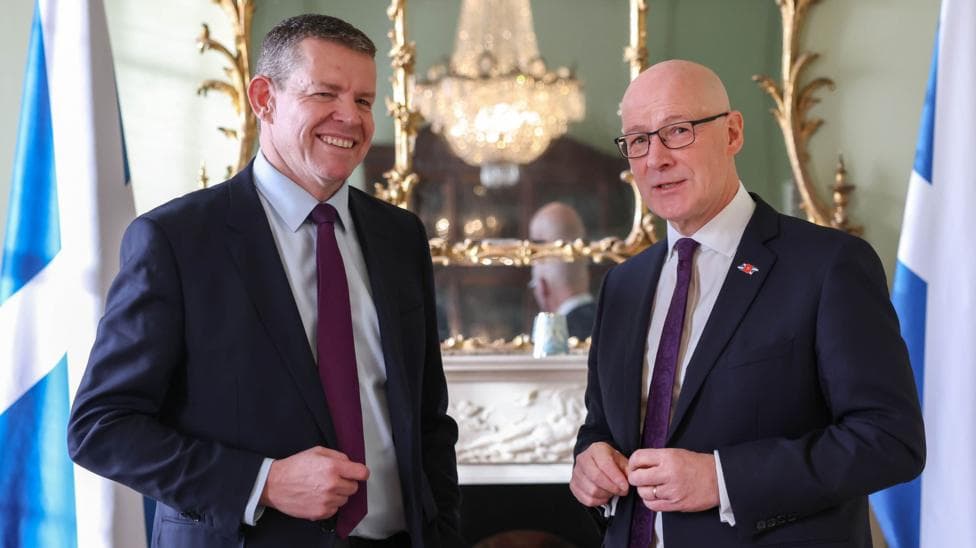
John Swinney has declared the United Kingdom stands at a "pivotal moment of constitutional change" as he prepares to attend a summit with the leaders of Plaid Cymru and Sinn Féin in Cardiff. The gathering will bring together Scottish First Minister Swinney, Welsh First Minister Rhun ap Iorwerth, and Sinn Féin president Mary Lou McDonald and vice-president Michelle O'Neill to discuss how their parties can coordinate on shared interests and constitutional matters.
This meeting represents a historic political alignment: for the first time ever, all three devolved governments are led by pro-independence representatives. According to reporting on the summit plans, the leaders are expected to sign a memorandum of understanding calling on Westminster to prepare for constitutional change, rather than simply discussing closer cooperation between their administrations.
The three are meeting as party leaders rather than in their formal government capacities, marking a significant moment in UK politics. This represents the first time nationalist parties simultaneously hold power across all three devolved nations following Plaid Cymru's breakthrough in Wales earlier this year.
Speaking ahead of the meeting, Swinney emphasised the symbolic weight of the moment.
For the first time ever, Scotland, Wales and Northern Ireland are led by pro-independence first ministers. There could be no clearer sign that the status quo is not sustainable – and that Westminster must prepare for a post-UK future.
Michelle O'Neill echoed this sentiment, stating that the gathering demonstrates
a clear indication that people see that Westminster is not working for the people of the North, Scotland or Wales.
Different constitutional trajectories
Beneath their shared goal of leaving the United Kingdom, however, the three nations face markedly different circumstances and timelines. Swinney is actively pushing for a second independence referendum following his party's victory in May's Scottish elections, and has written to Prime Minister Andy Burnham requesting a meeting to establish a legal mechanism for Scottish independence referendums.
In Wales, ap Iorwerth leads the Senedd's first pro-independence administration but is taking a more measured approach. He has previously ruled out holding a referendum during this parliamentary term, instead prioritising the devolution of additional powers from Westminster. Speaking on Sunday, ap Iorwerth acknowledged these differing contexts while emphasising common ground.
We have distinct nations with our own trajectories and our own priorities. But there is also something that ties us together...that pursuit of a different attitude from UK government. It could be around the constitutional question, it could, more acutely, be around fair funding.

In Northern Ireland, a different dynamic exists entirely. An agreed path to reunification is already established through the Good Friday Agreement, providing a formal constitutional framework absent in Scotland and Wales.
What will the summit discuss?
Beyond constitutional questions, the Cardiff meeting is expected to cover Europe, international cooperation, the economy and energy issues. The devolved funding settlement—a longstanding point of contention between the nations and Westminster—is anticipated to feature prominently in discussions.
The timing of this summit carries particular significance for the SNP. At last week's Prime Minister's Questions, Andy Burnham appeared to accept a parallel with Northern Ireland, suggesting that if support for constitutional change reaches a certain threshold, a Scottish referendum could be considered. Although Downing Street subsequently walked back these comments, one SNP figure characterised the moment as marking a turning point:
the cat is well and truly out the bag.
Swinney is now seeking an agreed mechanism for triggering a vote, and his advisers believe events such as this Cardiff gathering can help build both public support and political momentum. The international dimension has also shifted the landscape: President Trump's recent remarks in support of Irish reunification have kept the UK's constitutional arrangements firmly near the top of the news agenda, potentially energising nationalist movements across all three nations.
Political symbolism and practical challenges
A photograph featuring three nationalist first ministers serves as a highly visible reminder of the recent transformation in the UK's political landscape. The prospect of the three parties signing a shared agreement aimed at pressuring Downing Street to plan for referendums represents significant media spectacle, though observers note it carries limited formal weight in constitutional terms.
The summit is not without risks for Swinney. The SNP and Plaid Cymru have a history of working together, but Swinney has faced criticism over his approach to engaging with Sinn Féin. Shadow Scottish Secretary Harriet Cross has described the summit as
a performative photo calland
a distraction, arguing that Swinney
should be spending time focusing on what really matters to Scots.
Some within SNP ranks also believe that discussion of a referendum should be deprioritised in favour of driving up public support for independence itself. With polling indicating Scots remain evenly divided on the constitutional question, building that support remains Swinney's most significant challenge.
What happens next
The Cardiff summit is scheduled for Monday, 14 September 2026, when the memorandum of understanding is expected to be formally signed. A press conference is also anticipated following the meeting, providing the three leaders with an opportunity to present their unified position to the media and public.
The outcome of this gathering will likely shape the political agenda across all three devolved nations in the coming months, particularly as discussions with Westminster over constitutional arrangements and devolved powers continue.