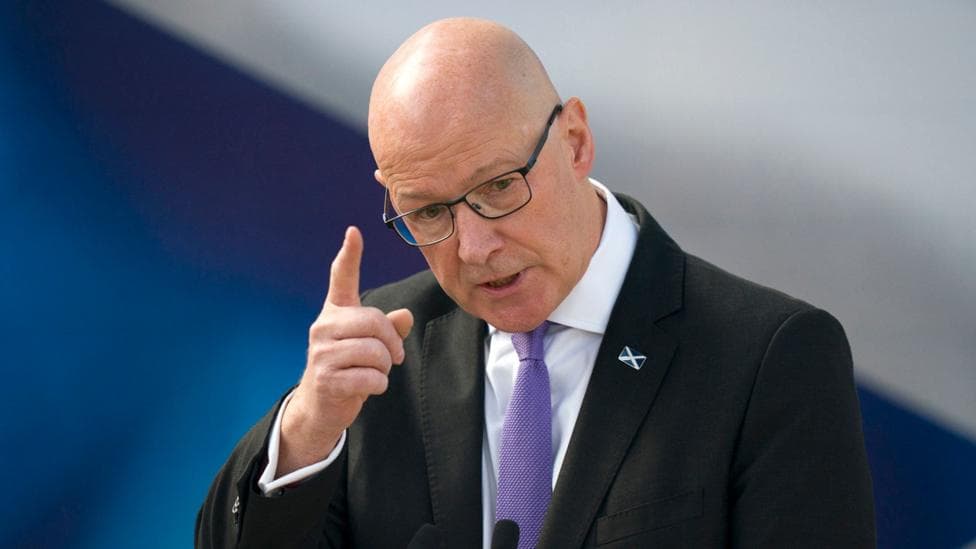
First Minister John Swinney has written to Prime Minister Andy Burnham requesting a meeting to discuss establishing a formal legal mechanism that would allow Scotland to hold an independence referendum. The letter, sent following Burnham's recent comments on the constitutional future of the UK's constituent nations, seeks to convert what Swinney characterises as an agreed principle into binding legislation.
Swinney's correspondence was prompted by remarks Burnham made during Prime Minister's Questions, in which he indicated that a border poll in Scotland would be considered if public opinion shifted decisively in favour of independence and a clear consensus emerged. However, Downing Street subsequently clarified that Burnham's position remains unchanged: such a vote is currently "off limits" and no referendum is planned in the immediate term.
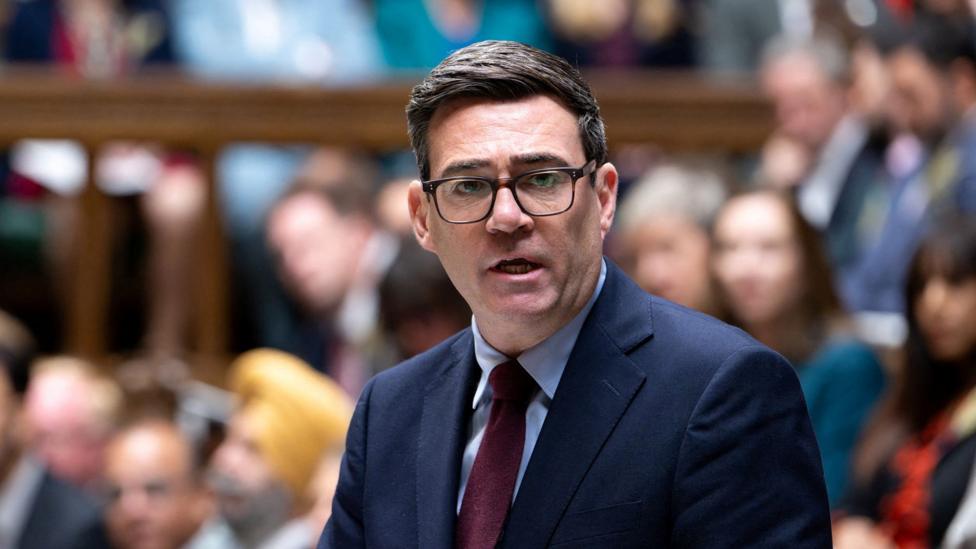
In his letter, Swinney welcomed Burnham's statement as recognition that majority support for independence should trigger a new referendum. He described the remarks as a "long-overdue acceptance of the reality that the people of Scotland will decide their own future". Swinney then pressed for formal negotiations:
Now that you have agreed the principle that Scotland should have a referendum when it is likely that people would vote for independence, it is important for us to meet to discuss how we turn that principle into an agreed legal mechanism, as exists in Northern Ireland.
What exactly did Burnham say?
Burnham's comments emerged during exchanges with Dundee SNP MP Chris Law, who drew a parallel between Scotland and Northern Ireland. Law noted that Burnham had committed to upholding the Good Friday Agreement, which includes a provision establishing when a border poll should be considered. He then asked whether similar legal conditions should apply to Scotland.
Burnham responded by explaining that the Good Friday Agreement requires the Northern Ireland Secretary to consider a border poll
when there is clear consensus in the country—when public opinion has changed to the point at which the call has to be considered. He continued:
I would say that it is exactly the same situation in Scotland. I am not aware that there is majority public support for another referendum, and until that changes, there will not be one.
This represented a shift in tone from Burnham's initial meeting with Swinney in July 2026, when he declared another independence referendum "off limits" because it would distract from economic growth and cost-of-living support. The earlier 2014 independence referendum saw Scotland vote to remain in the UK by 55.30% to 44.70%, on a turnout of 84.59%.
How much support is there for independence?
Sir John Curtice, professor of politics at Strathclyde University, cautioned against reading too much into Burnham's remarks. Recent polling suggests a very narrow majority currently favours independence, but Curtice told BBC Radio Scotland Breakfast that describing Scotland as "likely" to vote for leaving the UK overstates the evidence. He said it was
probably possible to make reasonable casethat the probability of a Yes vote exceeds zero, but that polling falls far short of indicating the outcome is
pretty damn certain.
Curtice noted that some within the independence movement have previously suggested a referendum should be held only when opinion polls consistently show around 60% support. According to reporting from September 2026, opinion polls in that year have remained tightly split, with support for Yes and No generally within a few points of each other.
The SNP frequently points to the May 2026 Scottish Parliament election as evidence of pro-independence sentiment. The SNP and Scottish Greens together secured 73 MSPs, increasing the pro-independence majority by one. However, the proportion of the electorate voting for pro-independence parties fell significantly to approximately 41%, down from roughly 50% in 2021. This decline occurred because the pro-union vote was more fragmented, partly due to the emergence of Reform UK.
Curtice observed that
the difficulty is that both sides in the argument can point to evidence to substantiate their case.
What have previous prime ministers said?
David Cameron was the prime minister who negotiated the agreement allowing the 2014 referendum with then SNP leader Alex Salmond. On the eve of the vote, Cameron declared it was a "once and for all decision" with "no going back" and "no re-run". He maintained this position afterwards, describing the debate as having been "settled for a generation".
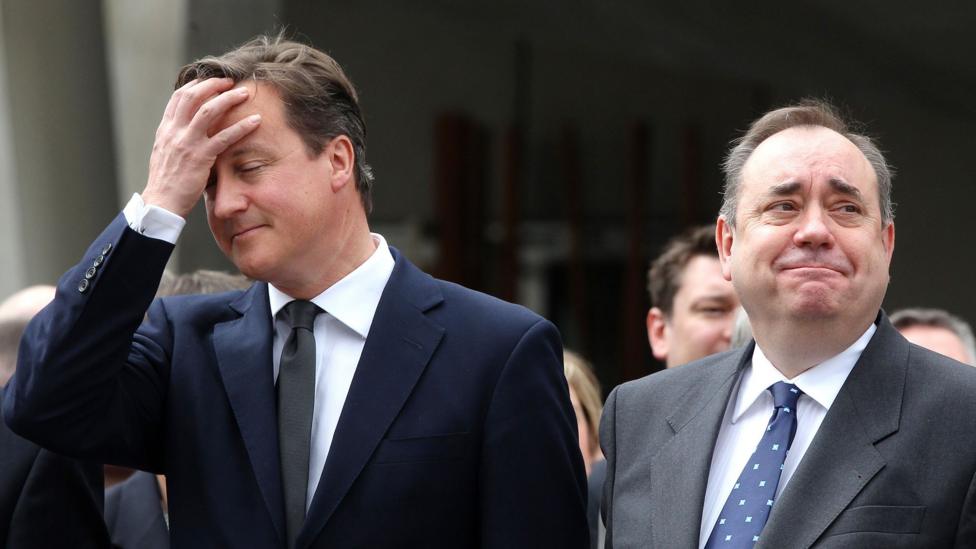
Salmond had previously characterised the vote as a "once in a lifetime, perhaps once in a lifetime opportunity" and indicated that by "political generation" he meant a 20 to 30-year interval. His successor as first minister, Nicola Sturgeon, later contended that the 2016 Brexit referendum—where the UK voted to leave the EU while a Scottish majority voted to remain—constituted a "material change of circumstances" that put another independence referendum back "on the table".
Cameron resigned following the Brexit vote and was succeeded by Theresa May, who repeatedly stated that "now is not the time" for another referendum. She argued it was premature because Scots did not yet understand the implications of EU withdrawal.
Boris Johnson, who became prime minister in 2019, also rejected calls for a referendum, invoking the "once in a generation" language from 2014. During her brief 2022 tenure, Liz Truss dismissed Sturgeon as an "attention seeker" whom she intended to ignore.
Rishi Sunak took office before the UK Supreme Court ruled in 2022 that the Scottish government lacked the power to hold an independence referendum without Westminster consent. According to analysis from the Institute for Government, another Scottish independence referendum cannot happen without UK Parliament legislation enabling it. Sunak argued there were "more pressing issues" for Scottish voters to prioritise.
When Labour won power at Westminster in 2024, Sir Keir Starmer adopted a comparable stance, saying an independence referendum was "not a priority" and he could not foresee one occurring during his premiership.
Recent developments and the Scottish government's draft bill
The Scottish government published its draft independence referendum bill on 28 August 2026, containing the proposed ballot question:
Should Scotland be an independent country?According to the Scottish government's official publication, the draft bill specifies that voters aged 16 and over, plus qualifying foreign nationals, would be eligible to participate. The proposed ballot paper would use straightforward Yes/No wording with an "X" marked against one option.
The draft bill leaves the referendum date to be decided by the Scottish Parliament, with the possibility of setting a later date through regulations. Swinney's plan, as reported in July 2026, was to aim for a referendum by 2028. However, the draft bill is expected to be introduced only once the Scottish government secures the necessary powers from Westminster.
What happens next
Any progress toward a referendum remains contingent on the UK government granting the required legislative authority. The bill text deliberately leaves the referendum date open, meaning any timing would depend on subsequent Scottish Parliament action. Swinney's letter to Burnham represents an attempt to move negotiations forward, but Westminster's consent remains the critical hurdle that must be cleared before the Scottish government can proceed with formal legislation.