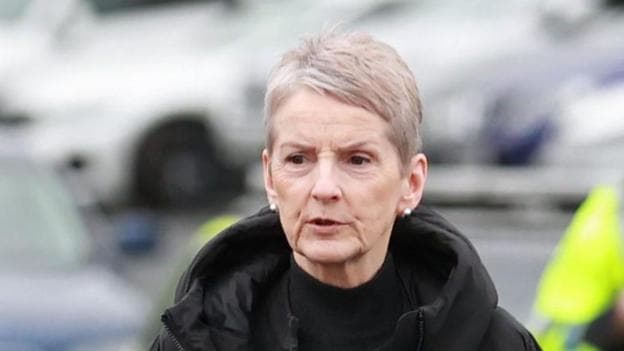
Stormont's justice and health ministers have initiated a joint review of the legal framework governing trials of the facts in response to the Eleanor Donaldson case, according to correspondence from the Department of Justice's assembly liaison officer to the Assembly's justice committee.
Eleanor Donaldson, spouse of convicted sex offender Jeffrey Donaldson, underwent a trial of the facts after being determined unfit for a conventional trial on mental health grounds. The trial resulted in a finding that she committed the acts alleged but cannot be sentenced to prison, as the procedure does not permit custodial punishment.
An external reviewer will be appointed to conduct the examination, with the process expected to commence in late October 2026 and conclude by the end of February 2027. The Department of Justice and Department of Health have been approached for additional comment on the initiative.
The letter to the justice committee attributed the review to "public concern and interest" surrounding trials of the facts, with officials now developing the terms of reference for the inquiry.
What is a trial of the facts?
A trial of the facts represents an alternative legal pathway available to prosecutors when a court establishes that a defendant cannot participate in a standard criminal trial due to mental health considerations, making conventional proceedings impossible to pursue.
Rather than replacing the criminal process entirely, this mechanism serves to establish whether an accused individual performed the acts that form the basis of the allegations against them. Unlike a conventional verdict, a trial of the facts cannot culminate in a criminal conviction. Should the court find insufficient evidence that the accused committed the alleged acts, an acquittal will be entered.
The procedure derives its authority from Article 49A of the Mental Health (Northern Ireland) Order 1986. While not frequently invoked, the framework was notably applied in the 2019 trial of former IRA leader Ivor Bell.
How does a trial of the facts differ from a standard criminal trial?
In structure, a trial of the facts bears considerable resemblance to an ordinary criminal proceeding—the prosecution presents its evidence before a judge and jury in open court. However, a fundamental distinction sets it apart: the accused plays no active role in the proceedings and need not attend any hearing.
Eleanor Donaldson exemplified this arrangement, remaining absent throughout the entire four-week trial during which evidence was presented against both her and her husband. Despite this absence, the defendant receives legal representation, with defence counsel permitted to cross-examine prosecution witnesses, contest evidence, and submit legal arguments on the accused's behalf.

Ian Turkington KC served as Eleanor Donaldson's legal representative during her trial of the facts, conducting witness cross-examinations and delivering closing submissions in her absence toward the trial's conclusion.
The most significant divergence emerges in the jury's task and the potential outcomes. Rather than determining guilt or innocence, jurors are asked whether the accused committed the specific acts alleged. This distinction proves crucial: the focus narrows to the physical actions the defendant is said to have performed, excluding consideration of their mental state at the time of those actions.
In a conventional criminal trial, jurors would be invited to assess whether a defendant possessed the requisite mental capacity to be found guilty of the offence. In a trial of the facts, this mental element is disregarded entirely. The standard of proof, however, remains unchanged—jurors must be certain beyond all reasonable doubt that the accused committed the alleged acts. While conviction remains impossible under this framework, an acquittal may be entered if the jury determines the accused did not commit the acts, and the court may instead make a treatment order or an absolute discharge.
Is the process robust enough?
Solicitor Paul Dougan characterised a trial of the facts as a "fusion between criminal justice and mental health provision", emphasising that the procedure incorporates substantial safeguards. He noted that a "relatively high bar" applies to medical evidence, requiring oral testimony from a medical practitioner and written reports from at least one additional medical professional.
Dougan cautioned against the perception that a trial of the facts represents a diminished or simplified process for someone deemed medically unfit to stand trial.
"With the involvement of medical practitioners and the interrogation of that process by a judge, at the moment it seems to me that the process is quite robust and a very high evidential threshold to be overcome. I would just caution people against jumping to conclusions based on a particularly high profile case that has brought these issue to the fore."
His remarks suggest that while the Donaldson case has elevated public awareness of the mechanism, legal professionals view the existing framework as containing adequate protections and demanding rigorous proof before findings are made.
Background to the Donaldson case
Eleanor Donaldson was declared unfit to stand trial on mental health grounds in May 2026, leading to the trial of facts proceeding in her case. Her husband, Sir Jeffrey Donaldson, faced 18 child sexual abuse charges in separate proceedings. Following her trial of the facts, Eleanor Donaldson subsequently applied to appeal the verdict, which found she committed acts related to all five charges against her.
A separate Stormont review into Jeffrey Donaldson's conduct during his time at the Assembly concluded with "no relevant information" being identified, though this inquiry operated independently of the trial of the facts review now being established.
What happens next?
The justice and health ministers will continue developing the terms of reference for the review before its anticipated launch in late October 2026. The inquiry is scheduled to deliver its findings by the end of February 2027, allowing several months for examination of the legal framework and consideration of any potential reforms to the trial of the facts procedure.