Reform UK has committed to banning face coverings in public spaces, including burkas and balaclavas, should the party gain power in a future general election. Party leader Nigel Farage outlined the proposal in a Telegraph article, arguing that facial coverings are incompatible with British values and erode the transparency required for a functioning open society.
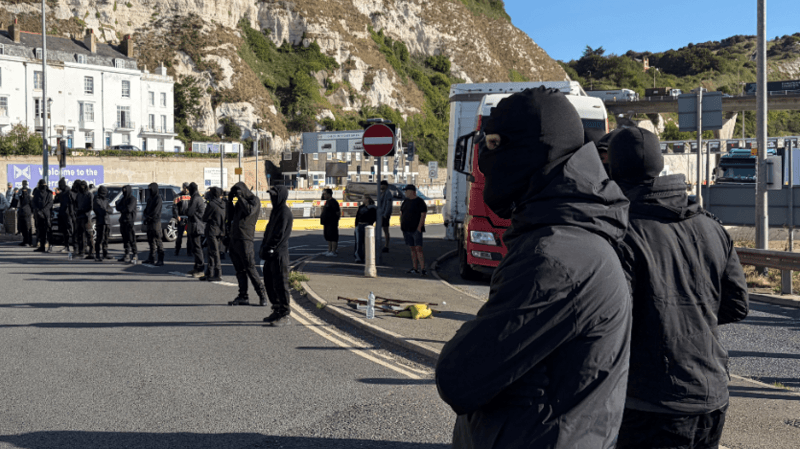
Farage's announcement follows weekend demonstrations in Dover where masked protesters chanting "stop the boats" blocked roads. Police described the gathering as spontaneous, and according to live coverage of the demonstrations, no arrests were made at the scene. Kent Police confirmed that officers took no action and characterised the event as a "spontaneous protest", though the force noted that "specific statutory requirements" would need to be satisfied before any mask ban could be enforced.
In his article, Farage expressed support for the Dover protest itself but distanced Reform from the tactics employed. He framed the policy as a response to broader public safety concerns, citing instances of masked youths on e-bikes and scooters terrorising residents in city centres.
Around city centres, balaclava-clad youths tear around neighbourhoods on e-bikes and scooters, terrorising residents, making them feel unsafe in their own communities.He argued that visibility and identifiability are essential to civilised society, stating:
This is not a matter of targeting one group. It's about saying that in a civilised society, people should be identifiable in public.
The proposal represents a significant escalation of Reform's position on face coverings. In February 2026, the party's home affairs spokesperson Zia Yusuf stated he "personally" supported a ban on "all face coverings in public", though the policy had not yet been formally adopted. Farage himself has advocated for restrictions on the burka since 2010, when he served as a Member of the European Parliament, but the current proposal extends beyond religious garments to encompass any full-face covering.
How would the ban work?
According to Reform's policy document, the party would introduce legislation empowering uniformed police officers to remove items used to conceal identity. Failure to comply with an officer's instruction to remove a face covering would constitute an offence, with an exception only for coverings worn for work-related purposes. The policy makes no exemption for religious, cultural, health or weather-related reasons, distinguishing it sharply from existing legal frameworks.
The current government's approach is narrower in scope. The Crime and Policing Act, which came into force in April 2026, granted police powers to establish mask-free zones at protests, backed by penalties of up to £1,000 or one month's imprisonment. Crucially, according to government guidance on the act, these powers apply only to individuals attempting to conceal their identity and explicitly exclude face coverings worn for religious, health or work purposes. Police must also take reasonable steps to notify the public of any restrictions, and mask-free zones can last up to 48 hours and apply only in areas where a senior officer believes a protest may involve offences.
On Monday following the Dover demonstration, Home Office minister Sarah Jones acknowledged the distinction between protest-related restrictions and everyday life.
When people are going about their daily business, it is absolutely fine to wear them for religious reasons, and that will continue.She confirmed that police possessed powers to manage coverings at protests but emphasised that religious face coverings would remain lawful outside that context.

What is the current legal landscape?
Several local authorities in England and Wales have begun using public spaces protection orders (PSPO) to address anti-social behaviour involving face coverings. Nottingham Council announced on Monday that it was implementing a face covering ban in the city centre, though this measure specifically targets individuals believed to be concealing their identity to commit crimes or anti-social behaviour. The Nottingham ban explicitly preserves the right to wear face coverings for religious, cultural, health, work, weather or personal safety reasons.
The distinction between Reform's proposed blanket ban and existing legal tools reflects a fundamental disagreement about how to balance public safety with individual rights. Reform's policy would eliminate exemptions that currently protect religious practice, whereas the government's protest law and local council measures maintain those protections while targeting specific contexts or behaviours.
International precedent
Several countries have introduced restrictions on face coverings, though approaches vary significantly. France, Denmark, Germany, Norway, Chad and Algeria have all implemented some form of ban or restriction, though the scope and enforcement mechanisms differ. The burka, a veil covering the face and body with a mesh screen for vision, is more concealing than the niqab, which leaves the area around the eyes visible, and the hijab, a headscarf that typically covers the head and neck but leaves the face clear.
Political context and recent developments
Reform UK reiterated its commitment to the face-covering ban in fresh media appearances on 2 September 2026, with Farage repeating the call for a comprehensive public prohibition. The party has also faced recent controversy: on 2 September 2026, Reform UK barred three journalists from its annual conference following criticism of the party and its leader.
The timing of Reform's policy announcement coincides with heightened debate about protest rights and public order. Human rights organisations have raised concerns about the direction of UK protest law. According to Human Rights Watch, UK protest restrictions are part of a broader pattern of tighter limits on demonstrations, a development the organisation warned about in January 2026.
What happens next?
Reform UK has not yet published an implementation date or detailed legislative framework for a nationwide face-covering ban. The government's existing protest face-covering rules remain in force, meaning future enforcement will likely depend on how police exercise their powers to designate mask-free zones at specific demonstrations. Any future Reform government would need to introduce primary legislation to replace the current framework with a blanket prohibition, a process that would require parliamentary debate and approval.
The debate over face coverings reflects deeper tensions between security, public order, religious freedom and individual liberty. While Reform frames the issue as essential to social cohesion and safety, critics argue that blanket bans risk disproportionately affecting religious minorities and limiting legitimate forms of protest and expression.